What is the Homtone Conical Burr Coffee Grinder?
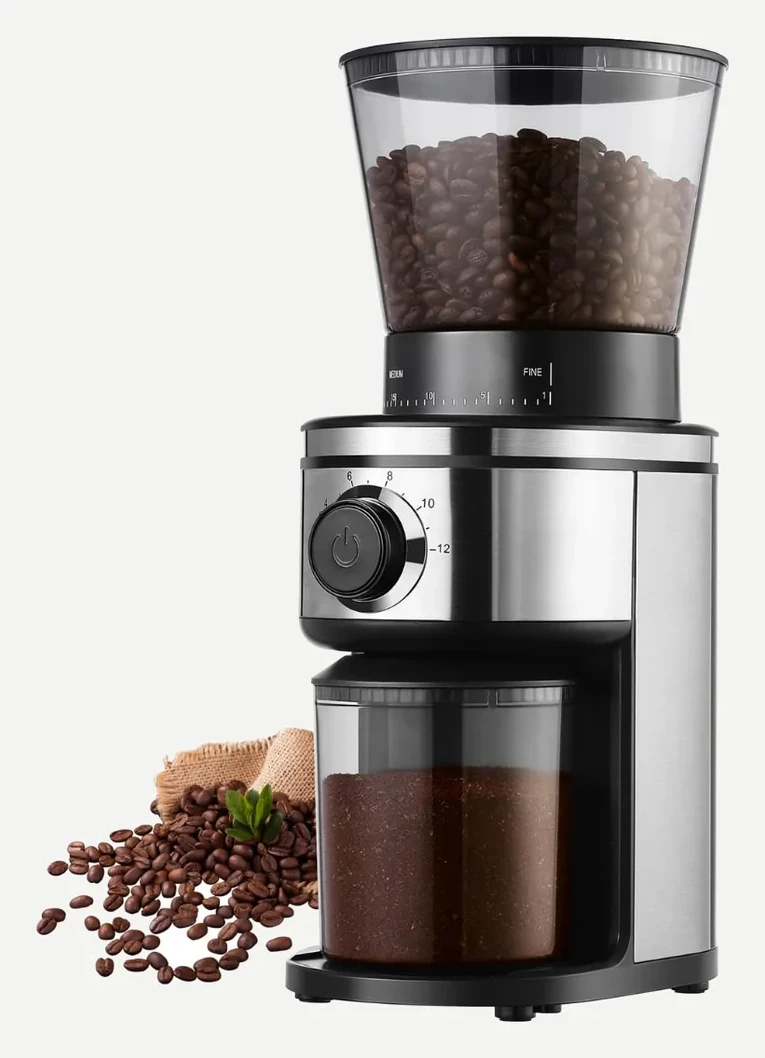
The Homtone Conical Burr Coffee Grinder is an electric burr grinder with 51 grind settings, a programmable timer, and stainless-steel housing, priced at $87.79.
It is built around a 40 mm conical burr and covers the full range from espresso to French press. The timer runs from one to sixty seconds and adjusts in 0.1-second steps, which gives repeatable grinding without a separate scale for time-based dosing.
The grinder ships in silver or black and weighs 2.94 kg, which is substantial enough to stay put on a counter during use. It sits in a competitive price bracket where electric burr grinders start to offer genuine consistency advantages over blade alternatives.
Homtone Conical Burr Coffee Grinder grind consistency: how even is it?
The 40 mm conical burr produces grind consistency that is adequate for most home brew methods, though espresso demands the closest attention to dialing in.
A 40 mm burr is a common size in this price range and should produce a usable particle distribution for drip, pour-over, and French press. Conical geometry tends to generate less heat than flat burrs at lower RPMs, which is generally considered a modest advantage for flavor.
Espresso is listed as a supported grind, and the 51-step adjustment range gives enough fine control to get close. How tight the particle distribution is at fine settings is not confirmed by independent test data, so buyers with strict espresso requirements should treat that as unverified.
- The 40 mm burr diameter is workable for home use but is on the smaller side compared to prosumer electric grinders starting above $200.
- Conical burr geometry tends to produce a bimodal particle distribution, which suits immersion and drip brewing and can work for espresso with careful adjustment.
- The 51-step range means fine adjustments between espresso settings are possible, reducing the chance of large, over-corrected jumps.
- Grind uniformity rests on the conical geometry and the step count, which is what separates a burr grinder from a blade one.
What you can brew with it
The Homtone handles espresso through French press across 51 steps, covering every common home brew method a single-grinder household is likely to need.
Both espresso and French press are confirmed supported grinds. With 51 positions between those two extremes, there is room for pour-over, drip, AeroPress, and Moka pot without competing brew methods sharing the same setting.
The upper end of the coarse range suits full-immersion methods where a consistently coarse grind matters for clarity in the cup. The fine end is usable for espresso, though precise dialing in will require patience and consistent bean density.
- Espresso and French press are both confirmed, covering the two ends of the grind range most buyers care about.
- Fifty-one steps give enough resolution to find distinct positions for drip, pour-over, and Moka pot without overlap.
- Buyers wanting a single grinder for both espresso and filter will need to track their setting numbers carefully when switching between them.
- Cold brew and Turkish grind are not listed as confirmed capabilities, so very coarse and very fine extremes are unverified.
Living with it, day to day
The stainless-steel housing is easy to wipe down, but static cling at fine grind settings will require a routine to keep the counter tidy.
Static is a known characteristic of metal-bodied grinders at fine settings, particularly in low-humidity environments. Buyers who grind for espresso every morning should expect to manage loose grounds clinging to the chute or catch area as part of their daily routine.
The timer handles repeat dosing without a scale, which simplifies workflow for buyers who use the same beans on a regular schedule. Switching beans with a different density will require retiming to keep the dose consistent.
- Stainless-steel housing is easy to wipe clean on the outside, but internal burr cleaning frequency is not specified.
- Static cling at fine settings is a practical reality with metal housings, and buyers should have a small brush on hand.
- The 0.1-second timer increments allow repeatable dosing, but only if bean density stays constant between bags.
- At 2.94 kg the grinder is heavy enough that most users will leave it in one place rather than move it to clean underneath regularly.
Homtone Conical Burr Coffee Grinder vs Hario Skerton Pro Ceramic Coffee Mill
The Homtone is an electric grinder with a programmable timer, while the Skerton Pro is a manual ceramic burr grinder, and the right choice depends on how you value convenience versus control.
The Skerton Pro uses ceramic burrs and a manual handle, costs $58.50, and weighs 0.649 kg, making it portable and quiet. It holds 100 g in the hopper, includes a glass bowl and detachable handle, and requires no power source. The Homtone automates the grind entirely and adds timer-based dosing.
Both grinders cover espresso and French press. The Homtone's 51 settings and 0.1-second timer increments give it a repeatability advantage for buyers who grind the same recipe daily. The Skerton Pro's manual nature means grind speed and pressure vary with the user, which can affect consistency.
- The Skerton Pro is silent and portable, making it better suited to travel, small kitchens, or grinding before others wake up.
- The Homtone's timer lets buyers repeat a dose without weighing beans each time, which the Skerton Pro cannot do.
- The Skerton Pro costs $36.79 less, a meaningful gap if budget is the primary concern and manual grinding is acceptable.
- The Homtone is the stronger choice for buyers grinding multiple times a day who want a hands-off, repeatable workflow.
Is the Homtone Conical Burr Coffee Grinder worth it?
At $87.79 the Homtone offers a useful feature set for the price, but buyers should weigh it carefully against both manual and electric alternatives before purchasing.
The timer, 51-step range, and stainless-steel build are reasonable at this price. Buyers who want automated, repeatable grinding across multiple brew methods without spending $150 or more on a mid-range electric grinder will find the feature list competitive. Static cling and unverified grind uniformity at fine settings are the main practical caveats.
The Skerton Pro at $58.50 is a credible alternative for anyone willing to grind by hand, offering ceramic burrs and portability at a lower cost. If automation and timer dosing are priorities, the Homtone earns its premium. If they are not, the price gap is hard to ignore.
Who should buy it (and who should not)
This grinder suits home brewers who want automated, adjustable grinding across multiple methods, and is a less obvious fit for those prioritising portability or verified espresso precision.
Buyers who make one or two brews a day from the same beans, switching occasionally between drip and French press, will get good use from the timer and 51-step range without needing a more expensive grinder.
Those chasing tight espresso consistency or grinding in noise-sensitive environments will face limitations that the published specs cannot resolve. A manual ceramic grinder or a higher-tier electric option would serve those needs more reliably.
Buy it if
- You brew by multiple methods at home and want one electric grinder to cover all of them.
- Repeatable, timer-based dosing matters more to you than carrying a grinder between locations.
- You are upgrading from a blade grinder and want a meaningful step up without crossing $100.
Skip it if
- You need verified, tight particle distribution for dialed-in espresso on a consistent basis.
- Quiet operation is essential because you grind early in the morning or in a shared space.
- Portability or low counter footprint is a priority, as the 2.94 kg weight makes this a stay-put appliance.
Frequently Asked Questions
Is the Homtone Conical Burr Coffee Grinder good for espresso?
Espresso is a listed supported grind, and the 51-step adjustment range gives enough fine resolution to work toward a usable espresso setting. That said, buyers expecting tight, barista-level consistency should treat espresso capability as a starting point that will require patient dialing in rather than a guaranteed result.
What size are the Homtone burrs?
The burrs measure 40 mm in diameter and are conical in geometry. That size is common in entry-to-mid electric grinders and is adequate for home brewing across drip, pour-over, French press, and espresso. It is smaller than the burrs found in prosumer grinders, which typically start at 48 mm and above.
How many grind settings does the Homtone coffee grinder have?
It has 51 grind settings, covering the full range from espresso to French press. That number of positions gives enough resolution to find distinct settings for most common brew methods without two methods having to share the same coarseness level, which matters when you switch between espresso and drip on a regular basis.
Does the Homtone grinder have a timer?
Yes. The built-in timer runs from one to sixty seconds and adjusts in 0.1-second increments. This lets you repeat the same grind duration each session without weighing beans each time. Keep in mind that dose consistency from a timer depends on bean density staying constant, so switching to a different bag may require a small retiming adjustment.
How does the Homtone Conical Burr Coffee Grinder compare to the Hario Skerton Pro?
The Homtone is electric with a programmable timer and 51 grind steps, priced at $87.79. The Skerton Pro is a manual ceramic burr grinder at $58.50, weighing 0.649 kg with a 100 g hopper and glass bowl. The Homtone automates grinding and offers timer-based repeatability. The Skerton Pro is quieter, portable, and meaningfully cheaper, but requires manual effort for every grind.
Is the Homtone coffee grinder easy to clean?
The stainless-steel housing wipes down easily on the outside. Static cling is a known characteristic of metal-bodied grinders at fine settings, and buyers can expect loose grounds to collect around the chute area after grinding for espresso. Keeping a small cleaning brush near the grinder makes the daily tidy-up faster and reduces grounds scatter on the counter.