What is the OutIn Fino?
A battery grinder that publishes the number portable grinders usually hide.
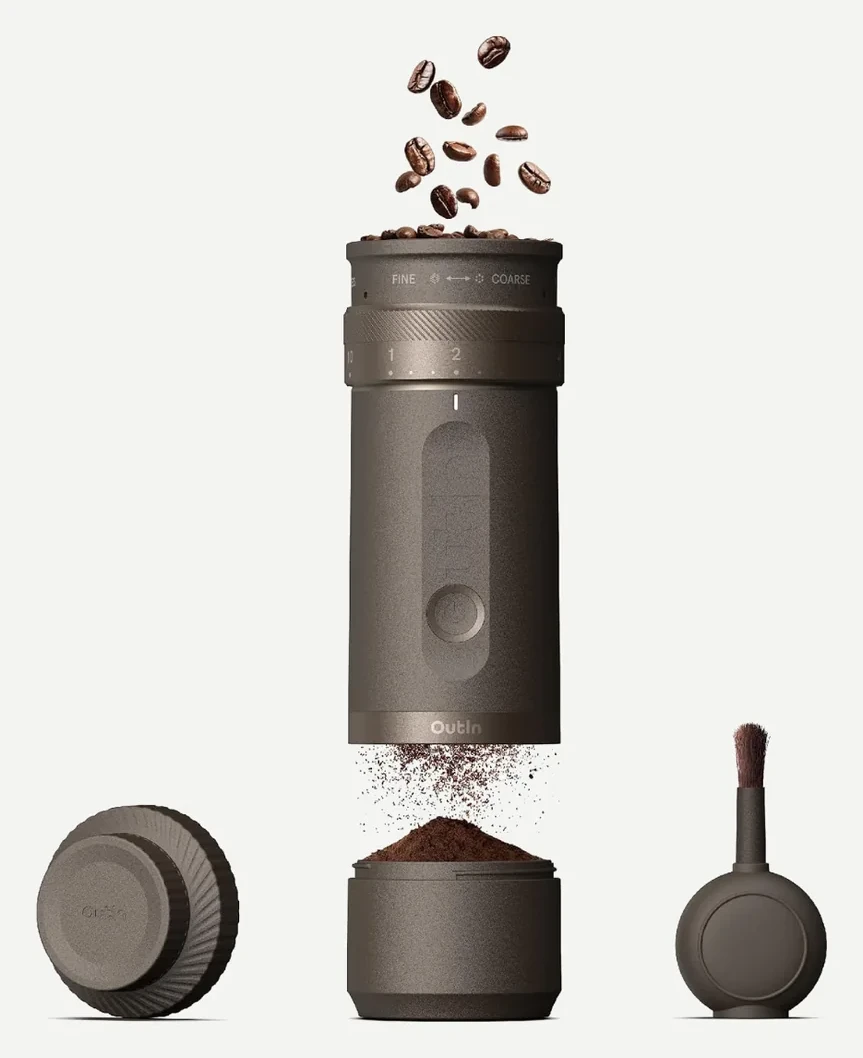
OutIn publishes a 38mm heptagonal conical burr in 420 stainless steel hardened to 55-60 HRC, a patented 28-position dial covering espresso to French press, one-button operation with auto-start, auto-stop and anti-clog reversal, operation below 60 dB(A), a body of food-grade ABS and stainless steel, USB-C fast charging, a detachable dosing cup, and a weight of 690g. The maker rates the burrs for 100kg of beans.
38mm is the number that makes this credible
Most portable grinders do not publish a burr diameter, and the reason is usually that it is small.
Burr size drives grind uniformity more than any other single specification, because larger burrs cut each fragment in fewer passes. Cramming a large burr into a handheld body is difficult, which is why portables tend to describe their burrs by shape and alloy and stay quiet about size.
At 38mm this is within touching distance of the 40mm burrs in full-size countertop grinders like the 12oz OXO Brew grinder and the Ollygrin conical burr grinder. That is the fact that separates it from a travel gadget.
Sixty decibels, and why it is on the spec sheet
A published noise figure is rare here and genuinely useful.
Grinders are loud, and the ones people actually resent are the ones used early in a quiet house or in a shared office. Under 60 dB(A) is roughly conversation level, which is quiet for a motorised grinder.
Only five products in this category publish a noise figure at all, so this one earns on a criterion most of its rivals leave blank. The anti-clog reversal is the other quality-of-life feature: a portable grinder jamming on a dark campsite is the failure mode, and reversing the burr clears it without disassembly.
OutIn Fino vs TIMEMORE Whirly 01S
Lighter and better documented against finer and better sealed.
The Whirly 01S adjusts in 0.025mm steps and has a sealed swivel hopper, which are two things this cannot match. It is also 265g heavier and publishes no burr diameter.
The Fino publishes 38mm, a noise figure, a burr hardness range and a burr life claim. For filter coffee on the move, the lighter, better-specified one is the easier recommendation; for espresso, the Whirly's resolution wins.
Is the OutIn Fino worth it?
Yes, if portability is a real requirement rather than a nice idea.
Battery grinders cost more than mains ones of similar quality, because the battery and motor control are the expensive parts. What you are buying is grinding fresh in places where there is no socket, and at 690g with a 38mm burr this does that better than the alternatives.
If it will live on a worktop, you are paying a premium for a battery you will never need, and a countertop grinder gives you more burr for the money.
Who should buy the OutIn Fino (and who should not)
Buy it for camping, travel, an office, or anywhere the socket is somebody else's.
It suits people who already carry a portable brewer, and anybody who has tried hand-grinding on a cold morning and decided once was enough. The detachable dosing cup and one-button operation make it genuinely simple.
Do not buy it as a home grinder. And if you brew espresso as your main method, the finer adjustment on the Whirly is worth more than this one's extra published detail.
Frequently Asked Questions
How big are the OutIn Fino burrs?
38mm, heptagonal conical, in 420 stainless steel hardened to 55-60 HRC. That is close to the 40mm burrs in full-size countertop grinders.
How loud is the OutIn Fino?
Under 60 dB(A) per the maker, which is roughly conversation level and quiet for a motorised grinder.
How is the OutIn Fino charged?
USB-C, with what the maker describes as fast charging. It runs on its own battery rather than needing a socket while grinding.
What happens if it jams?
It has anti-clog reversal, which backs the burr off to clear a jam without taking the grinder apart.