What is the WILLOW Glass Gooseneck Electric Kettle?
A pour-over kettle you can see into, which no other kettle in this category offers.
WILLOW publishes a 1 litre capacity, 1200W, a body of glass and 304 stainless steel with a food-grade silicone lid seal and a plastic lid, five one-touch presets selected with a MODE button across a 100F to 212F span, a keep-warm option, automatic shut-off and an LED display.
Every other gooseneck here is opaque steel. This one is not, and that is the whole reason to consider it.
What you actually get from a glass body
Two things, and one of them is more useful than it sounds.
The obvious one is the fill level. A steel kettle gives you a window, a gauge on the handle or nothing at all, and on a 0.8 litre gooseneck the difference between 300ml and 500ml matters for how the spout behaves. With glass, the level is simply visible.
The second is scale. Limescale is invisible inside a steel kettle until it flakes into a cup, and in a hard water area a kettle can be badly furred before you ever look. In glass you watch it build, so you descale on evidence rather than on a schedule. For anybody in a hard water region this is a practical advantage over the entire rest of this category.
What glass costs
Robustness, and a slightly weaker showing on materials.
Glass breaks, and a kettle is an object that gets knocked against taps and set down heavily. Steel dents; glass does not offer that option. If the kettle lives on a crowded counter or a shared kitchen in a house with children, this is a real risk that a stainless steel kettle does not carry.
Our build quality criterion also ranks glass below stainless, which is a defensible arithmetic rather than a judgement about taste: glass is more fragile, and the lid here uses plastic where an INTASTING 0.9L kettle publishes metal throughout the water path.
WILLOW vs Cosori CO108-NK
Same money, roughly. One shows you the water and the other publishes a warranty.
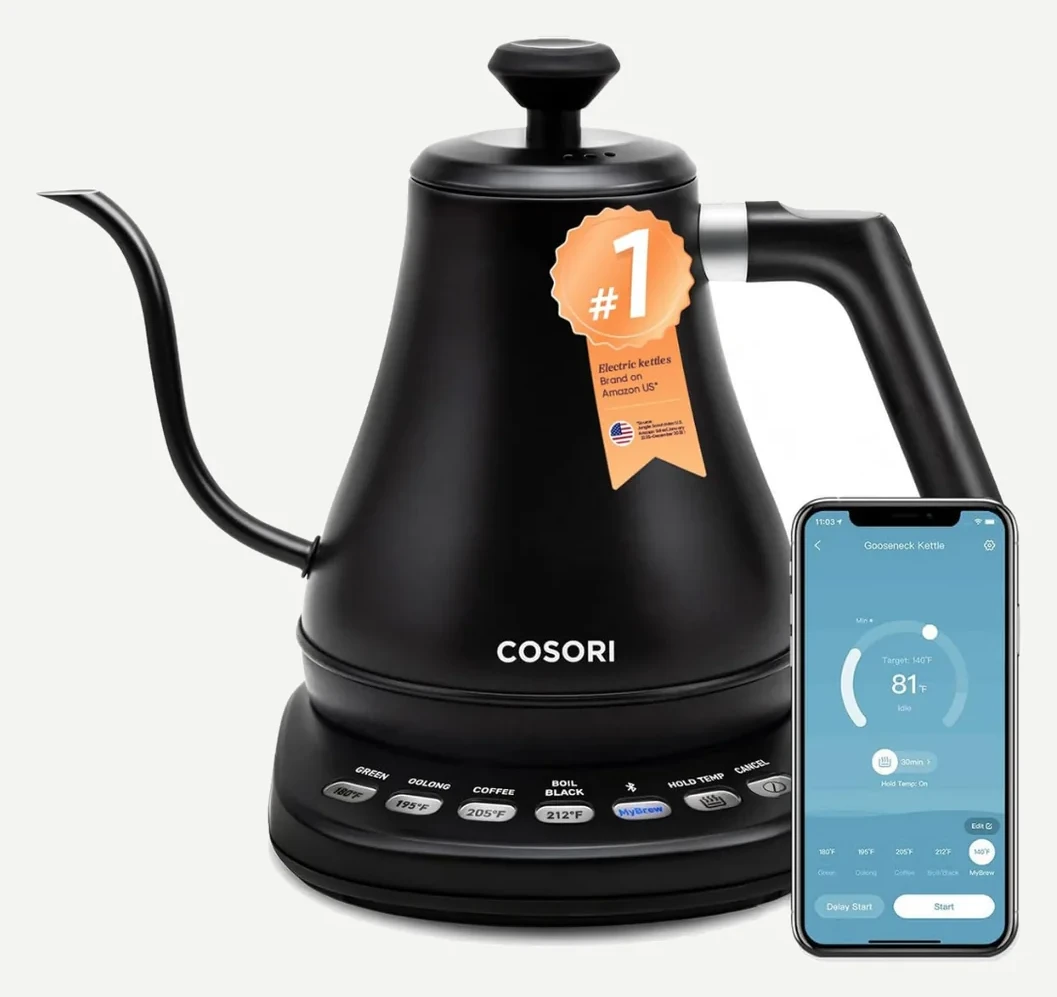
The Cosori CO108-NK is 0.8 litres of stainless with no plastic in the water path, a published 77C to 100C range and a two-year warranty, which is a stronger published record than WILLOW gives.
The WILLOW answers with the glass body, a full litre, and a wider preset span reaching down to 100F for delicate teas. If you brew tea as much as coffee, or your water is hard, the glass earns its place. If the kettle is a coffee tool and nothing else, the Cosori is better documented.
Is the WILLOW glass kettle worth it?
Worth it for the visibility, in a hard water area especially. Otherwise it is a style choice.
It is priced in the accessible middle of this category and gives you a litre, five presets, a keep-warm and 1200W, all of which are competitive. The glass is genuinely differentiated rather than cosmetic.
Against that, five presets is coarse next to the one-degree control on the OXO, KOIOS or INTASTING at similar money, and there is no published warranty or increment. You are buying the body, not the controller.
Who should buy the WILLOW (and who should not)
Buy it if you live with hard water, or drink tea across a wide temperature range.
It suits kitchens where limescale is a running battle, households mixing green tea at the low end with coffee at the high end, and anybody who simply wants to see the water. The LED display and one-touch presets keep it simple to use.
Do not buy it if you want to set an exact number, because five presets is not that. And think carefully about where it will live: glass on a busy counter is a different proposition from steel.
Frequently Asked Questions
Is the WILLOW kettle body really glass?
Yes, glass with 304 stainless steel, sealed with food-grade silicone. The lid itself is plastic.
How many temperature settings does the WILLOW kettle have?
Five one-touch presets, selected with the MODE button, across a span from 100F to 212F.
Is a glass kettle better for hard water?
It is better for spotting hard water. Limescale builds the same either way, but in glass you can see it and descale when it appears rather than on guesswork.
How powerful is the WILLOW gooseneck kettle?
1200W, which is typical for a gooseneck of this size and slower than the 1500W INTASTING.