What is the Tayst Bold & Brazen?
A dark, full-bodied K-Cup with a smoky cocoa finish, sold in a pod whose every component (body, lid, ring and mesh) is certified compostable.
Tayst blend and roast their own coffee, pack it into a plant-based pod built on PurPod100, and sell it direct rather than through a supermarket. Bold & Brazen is the darkest of their three unflavoured everyday blends and the one aimed at somebody who finds most pod coffee thin. Tayst describe it as a kick in the cup: rich, full-bodied and intense, with the cocoa sitting on the finish rather than the front.
It comes in boxes of 40, 50 or 60 pods, at $41.65, $52.06 and $62.47.
What is in the capsule
A dark-roast blend from Rainforest Alliance Certified farms. Tayst name the certification and the roast; they do not name the origins.
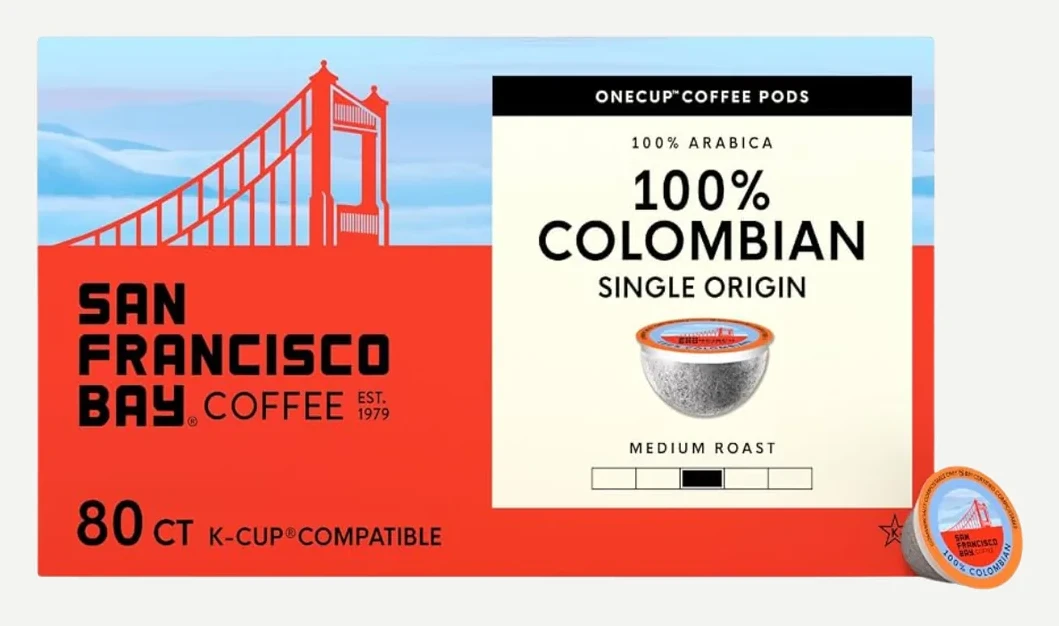
The Rainforest Alliance mark is the useful part of that, because it is a third-party audit of the farm rather than a phrase the roaster wrote about itself. What it does not tell you is which country the coffee came from, and Tayst do not publish that for their blends. If origin is how you choose, a single-origin pod like San Francisco Bay's 100% Colombian answers a question this one leaves open.
The dose is not published either. Every other coffee on this site carries a price per kilo; this one cannot, because Tayst do not say how many grams are in the pod.
Which machines does it fit?
Keurig K-Cup brewers. Tayst make the pod, not the machine, and say so.
These are K-Cup compatible rather than Keurig-made, which in practice means any brewer that takes a standard K-Cup: the K-Classic, K-Mini, K-Duo, K-Elite and K-Supreme, plus the K-Cup compatible machines from Cuisinart, Mr. Coffee and Breville. Tayst sell their own compatible brewers too, which is a convenience rather than a requirement.
Not to be confused with their Nespresso line. Tayst also make espresso capsules for Nespresso OriginalLine machines (Moriondo, Pavoni and Achille Decaf) at $0.82 a cup. Those are a different capsule for a different machine and will not fit a Keurig.
What “compostable” actually means here
The certification is real and unusually complete. The catch is not the pod, it is what you can do with it once it is used.
Tayst pods are BPI Certified Compostable, built on PurPod100, and the certification covers the pod, the lid, the ring and the mesh rather than one component with the rest left unsaid. That is the distinction that matters whenever a package says biodegradable: a pod whose ring is still plastic is a plastic pod with a compostable lid.
It is commercially compostable, not home compostable, and Tayst say plainly that facilities may not exist where you live. That is the honest half of the pitch and the half you have to act on. Put one of these in a garden heap and it will not break down on the timetable the certification describes; put it in landfill and the certification buys nothing at all.
Tayst do sell a way round it. The Down To Earth return kit is $20 and posts used pods back to them for composting, the same idea as Nespresso's mail-back aluminium scheme pointed at a different material. It is worth counting into the price, because without either a commercial kerbside collection or that kit, the certification describes a facility you cannot reach.
Tayst vs San Francisco Bay OneCUP
The comparison that decides this one. Both are BPI certified compostable K-Cups. San Francisco Bay's OneCUP is $0.64 a pod and Tayst is $1.04, which is 63% more for the same certification in the same format.
They are not the same product, and the differences are real rather than marketing. OneCUP is a single origin (100% Colombian, medium roast, cherry and citrus over a long cocoa finish) and comes 80 to a box. Tayst is a blend, in ten varieties including a decaf and a half-caff, and comes 40 to a box. If you want one specific origin repeatedly, San Francisco Bay is both cheaper and more specific about what is in it.
Tayst answer on two things. The Rainforest Alliance certification sits on the beans as well as the BPI certification on the pod, so both halves of the claim are audited by somebody other than the seller. And the Down To Earth return kit gives you a route to composting the pod when your council will not, which is the gap that makes most compostable pods theoretical.
Neither company publishes a dose, so neither pod can be priced per kilo. The per-pod figures above are the honest limit of what the two of them let you work out.
Is it worth it?
$1.04 a cup, and the same $1.04 whether you buy 40, 50 or 60. There is no bulk discount here, which is unusual and worth knowing before you size the order.
The arithmetic is flat: 40 cups is $41.65, 50 is $52.06 and 60 is $62.47, and all three divide to $1.041. Buying the biggest box saves nothing per pod, so buy the smallest one first and find out whether you like the coffee. The only real discount sits on the wholesale side, where a case of 240 is $168, or $0.70 a pod.
Against the rest of the pod shelf that lands mid-table rather than at either end. It undercuts Nespresso's Vertuo Melozio at $1.40 a capsule, and sits well above a supermarket K-Cup.
One number is missing, and not by accident. Tayst do not publish how much coffee is in a pod, so the price per kilo, which this site gives wherever a maker states the dose, cannot be calculated for these. A 40-cup box at $41.65 is decent value or poor value depending on whether the pod holds 9g or 13g, and Tayst are the only people who know.
Who should buy it (and who should not)
Buy it if you have somewhere to compost it and you want a dark pod. Skip it if the pod is going in a landfill bin either way.
Buy it if
- You have commercial kerbside composting, or you will actually buy the $20 return kit
- You drink dark, strong coffee and find most K-Cups watery
- You would rather pay a premium than put another aluminium or plastic capsule in the bin
Skip it if
- Your used pods go to landfill, in which case the certification changes nothing and a cheaper pod does the same job
- You buy on price per cup, where San Francisco Bay's OneCUP is the same certification at $0.64
- You want to know where your coffee was grown, because this blend does not say
Frequently Asked Questions
Are Tayst pods actually compostable, or is that marketing?
They are BPI Certified Compostable, a third-party certification from the Biodegradable Products Institute rather than a claim Tayst make about themselves, and it covers the pod, the lid, the ring and the mesh. The qualifier that matters is that it means commercial composting, not a garden heap, and Tayst state that facilities may not exist in every area.
Can I put Tayst pods in my home compost?
No. They are certified for commercial composting, which runs hotter and longer than a domestic heap. If you have no commercial collection, Tayst sell a $20 Down To Earth kit that posts used pods back to them, which is the only route to composting them that does not depend on your council.
Do Tayst pods work in a Keurig?
Yes. They are standard K-Cup format and fit Keurig brewers including the K-Classic, K-Mini, K-Duo, K-Elite and K-Supreme, as well as K-Cup compatible machines from other makers. Tayst are not affiliated with Keurig.
How much is a Tayst pod?
$1.04, and the same $1.04 at every box size: 40 pods is $41.65, 50 is $52.06 and 60 is $62.47, which all divide to the same figure. There is no bulk discount on the retail boxes, so there is no reason to buy the big one first.
Is Bold & Brazen stronger than Medium & Magnificent?
In roast and body, yes. Bold & Brazen is the dark roast with a smoky cocoa finish; Medium & Magnificent is a medium roast with soft fruity mocha notes and a lighter body. Caffeine is not the difference people expect it to be: a darker roast is not a stronger one in that sense.