


The Coffee Belt: Why Coffee Only Grows Where It Does
A band around the equator between the tropics, and a set of conditions narrow enough that climate change is redrawing it.
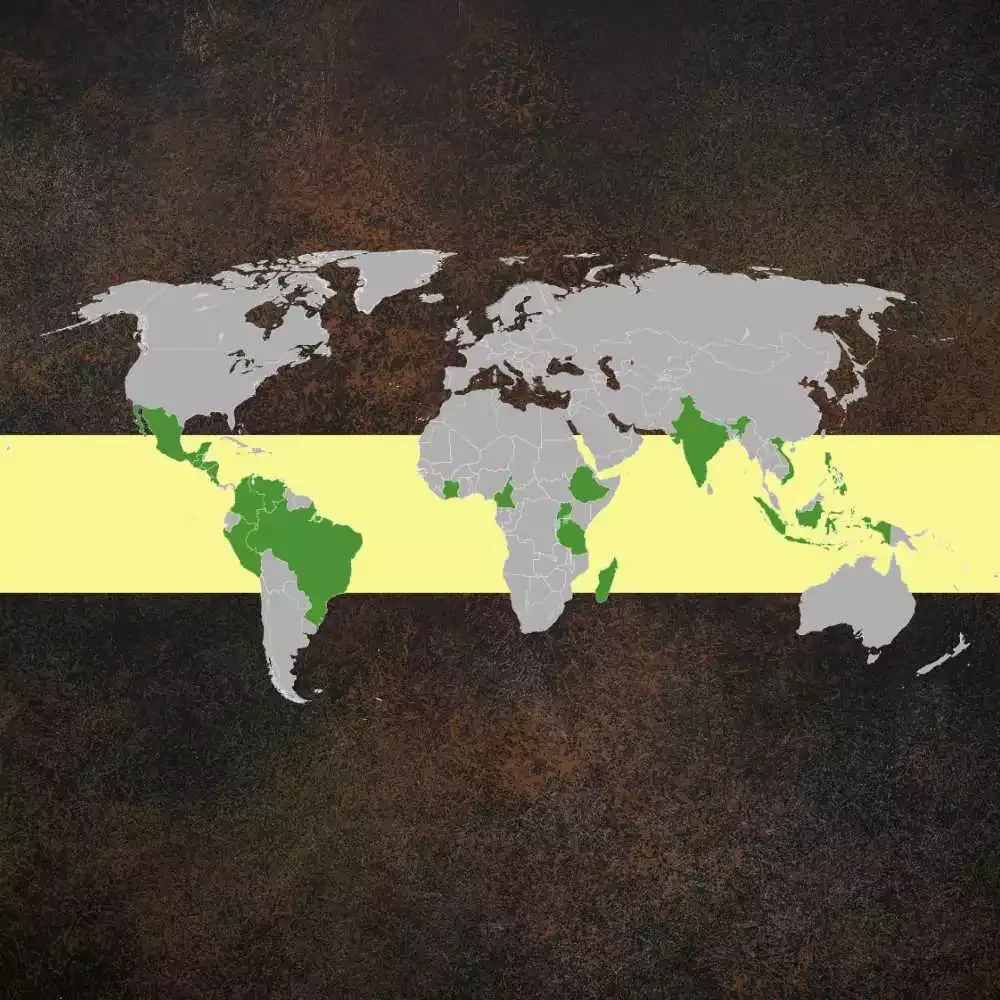
Every coffee-producing country of any size sits in a band around the equator between the two tropics. It is not tradition or trade routes that put them there; it is that coffee will not tolerate frost and needs a specific combination of warmth, rain and dry season that exists almost nowhere else.
What is the coffee belt?
Roughly 25 degrees north to 30 degrees south, between the Tropic of Cancer and the Tropic of Capricorn. Within it sit Brazil, Vietnam, Colombia, Indonesia, Ethiopia, Honduras, India, Uganda, Mexico, Peru and dozens of others.
Outside it, coffee is grown only in glasshouses and in a handful of unusual microclimates such as Hawaii, which sits just inside the northern edge.
The four conditions coffee needs to grow
- No frost, ever. A single frost event can kill a plantation. Brazilian frosts have moved the world coffee price more than once.
- Consistent warmth. Arabica wants roughly 18 to 22 °C. Too cool and it will not fruit; too hot and it ripens too fast and tastes flat.
- Reliable rainfall, around 1,500 to 2,500 mm a year, with a distinct dry season for harvest and drying.
- Well-drained soil, traditionally volcanic, which is why so many famous origins sit on volcanoes.
Altitude in the coffee belt: why height matters
Within the belt, height above sea level is the variable that separates ordinary coffee from good coffee.
Higher is cooler, and cooler slows the cherry's development. A slower-ripening cherry gives the seed more time to accumulate sugars and acids, which produces a denser bean and a more complex cup. This is why bags advertise metres above sea level and why "high grown" is a grading term in several countries.
That is also the split between the two commercial species. Arabica wants altitude and mild temperatures, so it grows on highlands and mountainsides. Robusta tolerates heat, humidity and lower ground, which is where it is grown, and it carries roughly twice the caffeine as part of the same hardiness.
Is the coffee belt moving?
Rising temperatures are pushing the viable range for arabica uphill and toward the poleward edges of the belt. Published projections of how much suitable land is lost by 2050 vary widely, and all of them point the same direction.
The consequences are not evenly shared. Land higher up the same mountain is finite and often forested or protected, so "move uphill" is not a real option for most smallholders. It is one of several reasons the economics of who gets paid is not separable from the environmental question.
Why the coffee belt affects what you pay for coffee
Because it explains the price of good coffee. The land that grows it is genuinely scarce, it cannot be manufactured, and it is shrinking. Coffee has been unusually cheap for a long time relative to what producing it costs, and that is the thing changing rather than any fashion in cafes.
Coffee belt harvest seasons: why your bag has one
The belt straddles the equator, so there is no single world harvest. Countries north of the line generally pick between October and March. Countries south of it pick between April and September.
That is why a roaster's Ethiopian lands at a different time of year from their Brazilian, and why a genuinely good single origin is not available all year round. Green coffee is at its best within roughly a year of harvest, so the same bag sold in month fourteen is a different product from the one sold in month three, whatever the roast date says.
A roaster who publishes the harvest year next to the roast date is telling you something the roast date by itself cannot.
Coffee grown at the edges of the coffee belt
A few places grow coffee commercially at or just past the margins. Hawaii sits barely inside the northern tropic, and there are working farms in Nepal, in parts of Australia, and in Yunnan in southern China.
They succeed because altitude, maritime climate or a sheltered valley reproduces conditions the latitude alone would not supply. They are also, without exception, expensive, because the yields are small and the land is usually worth more doing something else.
Coffee belt FAQ
Where is the coffee belt?
The band between the Tropic of Cancer and the Tropic of Capricorn, roughly 25 degrees north to 30 degrees south. Every commercially significant coffee-producing country sits inside it.
Why can coffee not grow outside the tropics?
Coffee cannot survive frost and needs consistent warmth, reliable rainfall and a distinct dry season for harvesting. Outside the tropics at least one of those fails, usually the frost.
Why is high-altitude coffee better?
Cooler temperatures at altitude slow the cherry's development, giving the seed longer to accumulate sugars and acids. Slower ripening produces denser beans and more complex flavour.
Is climate change affecting the coffee belt?
Yes, and it is well documented. Suitable arabica land is projected to shrink significantly this century as temperatures rise, pushing viable growing further uphill and toward the edges of the belt.