


Turkish Sand Coffee: Why the Sand Is Not a Gimmick
Brewing a cezve buried in hot sand is theatre in a tourist cafe and genuine technique everywhere else. The sand does something no burner can.
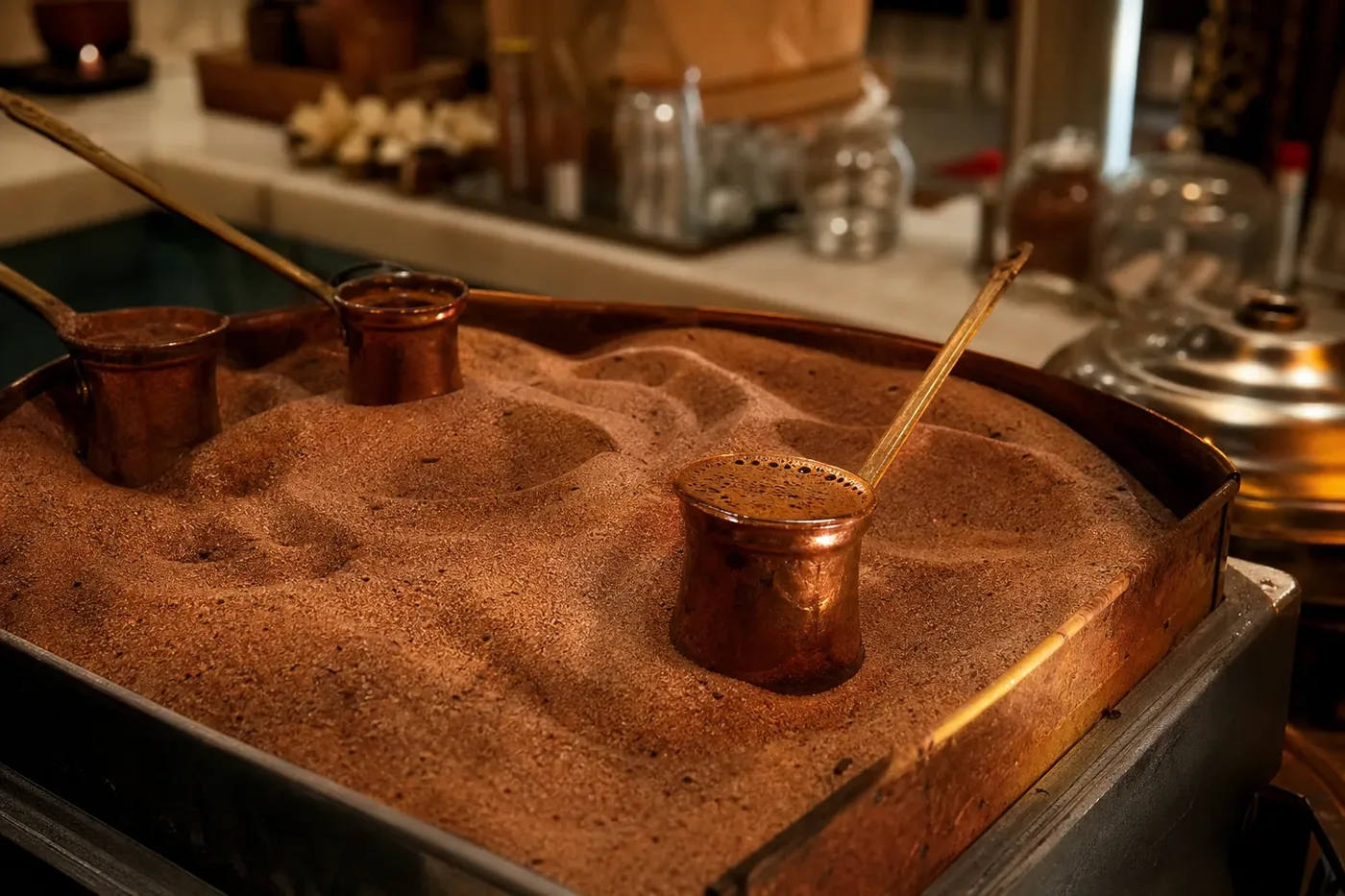
A tray of hot sand with copper pots buried in it looks like something staged for tourists. It is used that way. It is also the most controllable heat source anyone has applied to this method, and the reasons are worth understanding even if you will only ever brew on a hob.
What the sand changes in Turkish sand coffee
A burner heats the bottom of the pot. Sand surrounds it, so the coffee heats from every wetted surface at once. That matters here more than in any other method because a cezve is narrow, deep, and brewed without stirring once it is on the heat.
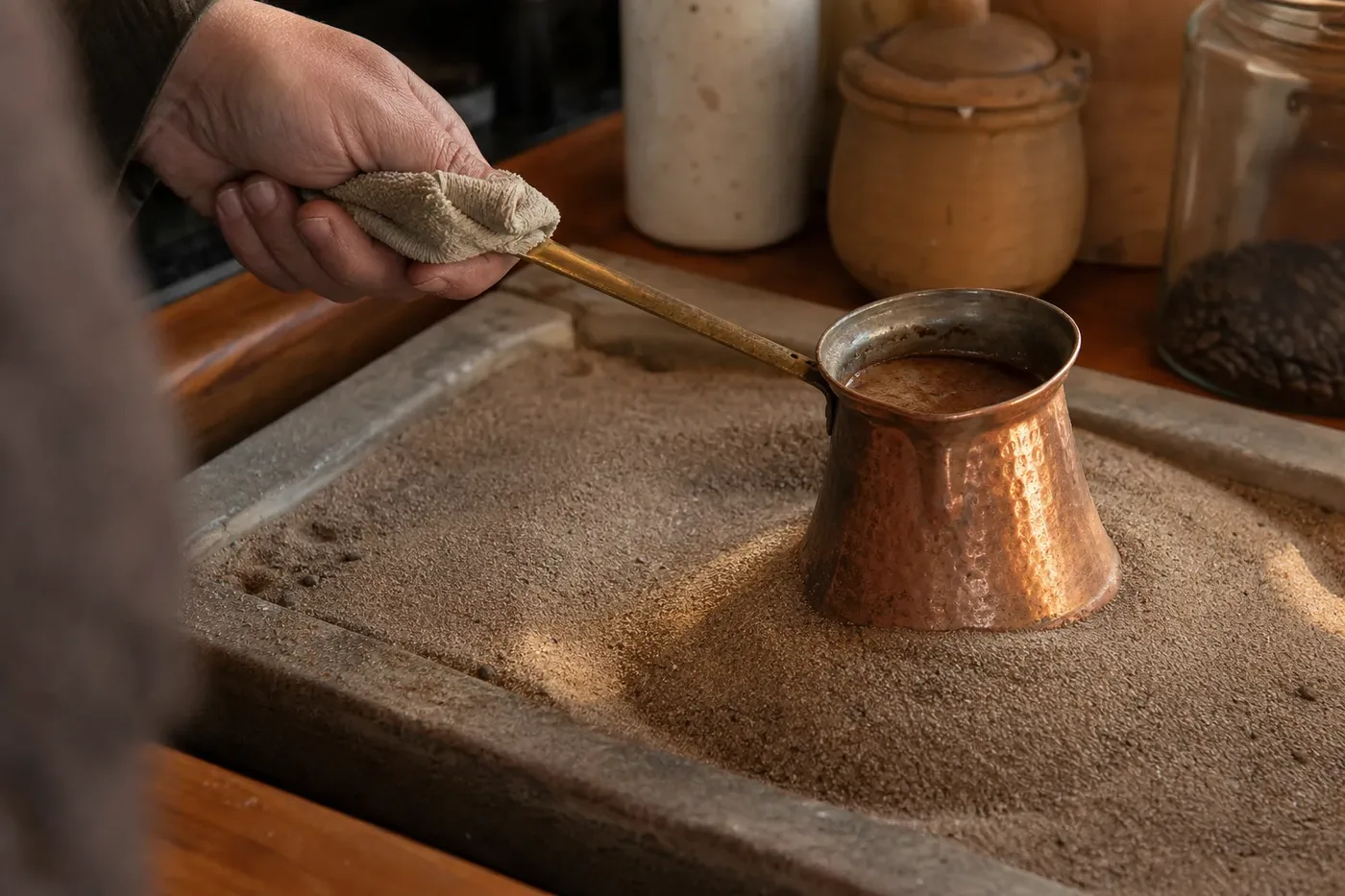
The second thing is control, and it is the real reason professionals use it. Depth is temperature. Push the pot deeper and it heats faster; lift it to the surface and it slows immediately; take it out and it stops. No burner responds in under a second, and Turkish coffee is a method where the decisive moment lasts about that long.
Why foam is the point of sand coffee
Turkish coffee is judged on its foam. A cup served without it has been made badly, and in a domestic setting it is close to an insult.
The foam forms as the coffee approaches a boil and collapses if it gets there. So the entire technique is about walking the pot up to the edge, pulling it off, letting it settle, and often returning it once or twice. Sand makes that repeatable. It is why the brewer at a sand tray is watching the surface rather than a clock.
Sand coffee grind: finer than anything else you own
Turkish grind is the finest in coffee, finer than espresso, closer to flour than to powder. There is no filter, so the grounds have to be small enough to stay suspended and then settle cleanly, and large particles simply sit in the cup as grit.
Most domestic grinders cannot go this fine, and those that can will take a long time doing it. Turkish coffee is one of the few cases where buying it pre-ground is the sensible answer, or using a mill built specifically for it.
What goes in the pot: coffee, water and sugar
Coffee, water, and sugar decided before brewing rather than after. Sugar is added at the start, because nothing is stirred once the foam has begun to form. Ordering involves saying how sweet you want it, and that is a brewing instruction rather than a preference expressed at the table. Cardamom is common in the Arab world and less so in Turkey.
How to get close to sand coffee at home
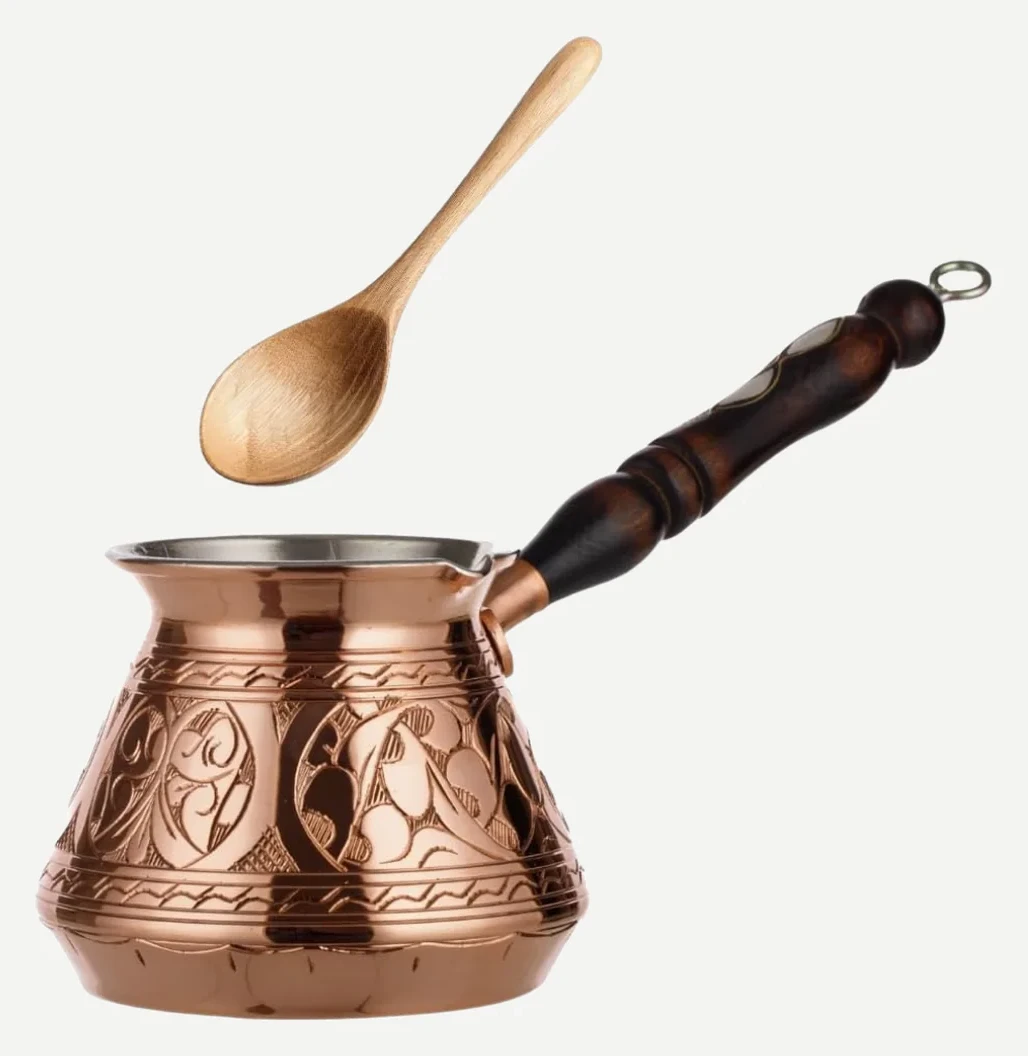
You need a cezve, and there is a real difference between a good one and a cheap one: the DEMMEX copper cezve is hammered copper with a tin lining, which conducts fast enough that the pot responds to being lifted the way the method assumes.
Then use the lowest heat your hob will hold, do not stir after the first mix, and take the pot off the moment the foam rises rather than when it boils. That last instruction is the whole method. Everything the sand does is in service of making it easier to obey.

Sand coffee vs a stove, plainly
Sand wins on two counts and loses on the ones that decide most kitchens.
- Heat distribution. Sand surrounds the pot; a burner heats its base. In a narrow, unstirred vessel that changes where the convection starts.
- Response. Depth is temperature, and it changes instantly. A gas ring is slower and an electric hob is much slower.
- Practicality. A sand tray takes a long time to come up to temperature and stays dangerously hot for a long time after. That is fine for a cafe running all day and absurd for one cup at home.
Which is why the honest summary is that sand is a professional tool. Home Turkish coffee has been made on stoves and over coals for centuries and nobody considers it a compromise.
Reading the cup, and what to do with the grounds
The grounds settle into a thick layer at the bottom and you stop drinking when you reach it. In much of the region the cup is then turned onto its saucer, left to cool, and the patterns read, which is tasseography.
Take it as seriously as you like. What it tells you reliably is that the coffee was made correctly: a cup that leaves a clean, even sludge and a clear liquid above it was brewed at the right grind and pulled off the heat at the right moment. A gritty cup was ground too coarse.
Where sand coffee is drunk
The method belongs to a region rather than a country, and the arguments about naming are older than most of the borders. Turkey, Greece, Armenia, Cyprus, the Levant and much of the Balkans all brew a version, and the name changes at nearly every border while the technique does not.
The differences that do exist are real but small: cardamom is standard in the Arab world and unusual in Turkey, sweetness levels have their own vocabulary in each language, and the pot has a different name in each. The pot itself is the same object.
Turkish sand coffee FAQ
What does the sand actually do?
It gives even heat on every surface of the pot at once, instead of only the base, and it lets the brewer change the temperature instantly by lifting the cezve or pushing it deeper. A burner can do neither.
Can I make Turkish coffee without sand?
Yes. Almost all Turkish coffee at home is made on a stove, and it is good. The sand is a professional and ceremonial method that gives more control, not a requirement.
How fine does the grind need to be?
Finer than espresso. It should feel like flour rather than sand, which most domestic grinders cannot reach. Turkish grind is usually bought pre-ground or done on a mill built for it.
Do you drink the grounds?
No. Turkish coffee is unfiltered, so the grounds go into the cup and settle. You drink until you reach the sludge and then stop, which is also why the cup is left standing for a moment before anyone lifts it.