


Flat White vs Cappuccino: What Actually Differs
Not the size, and not the amount of milk. The difference is the texture of the foam, and it changes everything about how the coffee comes through.

Both are espresso and steamed milk. The difference is the milk: a cappuccino carries a distinct layer of airy foam on top, a flat white has fine, silky milk foam mixed through the whole drink. The flat white is also smaller, which means more coffee per mouthful.
People reach for size as the distinguishing feature and it is the least reliable one, because cup sizes vary by country and by cafe. Texture does not vary. If the foam sits on top as a separate layer you are drinking a cappuccino; if it is folded through so the drink is uniform from first sip to last, you are drinking a flat white.
| Flat white | Cappuccino | |
|---|---|---|
| Espresso | Double shot, sometimes a double ristretto | 1 or 2 shots |
| Milk | Steamed to a thin, glossy microfoam, about 120ml | Steamed, about 120ml |
| Foam | Microfoam folded through, not a separate layer | Thick cap, the milk grown by about a third |
| Also in it | Nothing | Nothing |
| Served in | 150 to 180ml | 150 to 180ml |
| Vessel | Small cup | Cup |
| Caffeine | About 120 to 150mg | 60 to 75mg a shot, so 60 to 150mg |
| The ratio that defines it | A double shot in a small cup: more coffee per mouthful than a latte | Roughly equal thirds espresso, milk and foam |
| Where it comes from | Australia and New Zealand, 1980s | Named after the Capuchin friars' robes; the Italian drink as we know it is 20th century |
Ranges, not averages: cafes pour these differently, and a figure pretending to be exact would be worse than the range. Figures from our flat white page and Italian tradition, as set out on our cappuccino page.
What microfoam is
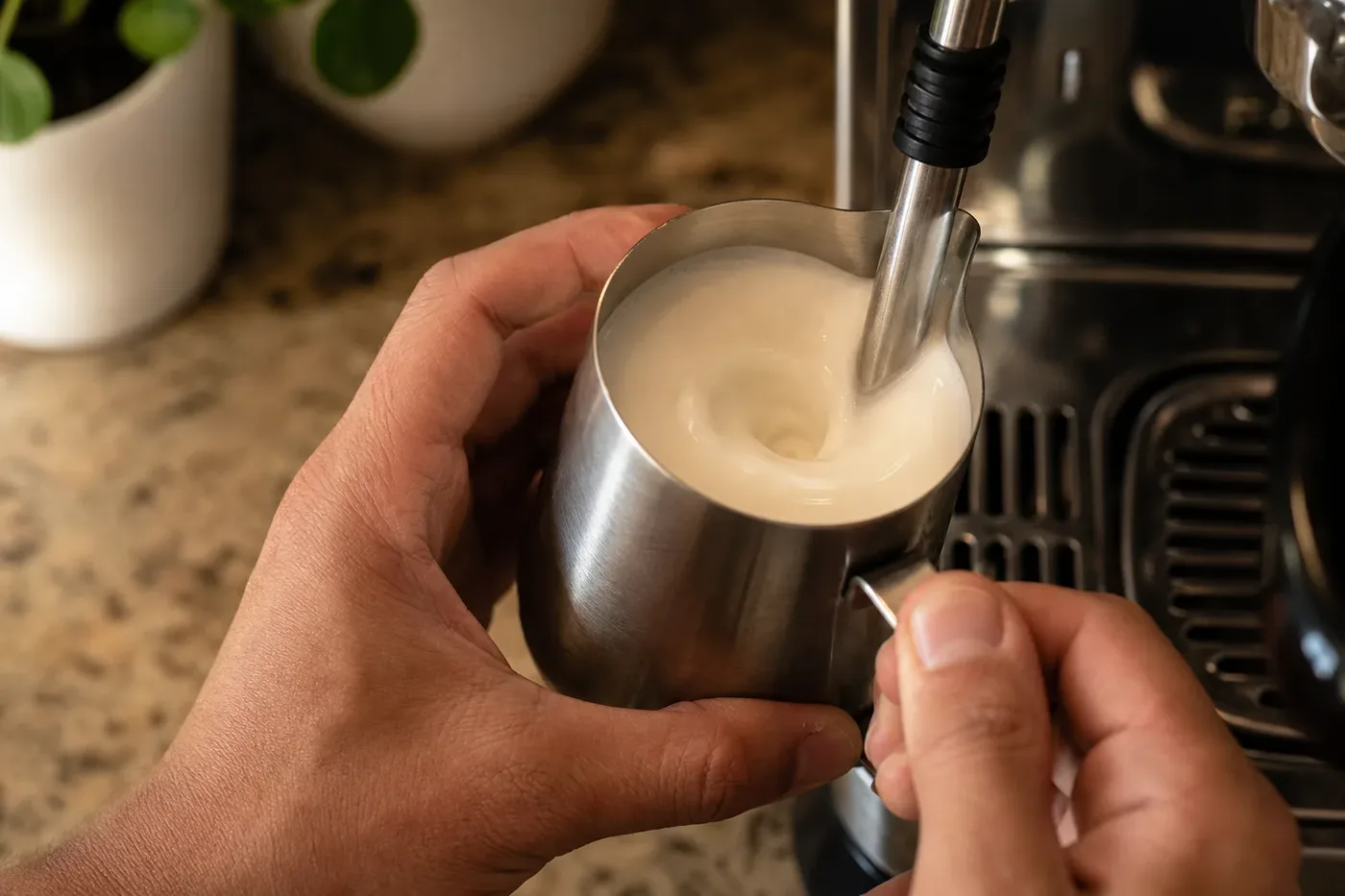
Steaming milk does two things: it heats it and it introduces air. How much air, and how finely it is broken up, is the whole craft. Stop early and you get large bubbles that separate into a dry foam cap sitting on liquid underneath. Keep the air fine and keep it moving and the bubbles become too small to see, producing a glossy liquid with the texture of wet paint. That is microfoam, and it does not separate.
What good steamed milk actually is covers how it is made. The practical test is whether the drink looks the same in the last mouthful as it did in the first.
Flat white vs cappuccino ratios and strength
A traditional cappuccino is described as equal thirds: espresso, steamed milk, foam, in a cup around 150 to 180ml. A flat white is typically 150 to 165ml with only a thin layer of microfoam, so there is less air and more liquid milk, and the coffee base is often a doppio ristretto rather than a standard shot.
Put those together and the flat white carries more coffee in less volume. It is not a stronger drink in the sense of more caffeine, necessarily, but it tastes considerably more of coffee, which is the reason people who find cappuccinos milky order one.
Where the flat white and cappuccino came from
The flat white comes from Australia and New Zealand in the 1980s, and both countries still claim it as their own. It arrived in Britain and the United States much later and was widely misunderstood on the way, which is why a flat white in a chain is often just a small latte with less foam. The version worth ordering is the one where the barista steams the milk thinner and silkier, rather than simply pouring less of it.
The cappuccino is much older. The name comes from the Capuchin friars, an order of Catholic monks who wear brown hooded robes, roughly the colour of coffee with a little milk in it. Cafes in Vienna were serving a coffee with cream called a Kapuziner, German for Capuchin, long before espresso machines existed. The Italian cappuccino we know today, espresso topped with steamed and foamed milk, only arrived in the twentieth century, once espresso machines could steam milk.
Latte art: how to tell a flat white from a cappuccino
You cannot pour a pattern with dry foam. If a drink arrives with a clean rosetta or heart, the milk was textured as microfoam, whatever it was called. A cappuccino traditionally arrives with a dusting of chocolate and no pattern precisely because the foam is too stiff to pour with. This is the fastest way to tell what you have actually been served.
Flat white and cappuccino sizes are not fixed
Italy has a rough consensus on a cappuccino and nowhere else does. British and American chains serve them in 12oz cups that would be a latte in Rome, and a flat white in London is routinely larger than one in Auckland. This is why size is a poor guide and texture is a reliable one: the foam either separates or it does not, in any country.
It also explains a common complaint. If your cappuccino arrives tasting like warm milk, the cup was probably too big for the number of shots in it rather than the milk being wrong. Asking for an extra shot fixes it more often than changing drink does.
Flat white or cappuccino: which to order?
If you want the coffee to lead, a flat white, or smaller again a cortado or a piccolo, both of which take the same idea further. If you want something softer and longer to drink, a cappuccino. If what you actually want is a lot of milk, a latte is the honest answer and there is nothing wrong with it.
At home, the limiting factor is almost always the steam wand rather than the coffee. Making microfoam needs a wand with enough pressure to create a vortex, which is where inexpensive machines struggle. Espresso machine reviews cover what to look for, and cappuccino against frappuccino sorts out a different confusion entirely.
Flat white vs cappuccino FAQ
Is a flat white stronger than a cappuccino?
It tastes stronger, because it holds more coffee in less volume and less of that volume is air. Caffeine depends on how many shots each is built on, which varies by cafe, so the difference is in flavour rather than necessarily in stimulant.
What is the main difference between a flat white and a cappuccino?
The milk texture. A cappuccino has a distinct layer of airy foam on top; a flat white has fine, silky milk foam mixed through the whole drink, so it is uniform from the first sip to the last. Size is the less reliable guide because cup sizes vary by country.
Why does my cappuccino have latte art?
Because it was made with microfoam rather than a stiff foam cap. You cannot pour a pattern with dry foam. A traditional cappuccino arrives with a chocolate dusting and no pattern, so latte art is a sign you have been served something closer to a flat white.