
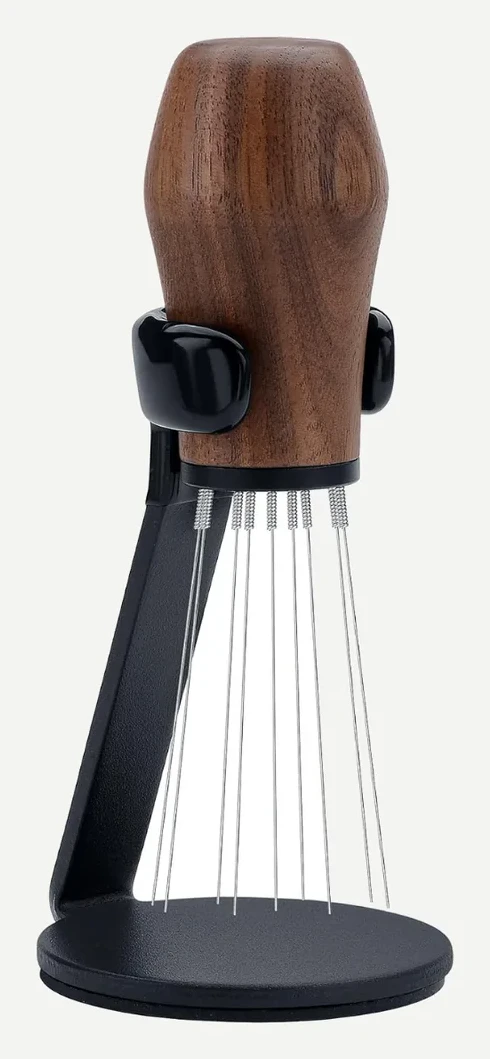
What is the Normcore WDT Distribution Tool?
Nine needles on a handle, and the cheapest real fix for bad espresso.
Normcore publishes nine 304 stainless steel needles described as nonstick and rust resistant, an anodized CNC aluminium handle shaped for grip, and a stand so the tool sits on the counter with the needles clear of the surface.
WDT stands for Weiss Distribution Technique, after the person who popularised it. The technique is simply stirring the dry grounds in the basket with something thin before you tamp.
Why stirring the grounds fixes more than a better tamper does
Channelling is the main fault in home espresso, and it starts before the tamp.
Coffee comes out of a grinder in clumps, held together by static and by the oils on freshly cut surfaces. Tamping compresses those clumps but does not break them, so the puck ends up with dense regions and loose ones.
Water under nine bars finds the loose regions and runs through them, which is channelling. The result is a shot that is simultaneously over-extracted where the water lingered and under-extracted where it never went, and it tastes sour and harsh at once. No tamping pressure fixes it, because the unevenness is already inside the puck.
Stirring with needles breaks the clumps and lets the grounds settle evenly. It is a twenty-second habit that changes shots more than most equipment upgrades, which is why a tool that costs so little sits alongside machines costing hundreds.
The stand, and why it is not a gimmick
A WDT tool with wet grounds on nine needles has to go somewhere.
The needles are thin enough to bend if the tool is dropped in a drawer, and they carry coffee dust after every use. A stand keeps them vertical, clear of the counter and visible, which is the difference between a tool you use every morning and one you use for a fortnight.
It sits well beside Normcore's knock box, which makes the two a coherent kit.
Normcore WDT vs the generic espresso accessory kits
The kits are cheaper and they are a false economy.
Search for a WDT tool and most of what comes back is a five-piece kit from a seller you have not heard of, bundling a tamper, funnel, screen and distributor. The tamper in those kits is usually the weak part, and the needles are usually thicker than they should be, which defeats the purpose.
Buying the tools individually costs more and gets you a 304 stainless needle set from a company that will still exist when you want a replacement. Pair it with the Normcore spring-loaded tamper and you have the two tools that matter.
Is the Normcore WDT tool worth it?
Yes, and it is the highest return per pound on this entire site.
For the price of two bags of coffee you get the single change that most improves a home espresso shot. Anybody with a machine and a grinder who is not doing this is leaving the easiest improvement on the table.
Normcore ships two needle sets, nine at 0.25 mm and nine at 0.3 mm, so you can fit the finer or the stiffer set; it does not publish a weight or a warranty term. Needle gauge in particular varies between WDT tools and finer needles disturb the bed less, so it is a gap worth noting.
Who should buy it (and who should not)
Buy it if you pull espresso at home and grind fresh.
It suits anybody whose shots run at different speeds on the same setting, which is the classic symptom of channelling. It works with any portafilter size, since it is used inside the basket.
It does nothing for filter coffee, where there is no puck and no pressure. And if you use pre-ground coffee from a bag, the clumping problem is smaller and the gain is correspondingly less.
Frequently Asked Questions
What does a WDT tool actually do?
It stirs dry coffee grounds in the portafilter with fine needles to break up clumps, so the puck compresses evenly when you tamp and water cannot find a loose channel through it.
Do I still need to tamp after using a WDT tool?
Yes. Stirring evens out the distribution; tamping compresses it. They solve different halves of the same problem.
What size portafilter does it fit?
Any. The tool is used inside the basket rather than fitted to the portafilter, so 51mm, 54mm and 58mm all work.
Is the stand necessary?
Not strictly, but nine thin needles loose in a drawer bend, and they carry coffee dust. The stand is why the tool stays usable.