What is the Takeya Deluxe Cold Brew Coffee Maker?
The cold brew pitcher most people own, and it earned that by being hard to break.
Takeya publishes shatterproof Tritan construction described as stain and odour resistant, a 1 quart capacity, a patented airtight leakproof lid, a fine-mesh permanent filter, a silicone grip handle, dishwasher-safe cleaning and manufacture in the USA. It measures 127 by 190 by 241mm.
Why the leakproof lid is the feature
Cold brew steeps for twelve hours, and a fridge is not a still place.
Most cold brew makers are glass carafes with a filter core and a lid that rests on top. They work, and they also drip when tilted, cannot be laid down, and take up a shelf rather than a door.
An airtight leakproof lid means the pitcher can go on its side, which is the difference between fitting your fridge and not. It also seals the coffee once brewed: cold brew concentrate oxidises like anything else, and a sealed pitcher keeps it drinkable for the fortnight the method promises.
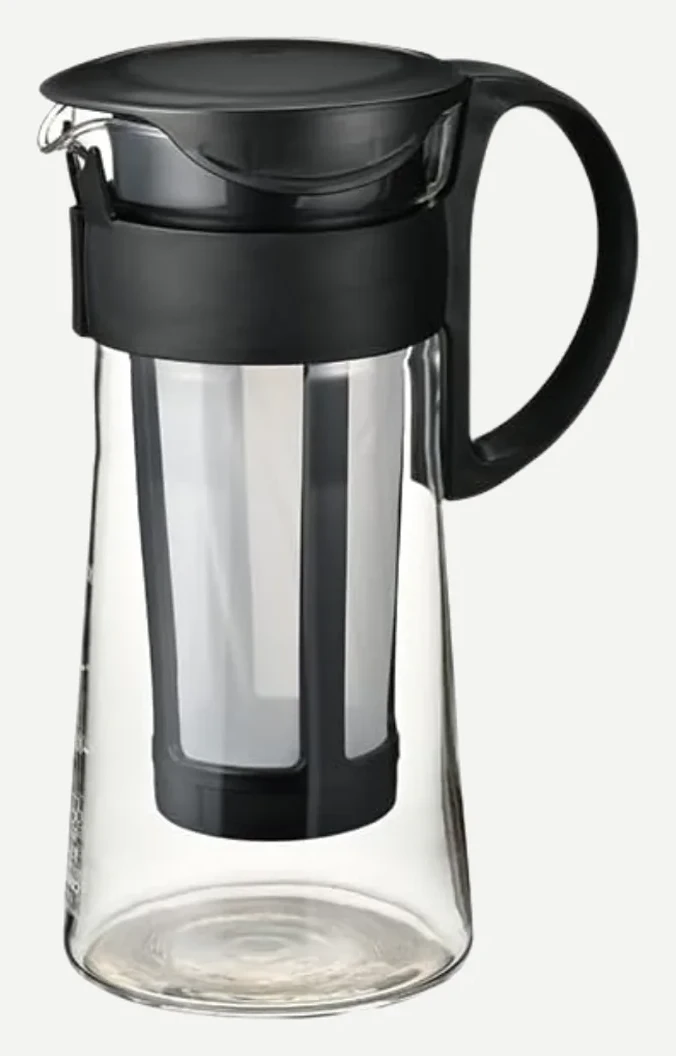
Glass rivals like the OVALWARE RJ3 also publish an airtight seal, and they will still shatter if the handle slips in a wet hand.
Tritan against glass
The trade is breakage against the way the vessel ages.
Glass is inert. It will not stain, will not hold an odour, and looks the same in five years. It also breaks, and a cold brew pitcher is handled wet, full and often half-asleep.
Tritan is a copolyester chosen precisely because it resists the staining and odour retention that ordinary plastics get from coffee oils, and Takeya publishes both claims. It is shatterproof and dishwasher safe. Our build scoring still ranks glass above plastic, which is the honest general rule even where a specific plastic is a good answer.
Takeya vs OXO Good Grips Cold Brew 32oz
Same volume, different philosophy about what a cold brew maker is.
The OXO Good Grips is a two-part system: a brewing container with a rainmaker lid that wets the bed evenly, and a separate glass carafe it drains into. It brews better and it occupies more of your kitchen.
The Takeya is one vessel. You brew and store in the same pitcher and pull the filter out. It is simpler, cheaper, unbreakable and fits in a door. If cold brew is a daily habit rather than a project, that matters more than a rainmaker lid does.
Is the Takeya worth it?
Yes, and it is the sensible default in this category.
It is at the accessible end of the pricing, needs no consumables, survives a dishwasher and a drop, and Takeya publishes more about it than most: material behaviour, the lid patent, dishwasher safety and country of manufacture.
What it does not publish is a warranty term or a weight. And a fine mesh passes more fines than a paper filter would, so cold brew from any mesh maker has more body and a little sediment.
Who should buy it (and who should not)
Buy it if you drink cold brew regularly and your fridge is full.
It suits a household getting through a quart every few days, anybody who has broken a glass carafe, and people who want to lay it on its side. The silicone handle makes a full quart easy to pour one-handed.
Do not buy it if you want the cleanest possible cup, where a paper-filtered method wins. And if you brew a week at a time, the Primula at 1.6 quarts or the OVALWARE at 1.5 litres hold more.
Frequently Asked Questions
Is the Takeya glass or plastic?
Tritan, a shatterproof copolyester that Takeya publishes as stain and odour resistant. It is dishwasher safe.
Can it lie on its side in the fridge?
Yes. The patented lid is published as airtight and leakproof, which is the main practical reason to choose it.
Does it need paper filters?
No, the fine-mesh filter is permanent. That also means a little more sediment than a paper method gives.
How much does it hold?
One quart, about 946ml.