

Arabic Coffee vs Turkish Coffee: Two Different Drinks
Both are old, both come from the same part of the world, and they taste almost nothing alike. Roast, grind, spice, pot and serving, side by side.
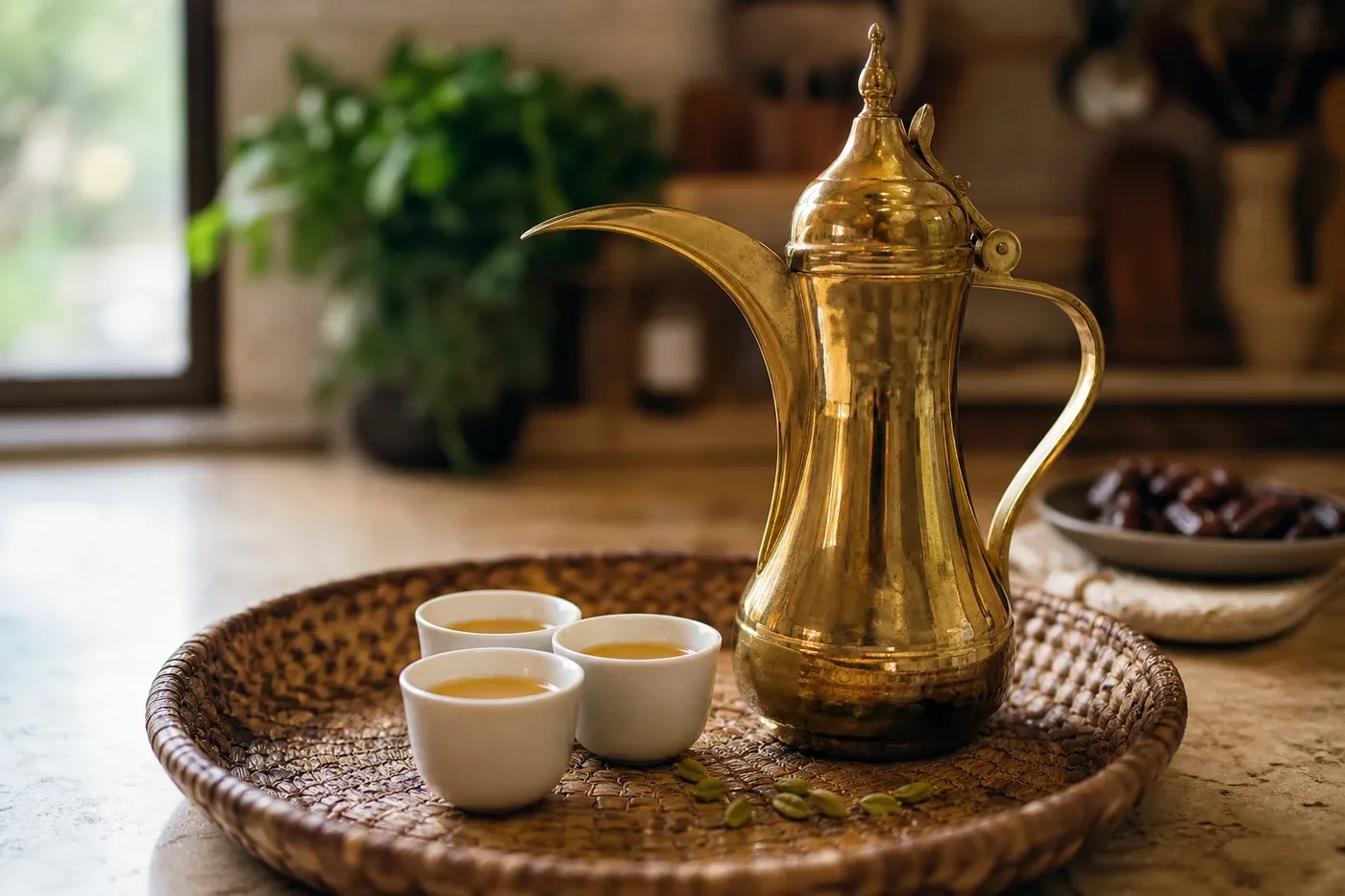
They are often treated as one drink with two names, and they are not. Arabic coffee is lightly roasted, spiced with cardamom and poured clear from a tall pot. Turkish coffee is darker, ground to a powder, brewed in a small pot and served with its grounds settled in the bottom of the cup.
Side by side
| Arabic coffee | Turkish coffee | |
|---|---|---|
| Roast | Light, often golden | Medium to medium-dark |
| Grind | Coarser, left behind in the pot | A very fine powder, served in the cup |
| Spice | Cardamom, sometimes saffron or cloves | Usually none |
| Sugar | Usually none | Chosen when ordering: none, a little, or sweet |
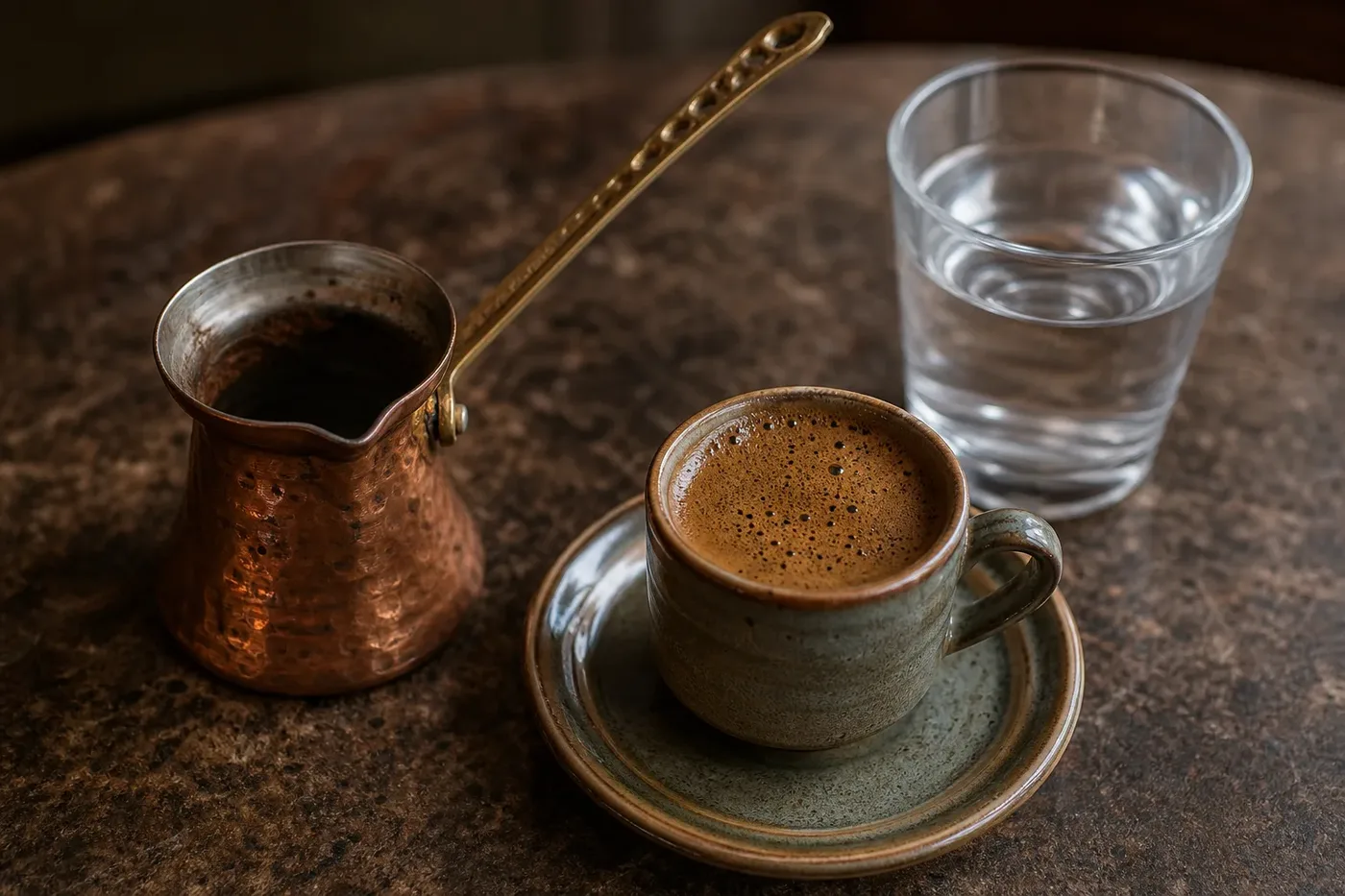
| Pot | The dallah, tall with a long spout | The cezve, small with a long handle |
| Served | Small cups without handles, filled only part way | Small cups, with a glass of water |
Arabic coffee
Arabic coffee, often called qahwa, is made from lightly roasted beans, boiled with cardamom and sometimes saffron or cloves, and then poured off its grounds, so what reaches the cup is thin and clear rather than thick. It tastes spiced and gentle, closer to a strong tea than to an espresso, and it is usually drunk without sugar.
The style changes across the region. In the Gulf it is often bright yellow from very light roasting and plenty of saffron and cardamom, while around the Levant it is typically darker and ground finer. It is poured from a dallah, the tall pot with a curved spout that has become a symbol of hospitality in its own right.
Serving is where the custom is strongest. UNESCO listed Arabic coffee as a symbol of generosity in 2015, on a file from the United Arab Emirates, Saudi Arabia, Oman and Qatar that now also includes Jordan. Its description notes that older people and guests are served first, that the coffee is poured with the right hand, and that a guest shakes the cup gently to say they have had enough. More on the drink itself is in our guide to Arabic coffee.
Turkish coffee
Turkish coffee starts with beans ground to a fine powder. UNESCO, which listed Turkish coffee culture and tradition in 2013, describes the method: the ground coffee, cold water and sugar go into a small pot and are brewed slowly on the stove until the foam rises. The sugar is decided before brewing, because it goes into the pot, so you choose when you order: none, a little, or sweet.
Nothing is filtered. The coffee is poured with its foam into a small cup and the powder settles to the bottom, which is why you stop drinking when you reach it, and why the grounds can be turned over and read afterwards, a custom covered in Turkish coffee fortune reading. It comes with a glass of water to clear the palate.
How they taste
Put the two side by side and the difference is obvious from the first sip. Arabic coffee is pale, light in body and fragrant with cardamom, sipped from a small cup that is filled only part way and topped up until the guest shakes it to say they have had enough. Turkish coffee is dark, strong and thick, with a velvety foam on top and the fine grounds giving it a heavy texture right to the end.
Making each at home
Arabic coffee needs lightly roasted beans ground medium, whole cardamom pods crushed just before use, and a pot you can pour from once the grounds have settled. The coffee is boiled, the cardamom goes in, and it is left to rest for a minute so the grounds sink before it is poured. Turkish coffee needs a cezve, beans ground as fine as flour, and a low flame, because it has to rise slowly to a foam rather than boil over.
Which to try
If you like spiced drinks and lighter coffee, start with Arabic coffee. If you like strong, heavy coffee with a lot of body, Turkish coffee is the one, and our guide to making Turkish coffee at home covers the pot, the grind and the heat.
Common questions
Is Arabic coffee the same as Turkish coffee?
No. Arabic coffee is lightly roasted, spiced with cardamom and poured clear from a dallah. Turkish coffee is darker, ground to a powder and served with its grounds in the cup.
Does Arabic coffee have cardamom?
Yes. Cardamom is the usual spice, and saffron or cloves are sometimes added, especially in the Gulf.
Why is Arabic coffee yellow?
In the Gulf the beans are roasted very lightly and brewed with saffron and cardamom, which turns the coffee pale gold or yellow.
Do you drink the grounds in Turkish coffee?
No. The fine grounds settle to the bottom of the cup, and you stop drinking when you reach them.