





Turkish Coffee Fortune Reading: How Reading the Cup Works
When the coffee is finished, the cup is turned upside down and the grounds are read. How the ritual goes, what the common shapes are said to mean, and how much of its history is known.
Turkish coffee is served with its grounds, and when the cup is empty a thick layer of them is left at the bottom. Reading the shapes in that layer is one of the oldest habits around the drink, and UNESCO mentions it in its description of Turkish coffee culture: the grounds left in the empty cup are often used to tell a person's fortune.
Why Turkish coffee can be read at all
Most coffee leaves nothing behind. A paper filter or an espresso machine keeps the grounds out of the cup, so there is nothing to look at when you finish. Turkish coffee is different. UNESCO describes how it is made: the beans are ground to a fine powder, then the ground coffee, cold water and sugar go into a small pot and are brewed slowly on the stove until the foam rises. Nothing is filtered, so the powder settles into a soft layer at the bottom of the cup.
That layer is what gets read. The full method for making the coffee is in our guide to Turkish coffee.
How a reading is done
The steps vary from family to family, but the common version goes like this:
- Drink the coffee and stop when you reach the thick layer at the bottom.
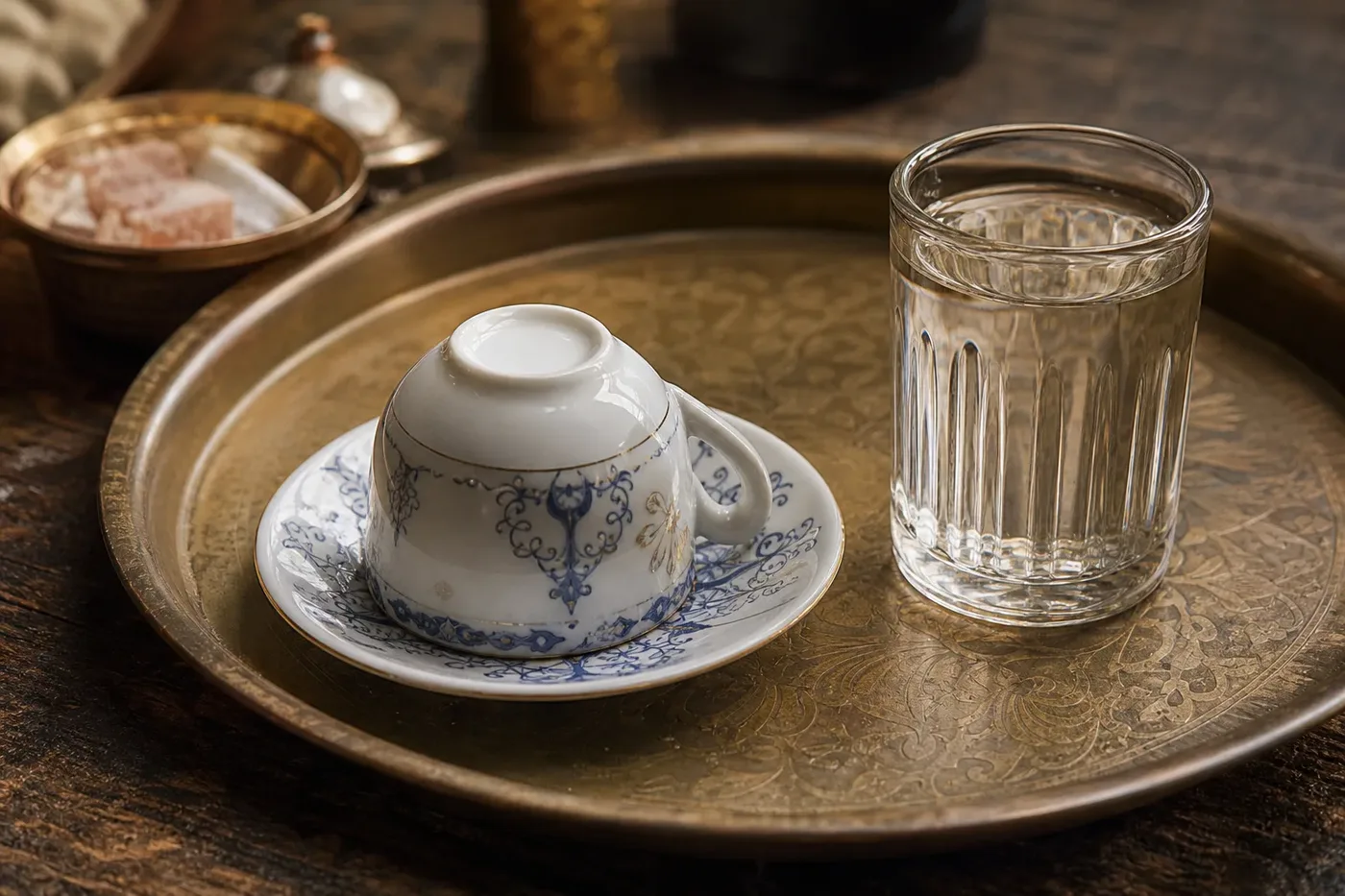
- Put the saucer on top of the cup, like a lid. Many people make a wish at this point.
- Turn the cup and saucer over together, so the grounds run down the inside walls of the cup.
- Wait for the cup to cool, usually a few minutes, so the grounds set into patterns.
- Lift the cup and read the shapes left on its sides, and sometimes the pattern on the saucer too.
By custom, somebody else reads your cup, often a friend or a relative who is known for it. Reading your own is considered a little like marking your own homework.

What the shapes are said to mean
These are traditional meanings passed on in families and in books on cup reading, not predictions anyone has tested. Coffee readers and tea-leaf readers share much of the same list. In the version most often reproduced, a snake stands for an enemy or a lie, a mountain for an obstacle on the way, a house for a change or a success, and a spade for good luck earned through hard work.
Where a shape sits matters as much as the shape. In tea-leaf reading, marks near the rim are said to speak about the near future and marks near the bottom about the distant future, and coffee readers often use the same idea.
Where the custom comes from
Coffee reached Istanbul in the first half of the 1500s, and its first coffeehouses are dated to the 1550s, although the exact year differs between sources. A story often told is that cup reading began in the Ottoman palace in the same century. It is repeated widely, but nobody has produced a record from the time that shows it, so it is best treated as a story rather than as history.
What is clear is that the habit spread with the coffeehouses. The same custom is found in Greece and across the Arab world, where coffee is also served with its grounds, and tea-leaf reading in Britain and Ireland follows the same idea with a different drink. The Greek and Turkish versions of the coffee itself are compared in Greek vs Turkish coffee.
Is any of it real?
There is no evidence that the grounds predict anything, and most people who enjoy a reading do not treat it as a forecast. Its real job is social. UNESCO describes Turkish coffee as a symbol of hospitality and friendship, and a reading is a reason to stay at the table a little longer, talk, and laugh at what the cup seems to say.
Making a cup worth reading
For a clear reading, the coffee needs a proper layer of grounds, which means Turkish-style grinding, as fine as flour, and no filtering. Pour the coffee gently into the cup, let it stand for a minute so the grounds settle, and drink slowly without stirring. When you taste the grounds, stop: that sludge is the part you turn over. Arabic coffee is a different drink with no grounds left in the cup, as Arabic vs Turkish coffee explains, so it cannot be read the same way.
Common questions
How do you read Turkish coffee grounds?
Drink the coffee down to the grounds, put the saucer on top, turn the cup and saucer over together, wait a few minutes for it to cool, then lift the cup and read the shapes the grounds have left on the sides.
Can you read your own coffee cup?
By custom, no. Someone else reads your cup, usually a friend or relative known for it, and reading your own is thought of as biased.
What does a snake mean in coffee fortune reading?
In the traditional list of meanings, a snake stands for an enemy or a lie. These meanings are passed on by custom and are not predictions anyone has tested.
Is coffee fortune reading part of Turkish coffee's UNESCO listing?
It is mentioned. UNESCO listed Turkish coffee culture and tradition in 2013, and its description notes that the grounds left in the empty cup are often used to tell a person's fortune.