The History of Espresso: Who Invented It and Where Crema Came From
Four men in northern Italy took 64 years to turn a slow cup into a 25-second shot. Who invented espresso, who built the machine, and why the first espresso had no crema.
The history of espresso is the story of four men in northern Italy who spent 64 years turning a slow cup into a 25-second shot. A Turin hotel owner patented a steam machine in 1884, a Milan mechanic made it brew one cup at a time, a businessman gave it a name and a factory, and a coffee-bar owner built the lever machine that first put crema on top. Each one fixed something the one before could not.
Why espresso was invented: coffee in Italy was slow
In the 1880s Italian cafés brewed coffee in big pots or through cloth filters, and a cup took several minutes. Italians drank their coffee standing at the counter, which is why a café in Italy is still called "un bar", after the counter itself. A drink that took minutes did not suit a counter where people stopped for one coffee and moved on. Every inventor below was chasing the same idea: push the water through the coffee faster than gravity can.
Who invented espresso? Angelo Moriondo, Turin, 1884
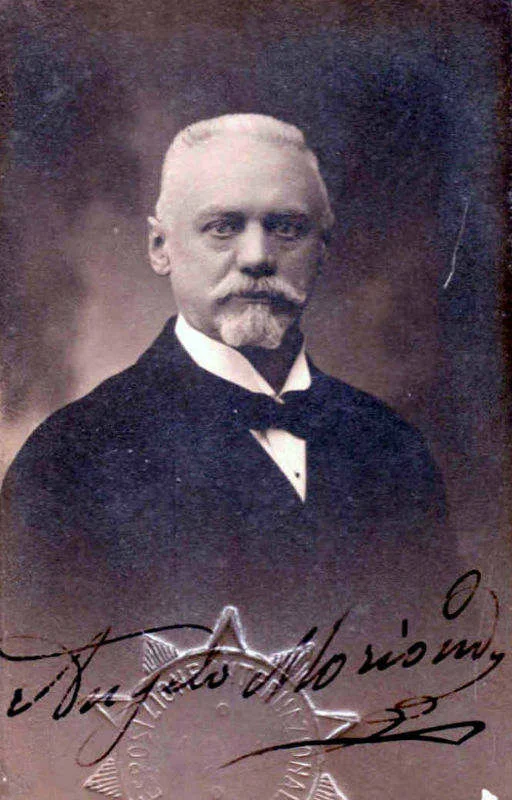
Angelo Moriondo owned a hotel, the Grand-Hotel Ligure, and a bar, the American Bar, in Turin, in the north-west of Italy near the French border. On 16 May 1884 he patented a machine in which a boiler made steam, and the steam pushed water through the coffee. It brewed in bulk rather than cup by cup. It won a bronze medal at the Turin General Exposition that year.
Moriondo built a few by hand for his own business and never sold the design, so his name faded while the people who came after him built companies. That is why the answer to "who invented espresso" depends on what is being counted. His patent is the first for a machine that forced water through coffee to make it faster. It did not make single cups, and it did not make the drink anyone would call espresso today.
Who invented the espresso machine as we know it: Luigi Bezzera, 1901
Luigi Bezzera was a mechanic in Milan, about 125 km (80 miles) east of Turin. He filed his patent on 19 December 1901, and it was granted on 5 June 1902. His machine made coffee one cup at a time, straight into the cup. It also brought in the part every café machine still uses: the portafilter, a basket of ground coffee on a handle that locks into the machine from below. Nobody knows whether Bezzera ever saw Moriondo's machine.
Desiderio Pavoni and the name espresso
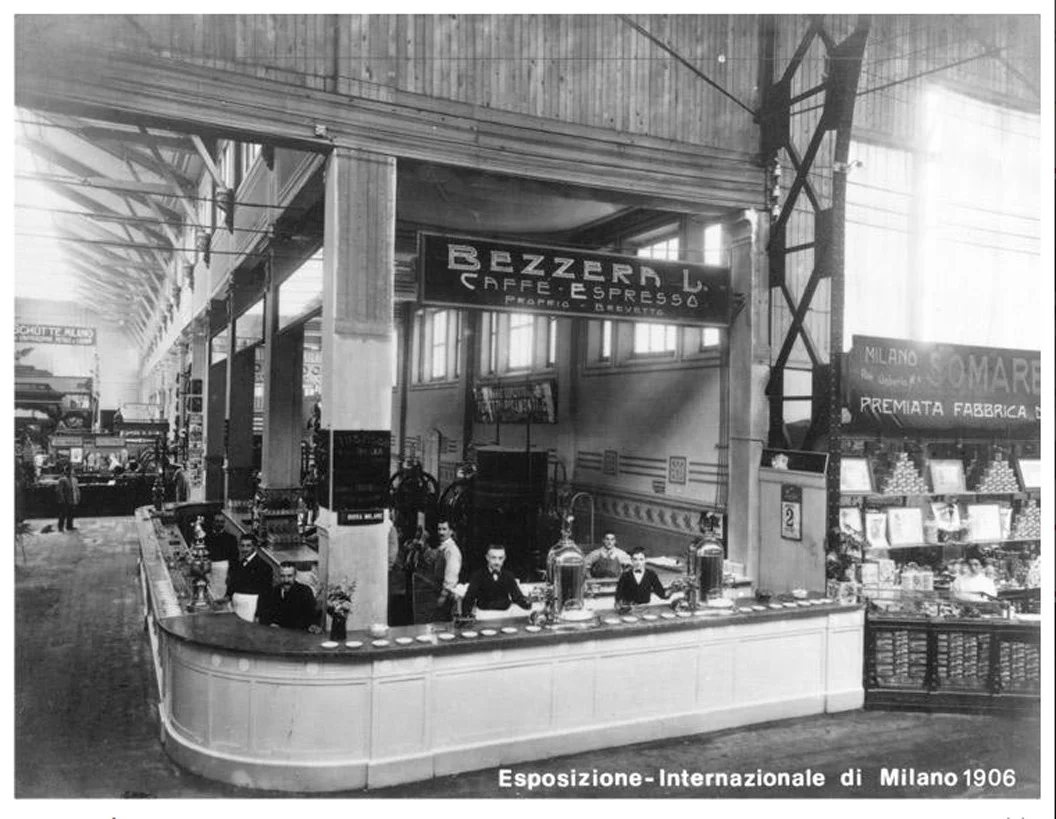
Desiderio Pavoni, a Milan businessman, bought Bezzera's patent in 1903 and founded La Pavoni in 1905, building about one machine a day. At the 1906 Milan fair, Bezzera's stand carried a sign reading "Caffè Espresso". The Italian word holds several meanings at once: made on the spot, made just for you, and fast, like an express train. In Italy today the drink is simply "un caffè", because espresso is the default coffee.
Why the first espresso was bitter: steam espresso machines
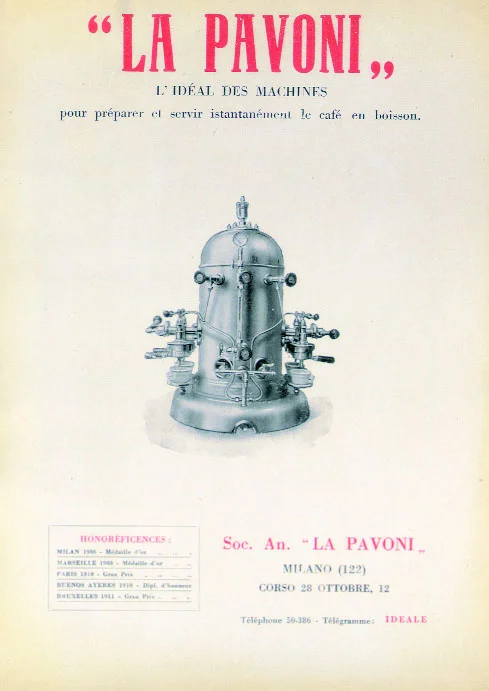
For about 40 years every one of these machines ran on steam. Steam pushed the water at about 1.5 bar, less than the pressure in a car tyre, and the water was well over 100 °C, past boiling. The coffee came out thin and bitter, with no foam on top. In 1935 Francesco Illy's Illetta swapped steam for compressed air, one of several attempts to get past the problem, but the real fix came from a coffee bar.
Achille Gaggia and the lever espresso machine
Achille Gaggia ran Caffè Achille, a coffee bar in Milan. He patented a piston design in 1938, and in 1947 built a spring-lever machine. The barista pulls a lever to load a spring, and the spring drives the water through the coffee at about 9 bar, roughly the pressure 90 metres (300 feet) under the sea, at a temperature below boiling. His company sold it from 1948. Sources give 1938, 1945 or 1947 as "the" Gaggia date depending on which step they count. The 1927 that is often repeated is wrong.
Where espresso crema came from
Gaggia's lever produced something steam never had: a thick golden-brown foam on top of the coffee. His machines carried the words "Crema caffè naturale", natural coffee cream, because nobody had seen it before.
Crema is mostly not oil, despite the common claim. Roasting fills coffee beans with carbon dioxide, and they hold it for weeks. At 9 bar that gas is forced into the hot coffee, and when the pressure drops in the cup it comes back out as tiny bubbles, 10 to 150 micrometres across. The coffee's oils, sugars and proteins wrap the bubbles and hold them, so the foam can last around 40 minutes. Steam at 1.5 bar never had the pressure to do it. Stale beans, with their gas gone, give little crema, and light and medium roasts give a thinner layer, which is normal. What crema does and does not tell you about a shot is covered on our espresso page.
The Faema E61 (1961): the espresso machine cafés still copy
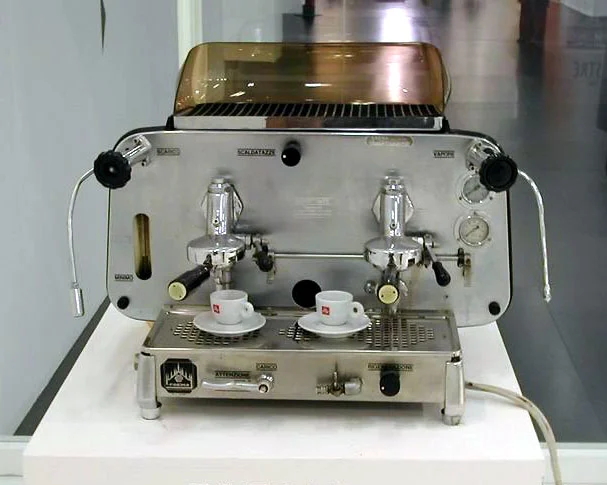
In 1961 Faema's E61 replaced the lever with an electric pump that made the 9 bar on its own. It added automatic pre-infusion: the grounds are wetted first, so they swell and settle before full pressure arrives, and the water cannot force a path through one weak spot in the coffee (channeling). It also used a thermosiphon, a loop of circulating hot water, to keep the brew head at temperature.
The machines that followed did the same two jobs, heat and pressure, more precisely. Saeco's Superautomatica in 1985 was the first fully automatic bean-to-cup machine for the home. La Marzocco's Linea, from around 1990, became the standard in serious cafés because it holds about 93 °C and 9 bar shot after shot. Since then come PID temperature control, volumetric dosing and pressure profiling. Today's espresso machines fall into three kinds: the manual lever, where the barista does the work; the semi-automatic, used in most cafés, where the barista grinds, tamps and starts the shot and the machine holds heat and pressure; and the super-automatic, which does everything at a button but cannot be adjusted for each coffee, which is why serious cafés do not use them.
The official espresso recipe from the INEI
Italy's espresso institute, the INEI, is a private body of roasters and machine makers. It certifies "Espresso Italiano", and its recipe is a standard rather than a law:
| Measure | INEI standard | For scale |
|---|---|---|
| Ground coffee | 7 g ±0.5 | a heaped teaspoon |
| Water temperature | 88 °C ±2 | just below boiling |
| Pressure | 9 bar ±1 | about 90 m (300 ft) under the sea |
| Brew time | 25 seconds ±5 | |
| In the cup | 25 ml ±2.5, crema included | less than two tablespoons |
| Temperature in the cup | 67 °C ±3 |
Specialty cafés and home baristas usually brew hotter, at 90 to 96 °C, and weigh instead of measuring volume, aiming for 1:2 to 1:3, coffee in to liquid out. Espresso is roughly 8 to 12% dissolved coffee against 1.3 to 1.5% for filter, so six to ten times as concentrated. One shot carries about 63 mg of caffeine, against about 95 mg in a mug of filter coffee; a doppio carries twice the single.
From espresso history to ristretto, lungo and americano
Once the machine could make one shot, cafés started changing how much water went through it. Same coffee, same machine, different water. A ristretto ("restricted") stops early, at about 1:1 to 1:1.5, before most of the bitterness arrives, so it is stronger, sweeter and thicker. A lungo ("long") runs on to 1:3 and as far as 1:5 or 1:6, into the bitter part, so it is bigger, lighter and more bitter. If an espresso tastes too bitter, a ristretto is the one to try; if it is too intense, a lungo or an americano.
An americano is espresso with hot water added, at roughly 1:3 to 1:5. The story that American soldiers in Italy during the Second World War watered down their espresso has never been proven. The only source Wikipedia gives for it is a 2009 coffeehouse mystery novel, and the lever machines that made espresso with crema only went on sale in 1948, after the war. The Oxford English Dictionary traces "americano" to Central American Spanish in the mid-1950s, as a teasing name for weak coffee, and its first known use in English is in Jamaica's Sunday Gleaner in 1964. A long black, from Australia and New Zealand, pours the espresso onto the water instead, which keeps more crema on top.
Espresso history timeline
| Year | Who | What changed |
|---|---|---|
| 1884 | Angelo Moriondo, Turin | First patent for a steam machine pushing water through coffee, in bulk |
| 1901 | Luigi Bezzera, Milan | One cup at a time, and the portafilter (patent granted 1902) |
| 1903 to 1906 | Desiderio Pavoni, Milan | Buys the patent, founds La Pavoni (1905); "Caffè Espresso" sign at the 1906 fair |
| 1935 | Francesco Illy | The Illetta, compressed air instead of steam |
| 1938 and 1947 | Achille Gaggia, Milan | Piston patent, then the spring lever at about 9 bar: the first crema. On sale from 1948 |
| 1961 | Faema | The E61: electric pump, automatic pre-infusion, thermosiphon |
| 1985 | Saeco | Superautomatica, the first fully automatic home bean-to-cup machine |
| Around 1990 | La Marzocco | The Linea becomes the café standard |
For most of that history darker roasts were thought best, because they are easier to brew and taste of chocolate and bitterness. The specialty movement showed that light roasts work too, with hotter water and longer shots, and that they taste of where the coffee was grown. In 25 seconds at 9 bar, nothing hides.
History of espresso FAQ
Who invented espresso?
Angelo Moriondo patented the first steam machine that forced water through coffee in Turin in 1884, but it brewed in bulk. Luigi Bezzera's 1901 patent made single cups, and Achille Gaggia's 1947 lever machine made the first espresso with crema, the drink as it is known today.
Who invented the espresso machine?
Luigi Bezzera, a Milan mechanic, patented the first machine that brewed one cup at a time in 1901, with the portafilter every café machine still uses. Desiderio Pavoni bought his patent in 1903 and built the machines commercially from 1905.
When was espresso invented?
Between 1884 and 1947. Moriondo's steam machine came in 1884, Bezzera's single-cup machine in 1901, and Gaggia's spring-lever machine, the first to make crema, in 1947. It went on sale in 1948.
Why is it called espresso?
The Italian word means made on the spot, made just for you, and fast, like an express train. A sign reading "Caffè Espresso" hung on Bezzera's stand at the 1906 Milan fair.
Did early espresso have crema?
No. Steam machines pushed at about 1.5 bar, not enough to force the coffee's carbon dioxide into the water. Crema arrived with Gaggia's lever machine at about 9 bar, sold as "Crema caffè naturale".
Was the americano named after American soldiers?
That has never been proven. The only source given for the story is a 2009 novel, and the Oxford English Dictionary traces the word to Central American Spanish in the mid-1950s, as a name for weak coffee.