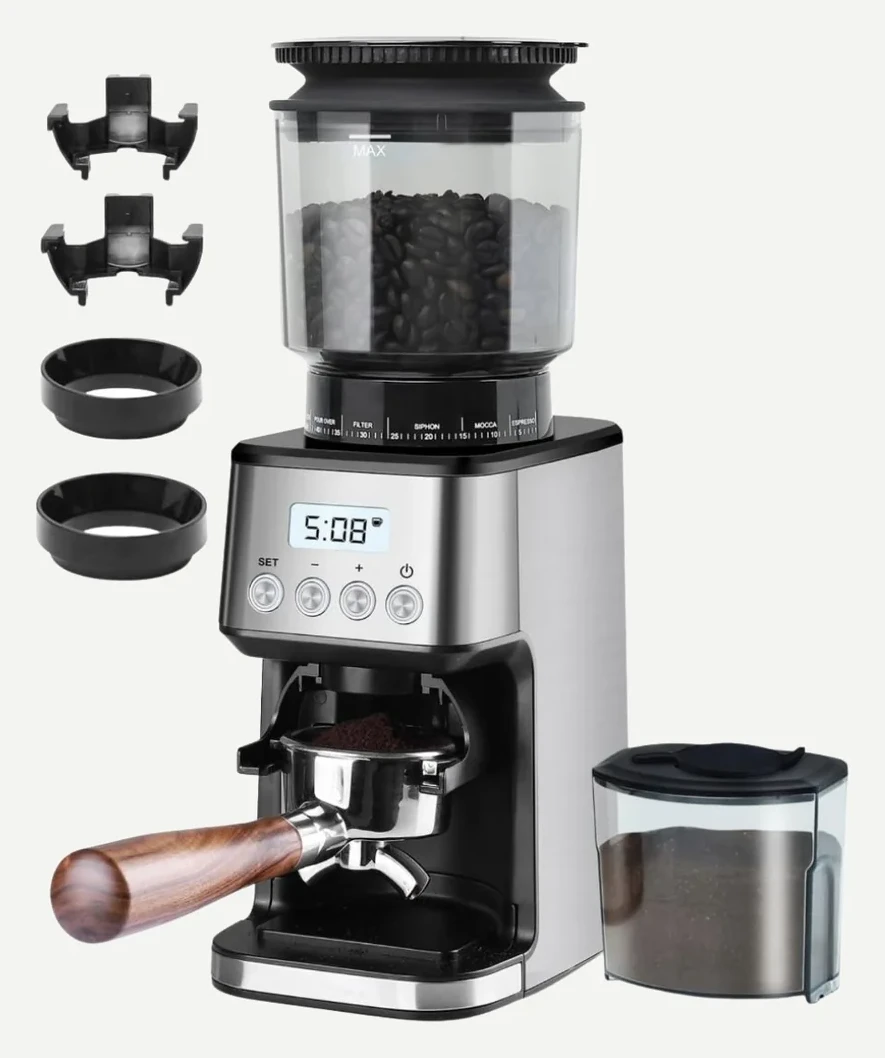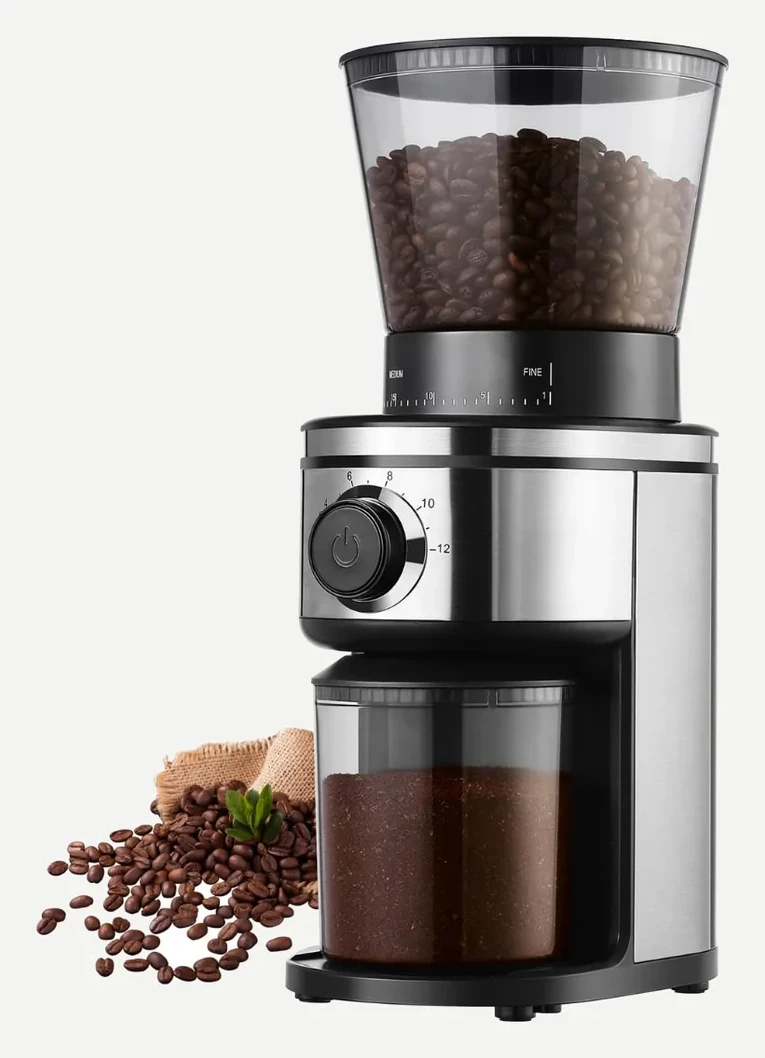
What is the Baratza Sette 30?
The Baratza Sette 30 is an electric conical burr grinder built specifically around espresso, sitting at the top of Baratza's entry-to-mid tier.
Baratza makes it in Taiwan and backs it with a one-year warranty. The grinder measures 130 x 250 x 410 mm, making it noticeably taller than most countertop rivals. It ships in black only, with a 300 g hopper, a grounds bin, and grind-range shims in the box.
The motor runs at 200 watts and spins the burrs at 650 rpm. Dosing is controlled by a 0.1-second resolution timer rather than a built-in scale. At $299.95 it sits $50 above the Virtuoso+ and targets buyers who need confirmed espresso capability.
Baratza Sette 30 grind consistency: how even is it?
The 40 mm conical S1 steel burrs produce consistent espresso grinds, with the geometry doing most of the work at this price point.
Conical burr geometry at 40 mm is a proven format for espresso consistency. The S1 steel designation refers to the burr alloy Baratza uses across several models. At 650 rpm the burrs move faster than many conical competitors, which affects heat generation over long sessions.
The included shims allow you to shift the grind range, which suggests the factory calibration is designed around a specific espresso window. Buyers who want to push finer or coarser than the default setting can adjust, but the shim system is less intuitive than a macro-micro ring.
- 40 mm conical S1 steel burrs are the core of the grind quality case, and the geometry is well suited to fine, even espresso output.
- A 650 rpm burr speed is on the higher end for a conical grinder, which can introduce heat during longer grinding sessions.
- Grind-range shims ship in the box, giving buyers a physical way to shift calibration, though the process requires disassembly.
- Consistency rests on the burr geometry and the format, and a conical set clears the bed faster than it grinds it finer.
What you can brew with it
The Sette 30 is confirmed for espresso and covers the fine end of the grind spectrum, but its range does not extend comfortably to filter brewing.
Espresso capability is a published specification, and the shims let you tune the grind range within that window. The 40 mm conical burr set handles the fine, consistent output that espresso extraction demands, making it a workable daily driver for a home espresso setup.
The adjustment system is calibrated for espresso rather than for the full spectrum from Turkish to coarse filter. Buyers who also brew French press or pour-over regularly will find the coarse end of the range constrained, and a second grinder becomes a practical consideration.
- Espresso is the confirmed use case, and the shim system lets you fine-tune the range within that window.
- Filter brewing methods such as pour-over and French press are not well served by a grinder calibrated for espresso fineness.
- The 300 g hopper suits single-origin espresso work where you swap beans frequently, rather than high-volume bulk grinding.
- A timer-based dosing system is practical for espresso shots but does not replace weight-based dosing for methods where grind output varies.
Living with it, day to day
Daily upkeep on the Sette 30 is manageable but requires consistent attention, particularly because fine espresso grinds accumulate in the burr chamber.
The vertical burr arrangement that makes the Sette 30 fast also means grounds travel a longer path before reaching the bin. Fine espresso grind settles in that path and needs regular brushing out. The included grounds bin collects the output cleanly, which reduces counter mess.
The 300 g hopper shuts off for bean changes, which is a practical feature if you run multiple coffees. Shim-based calibration adjustments require removing the hopper and partially disassembling the top of the grinder, so they are not a daily task.
- Brush out the burr chamber and the grounds chute regularly, as fine espresso particles accumulate and affect dose consistency.
- The shut-off hopper lets you swap beans without emptying the entire hopper, which reduces waste on daily coffee changes.
- Shim-based range adjustment requires partial disassembly and is a one-time setup task rather than a routine cleaning step.
- The timer should be checked against an external scale periodically, since dose consistency depends on motor and bean density stability.
Baratza Sette 30 vs Baratza Virtuoso+
The Sette 30 and the Virtuoso+ share the same burr size and timer system, but diverge on motor power, footprint, and espresso focus.
Both grinders carry 40 mm conical steel burrs, a 300 g hopper, and a 0.1-second timer. The Virtuoso+ runs a 70-watt motor at 550 rpm. The Sette 30 runs a 200-watt motor at 650 rpm, which makes it faster and positions it as the espresso-specific option between the two.
The Virtuoso+ measures 130 x 150 x 340 mm against the Sette 30's 130 x 250 x 410 mm, so it takes less counter space. The Virtuoso+ costs $249.95 against $299.95 for the Sette 30, and that $50 gap is the primary decision point for buyers whose use case either grinder can serve.
- The Sette 30 wins on motor power and burr speed, which means shorter grind times for espresso doses.
- The Virtuoso+ wins on footprint and price, fitting smaller kitchens and tighter budgets without giving up the same burr format.
- The Sette 30 ships with grind-range shims and confirms espresso capability, which the Virtuoso+ specification does not explicitly state.
- Both carry a one-year warranty and Taiwan manufacture, so neither separates on build backing or origin.
Is the Baratza Sette 30 worth it?
The Sette 30 is worth the price if espresso is your only brew method and you value grinding speed, but the gap over the Virtuoso+ is narrow.
At $299.95, the Sette 30 asks you to pay $50 more than the Virtuoso+ for a faster motor, confirmed espresso tuning, and a taller body. The burr size and timer resolution are identical. If your brewing is exclusively espresso and grind speed matters on a busy morning, that premium has a clear rationale.
If you brew espresso occasionally, or mix it with filter methods, the case weakens. The Virtuoso+ serves a wider range at a lower price. The Sette 30 earns its cost only when espresso is the daily priority and the faster motor and included shims represent genuine, regular utility rather than theoretical flexibility.
Who should buy it (and who should not)
The Sette 30 suits dedicated espresso drinkers who want a fast grind and confirmed fine-grind tuning, but it is not for filter brewers.
The faster motor and espresso-calibrated burr range make it a practical choice for anyone pulling shots daily and wanting consistent, repeatable output without a long wait. The grounds bin and shut-off hopper make the morning routine cleaner than portafilter-only designs.
Anyone who also brews pour-over, French press, or other filter methods should look elsewhere. The adjustment range does not reach comfortably into filter territory, and at $299.95 a single-method grinder is a harder case to make against more versatile options.
Buy it if
- You pull espresso every day and want a fast, repeatable grind without switching between methods.
- Counter space is available for a tall grinder and a dedicated espresso setup is already in place.
- Speed matters in the morning and you are willing to pay a small premium over the Virtuoso+ for a faster motor.
Skip it if
- You brew filter coffee regularly alongside espresso and need a grinder that handles both comfortably.
- Counter space is limited, since the 410 mm height and 250 mm depth make it one of the larger options at this price.
- Budget is tight, because the Virtuoso+ offers the same burr format and timer system for $50 less.
Frequently Asked Questions
Is the Baratza Sette 30 good for espresso?
Yes. Espresso capability is a confirmed published specification, and the grinder ships with grind-range shims designed to let you tune the burr set within the espresso window. The 40 mm conical S1 steel burrs and the 0.1-second timer make it a practical daily driver for home espresso. It is calibrated for that use case rather than for filter brewing.
What size are the Sette 30 burrs?
The Sette 30 uses 40 mm conical burrs made from S1 steel. That is the same diameter as the Virtuoso+, Baratza's less expensive model. The 40 mm conical format is a common and capable size for espresso work, balancing grind consistency with a compact footprint inside the grinder body.
Baratza Sette 30 vs Virtuoso+ which should I buy?
If espresso is your only brew method and grind speed matters, the Sette 30 is the stronger choice. Its 200-watt motor spins burrs at 650 rpm against the Virtuoso+'s 70-watt, 550-rpm setup. If you also brew filter coffee or want a smaller footprint, the Virtuoso+ costs $50 less and uses the same 40 mm conical burr format.
How loud is the Sette 30?
It is a 200 watt motor at 650 rpm driving 40 mm conical burrs, which is a short burst rather than a long one. The 200-watt motor running at 650 rpm is faster than most conical grinders at this price, and higher burr speeds typically produce more noise. Buyers who are sensitive to grinder noise in a small space should factor that in, but a precise noise level cannot be confirmed from available specifications.
How do you clean the Sette 30?
The main cleaning task is brushing out the burr chamber and grounds chute, where fine espresso particles accumulate between the grinding surfaces and the bin. The shut-off hopper allows bean changes without a full empty. Shim-based calibration adjustments require partial disassembly of the top of the grinder and are not a regular cleaning step.
Does the Sette 30 have a built-in scale?
No. The Sette 30 doses by time rather than weight, using a 0.1-second resolution timer. That system is consistent enough for repeatable espresso doses under stable conditions, but it does not account for changes in bean density or grind fineness. Buyers who want weight-based dosing will need a separate scale alongside the grinder.