What is the ESPRO P5?
The ESPRO P5 is a single-walled borosilicate glass French press with a stainless steel frame, available in 18 oz and 32 oz capacities for $49.99.
ESPRO built its reputation on filtration. The P5 carries the brand's Dual Micro-Filter System inside a borosilicate glass carafe, with a stainless steel lid fitted with a silicone seal. The body also includes polypropylene components. It ships in one finish, Polished Stainless Steel.
At $49.99, it occupies the lower end of the ESPRO lineup. The two size options, 5-cup at 532 ml and 7-cup at 946 ml, cover solo brewing and small-group serving. It is manufactured in China.
ESPRO P5 brew quality and how well it filters
The P5 filters through a two-stage micro-filter system that is designed to reduce sediment, though no independent cup-clarity data supports or contradicts that claim.
Standard French presses use a single stainless mesh screen, which lets fine coffee particles pass through. ESPRO's Dual Micro-Filter System adds a second filtration stage. The intent is a cleaner, less gritty cup. The filter material is not broken out in detail beyond the system name.
The borosilicate glass carafe is thermally stable and will not impart flavour, which is the main brew-quality advantage glass has over plastic. Heat leaves quickly through single-walled glass, so brew time management matters here. Steep too long after pressing and the coffee continues to extract in the cup.
- The Dual Micro-Filter System is the central filtration claim, and it sits above a conventional single-screen design in stated intent.
- Borosilicate glass is flavour-neutral, which removes one variable from cup quality that cheaper plastic bodies can introduce.
- Single-walled construction means the carafe does not slow heat loss, so over-extraction from sitting in the press is a real risk.
- Two stacked micro-filters catch what one screen passes, which is the whole of the P5's case against a standard press.
What you can brew with it
The P5 brews standard drip-ground French press coffee in one method, across two sizes, and is not designed for any other brewing style.
The 18 oz size covers one to two generous cups and suits a solo morning routine. The 32 oz size works for two to three people brewing at the same time. Both use the same filter system, so cup character is consistent across sizes.
French press suits medium to coarse grind coffee. Fine grinds will clog the filter or pass through it, and the P5 is no different from any press in that respect. Cold brew is physically possible in any French press, but the single-walled glass means it would need to sit in a refrigerator rather than on a counter.
- The 32 oz capacity suits small groups; the 18 oz suits a solo brewer who does not want leftover coffee sitting in the carafe.
- Medium to coarse grinds are the correct range. Fine grinds risk bypassing the filter and producing a muddy cup.
- The P5 is not an espresso maker and cannot produce pressure-extracted coffee of any kind.
- Tea and other steeping brews work mechanically, but the micro-filter system is calibrated for coffee and may clog with fine leaf teas.
Living with it, day to day
Owning the P5 day to day means hand-washing the filter system and lid after every brew, with no shortcut to the dishwasher.
The maker's maintenance guidance specifies hand-washing the lid with mild detergent and rinsing with water. The press itself is not dishwasher safe. The Dual Micro-Filter System will need to be rinsed and dried after each use to prevent coffee oils from building up between the filter stages.
The borosilicate glass carafe is robust against thermal shock but fragile against impact. Heat retention is rated by the maker at 15 to 30 minutes, which means serving promptly after pressing. The silicone-sealed lid slows heat loss slightly compared with a loose-fitting lid, but the single-walled glass is the limiting factor.
- The lid requires hand-washing with mild detergent after every brew. A dishwasher cycle is not recommended for any part.
- Coffee oils accumulate in multi-stage filter systems. The dual filter should be rinsed thoroughly after each use to maintain flow rate and taste.
- Plan to pour within 15 to 30 minutes of brewing. After that, the coffee in the carafe will be significantly cooler.
- The glass carafe should be kept away from hard surfaces and sudden impacts. A cracked carafe is the most likely failure mode.
ESPRO P5 vs Mueller French Press
The P5 and the Mueller French Press sit close in price but differ sharply on insulation, cleaning convenience, and filtration approach.
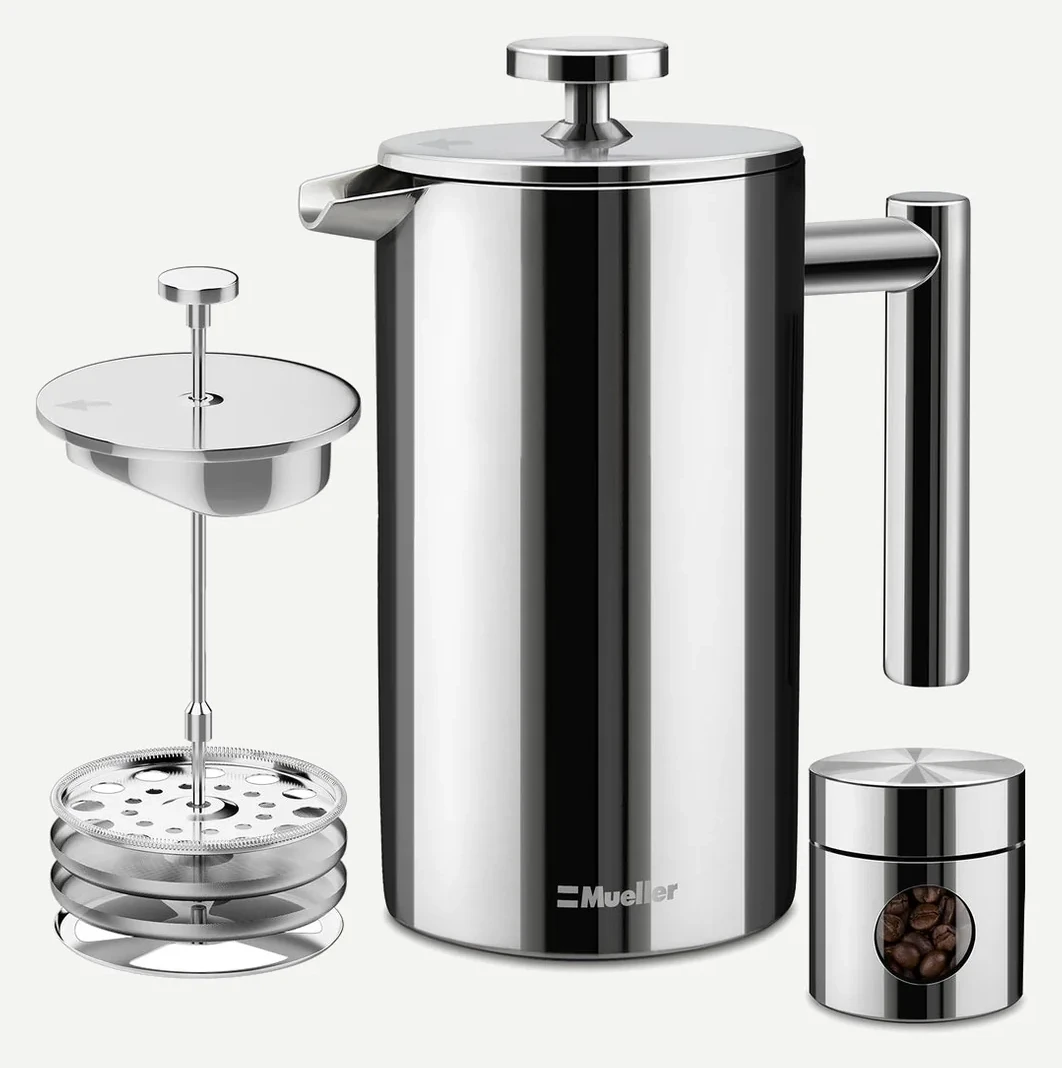
The Mueller costs $59.99 and holds 1000 ml, more than either P5 size. It is double-walled stainless steel and is dishwasher safe, including the plunger and filters. Its 4-level filtration system uses a coiled filter, two stainless screens, and a metal cross plate. The P5 costs ten dollars less and offers the Dual Micro-Filter System, but in a single-walled glass body that loses heat in under half an hour.
If cleaning time and heat retention matter most, the Mueller wins clearly. Its double-walled carafe keeps coffee hot substantially longer, and the dishwasher-safe construction removes the daily hand-washing burden. The P5's advantage is its glass carafe, which is flavour-neutral and visually transparent, letting the brewer watch the brew, and its lower price.
- Mueller keeps coffee hot far longer than the P5, thanks to double-walled stainless construction versus single-walled glass.
- Mueller goes in the dishwasher. The P5 requires hand-washing every time, which is a real daily difference.
- The P5 costs $10 less and uses a glass carafe that adds no flavour and lets you see the brew level.
- Mueller's 4-level filtration is more thoroughly described by stage and material. The P5's dual micro-filter is a simpler stated claim.
Is the ESPRO P5 worth it?
The P5 is worth $49.99 for buyers who want a glass carafe and a cleaner cup than a standard press, and who will pour and serve promptly.
The filtration claim is the reason to buy the P5 over a cheaper single-screen glass press. If sediment in the cup is your main complaint with French press coffee, the dual micro-filter addresses that directly. The price is fair for what the construction involves: a borosilicate carafe, stainless frame, and silicone-sealed lid.
Against the Mueller at $59.99, the P5 saves ten dollars but gives up insulation and dishwasher compatibility. For anyone who brews and drinks immediately, that trade is reasonable. For anyone who brews ahead or values low-maintenance cleaning, the Mueller is the stronger case despite the higher price.
Who should buy it (and who should not)
The P5 suits a patient hand-washer who drinks coffee immediately after brewing and wants less sediment than a standard press delivers.
The glass carafe and micro-filter system are the two things that distinguish it. Buyers who care about seeing through the carafe, or who have had consistent sediment problems with other presses, have concrete reasons to choose it.
Anyone who wants to brew a pot and return to it later, or who wants to load the press into a dishwasher at the end of the day, will find the P5 inconvenient. The Mueller is a more practical choice for those habits.
Buy it if
- You drink French press coffee immediately after brewing and sediment in the cup is your primary frustration.
- You prefer a glass carafe and do not mind hand-washing filter components every morning.
- You want two size options from one product line without paying more for insulation you do not need.
Skip it if
- You brew ahead and expect the coffee to stay hot in the carafe for more than 30 minutes.
- You rely on the dishwasher to handle morning cleanup and cannot add a hand-wash step to the routine.
- You want a stainless carafe that will survive a drop without breaking.
Frequently Asked Questions
Is the ESPRO P5 dishwasher safe?
No. The maker does not recommend putting any part of the P5 in the dishwasher. The lid should be hand-washed with mild detergent and rinsed with water. The filter system and carafe require hand-washing after every brew. If dishwasher compatibility matters to you, this press is not the right choice.
How long does the ESPRO P5 keep coffee hot?
The maker rates heat retention at 15 to 30 minutes. The single-walled borosilicate glass carafe loses heat relatively quickly, so the P5 is best suited to brewing and serving immediately. It is not designed to keep coffee hot over an extended period the way a double-walled stainless press would.
What sizes does the ESPRO P5 come in?
The P5 is available in two sizes. The smaller is 18 oz, described as a 5-cup press at 532 ml. The larger is 32 oz, described as a 7-cup press at 946 ml. Both use the same Dual Micro-Filter System and the same stainless steel and glass construction. Both sell for $49.99.
How does the ESPRO P5 filter work?
The P5 uses ESPRO's Dual Micro-Filter System, which adds a second filtration stage beyond the single-screen design common in standard French presses. The intent is to reduce the coffee sediment that typically passes through a conventional mesh plunger. The filter requires hand-washing and thorough rinsing after each use to maintain performance.
Is the ESPRO P5 good value compared with other French presses?
At $49.99, the P5 is priced below many insulated stainless steel presses. The Mueller French Press, for example, costs $59.99 but is double-walled, holds more coffee, and is dishwasher safe. The P5 is a reasonable value if the glass carafe and micro-filter system match your brewing habits. It is less practical if you need heat retention or easy cleaning.
What is the ESPRO P5 made of?
The carafe is single-walled borosilicate glass. The frame, handle, and lid are stainless steel, with a silicone seal on the lid. The press also includes polypropylene components. It is manufactured in China and comes in one finish, Polished Stainless Steel.