What is the Hario Mini Slim Plus?
The smallest sensible hand grinder, and the one that goes in a bag without arguing.
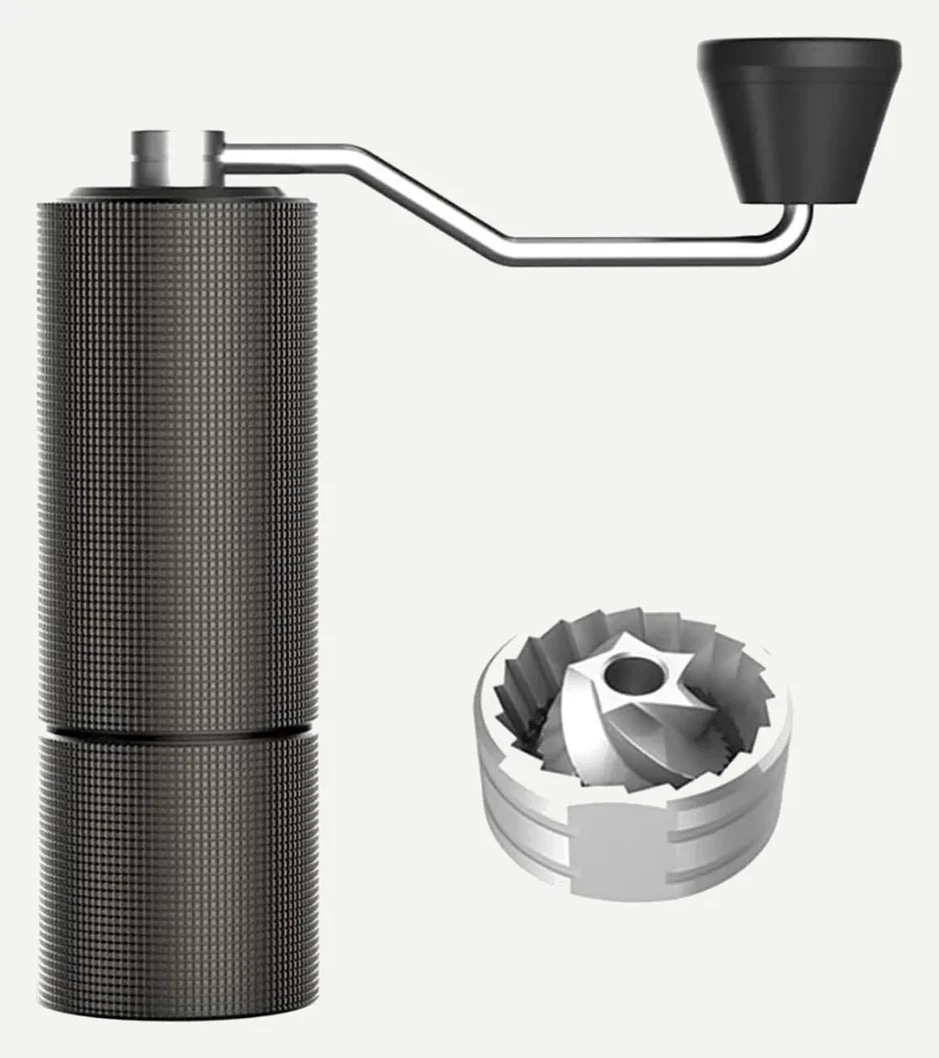
Hario publishes conical ceramic burrs, a stainless steel body, a detachable handle, a 24g bean capacity for single-dose grinding, dimensions of 72 by 150 by 220mm and a weight of 300g. It comes in a plain and a black finish.
At 300g it is half the weight of the TIMEMORE C2 and a fifth of most electric grinders.
Ceramic burrs, and where they win
Ceramic is not a cheaper substitute for steel; it is a different trade.
Ceramic is harder than steel and does not corrode, so it tolerates moisture and will not rust if put away damp, which for a grinder that lives in a rucksack is a real advantage. It also holds an edge for a long time under light use.
What it gives up is toughness. Ceramic is brittle, so a stone or a stray bean fragment that a steel burr would shrug off can chip it, and a chipped burr grinds unevenly for the rest of its life. It also cuts more slowly than hardened steel, which you feel in your arm.
The same burr material is in the Hario Skerton Pro, which is the larger sibling to this one.
24 grams, and what that rules out
One cup at a time, which is the point and also the limit.
24g is a single generous pour-over dose. Grinding for two people means two fills and two rounds of cranking, and grinding for four is not something you will do twice.
Read as a travel grinder, that is exactly right: the capacity matches what one person brews, and the detachable handle means the whole thing packs flat rather than snagging on everything in the bag. Read as a kitchen grinder, it is the wrong tool and the 12oz OXO Brew grinder or a larger hand grinder is what you want.
Hario Mini Slim Plus vs Hario Skerton Pro
Same burrs, same maker, different bodies and different jobs.
The Skerton Pro has a wider glass base that holds considerably more, and it sits on a counter properly rather than being held.
The Mini Slim Plus is the travelling one: slimmer, lighter, no glass to break, handle off. If the grinder never leaves the kitchen, the Skerton Pro is the better shape. If it goes in luggage, this.
Is the Hario Mini Slim Plus worth it?
Worth it as a travel grinder, and it is priced as one.
It is among the cheapest ways to grind fresh, from a maker whose brewing gear is a known quantity, in a body that survives being packed. For a second grinder that lives in a bag, that is the whole brief.
Hario publishes no burr diameter, no settings count, no country of manufacture and no warranty term for it, and ceramic burrs at this size will not match hardened steel for speed or for grind uniformity at the fine end.
Who should buy the Mini Slim Plus (and who should not)
Buy it as the grinder that travels, or as a first hand grinder for one drinker.
It suits hotel rooms, camping, an office drawer, and anybody who brews a single cup and wants it ground fresh. The stainless body and detachable handle are made for that use.
Do not buy it as your only grinder if you brew for more than one person, and do not buy it for espresso: ceramic burrs at this size are not the tool, and 24g of hand-cranked espresso grind is a workout with an uneven result.
Frequently Asked Questions
How much coffee does the Mini Slim Plus grind at once?
24g, which is a single generous pour-over dose. Two cups means two fills.
Are ceramic burrs good?
They are hard, corrosion-proof and long-lasting under light use, which suits travel. They are also brittle and cut more slowly than hardened steel.
Does the handle come off?
Yes, which is what makes it pack flat. It is the main practical difference from the larger Skerton Pro.
How heavy is it?
300g, about half the weight of a TIMEMORE Chestnut C2 and light enough to carry without thinking about it.