What is the TIMEMORE Chestnut C2?
The hand grinder that made good hand grinding cheap.
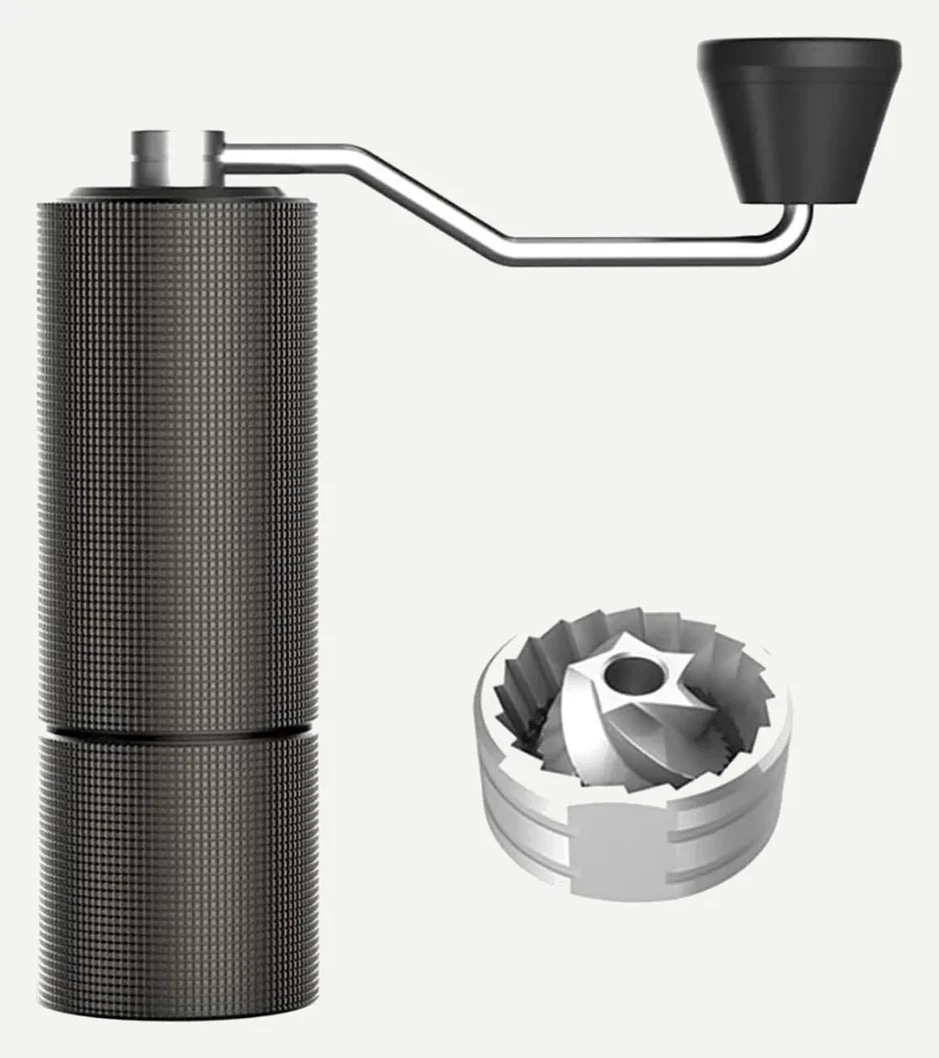
TIMEMORE publishes 420 stainless steel burrs cut on a five-axis CNC machine and hardened to 55-58 HRC, double bearing centre-axis positioning, an internal adjustment knob turning clockwise for finer, a 25g capacity, a metal body in aluminium and stainless steel, and a weight of 590g.
Why the bearings are the specification that matters
A hand grinder's enemy is wobble, not sharpness.
In a burr grinder the two burrs must stay precisely concentric while one turns inside the other. If the central shaft can move sideways even slightly, the gap between the burrs changes as it rotates, and a gap that varies produces particles of varying size from the same setting. That is the reason cheap hand grinders make uneven coffee even when their burrs are perfectly good.
Double bearings hold that shaft steady from two points instead of one. It is the single change that separated grinders like this from the generation before, and it is why a C2 outperforms hand grinders that cost the same and list better-sounding burrs.
Burrs, hardness, and what 55 HRC means
Hardness decides how long the grind stays as good as it was on day one.
Coffee is abrasive, and burrs dull. A softer burr rounds off at the cutting edges and starts crushing rather than slicing, which produces more fines and a muddier cup, gradually enough that most people never notice it happening.
420 stainless at 55-58 HRC is a proper tool hardness. Against ceramic burrs like those in the Hario Skerton Pro, steel cuts faster and stays sharper under load; ceramic resists corrosion better and does not mind moisture. Steel is the right choice for a grinder that will be used daily.
TIMEMORE Chestnut C2 vs Comandante C40
The value benchmark against the reference, at roughly six times the price.
The Comandante C40 MK4 is the hand grinder specialty coffee measures others against, with its own burr alloy and a stepless adjustment that lands anywhere.
The C2 gives you most of the mechanical fundamentals, double bearings and hardened CNC steel, for a fraction of that. What it does not give you is stepless adjustment or the Comandante's build. For somebody grinding filter coffee at home, the gap in the cup is far smaller than the gap in price.
Is the TIMEMORE Chestnut C2 worth it?
Yes. It is the best-value grinder on this site and it is not close.
Hardened CNC steel burrs and double bearings for hand-grinder money is the purchase that most improves a home setup. Somebody brewing with a cheap electric grinder and good beans will get more from swapping to this than from any brewer upgrade.
What is not published is a burr diameter, a settings count, whether the adjustment is stepped or stepless, or a warranty term. TIMEMORE tells you about the metallurgy and stays quiet on the rest.
Who should buy the C2 (and who should not)
Buy it if you brew one or two cups of filter coffee a day.
It suits pour over, moka pot and French press, which are the three uses the maker names, plus travel and camping given the 590g metal body. 25g is a large dose or two normal ones.
Do not buy it for espresso; TIMEMORE does not claim espresso for this model and hand-grinding espresso fine is hard work. And do not buy it if you grind for four people every morning, where turning a handle stops being charming.
Frequently Asked Questions
Is the TIMEMORE C2 good for espresso?
TIMEMORE does not claim espresso for it, listing pour over, moka pot and French press instead, so we record no espresso capability.
What does double bearing positioning do?
It holds the central shaft steady from two points so the burrs stay concentric as they turn. A shaft that wobbles changes the burr gap mid-rotation and produces uneven grounds.
How much coffee does the C2 hold?
25g, which is one large dose or two ordinary ones.
Are steel burrs better than ceramic?
For daily use, generally yes: steel cuts faster and holds an edge under load. Ceramic resists corrosion better and tolerates moisture, which suits occasional and travel use.