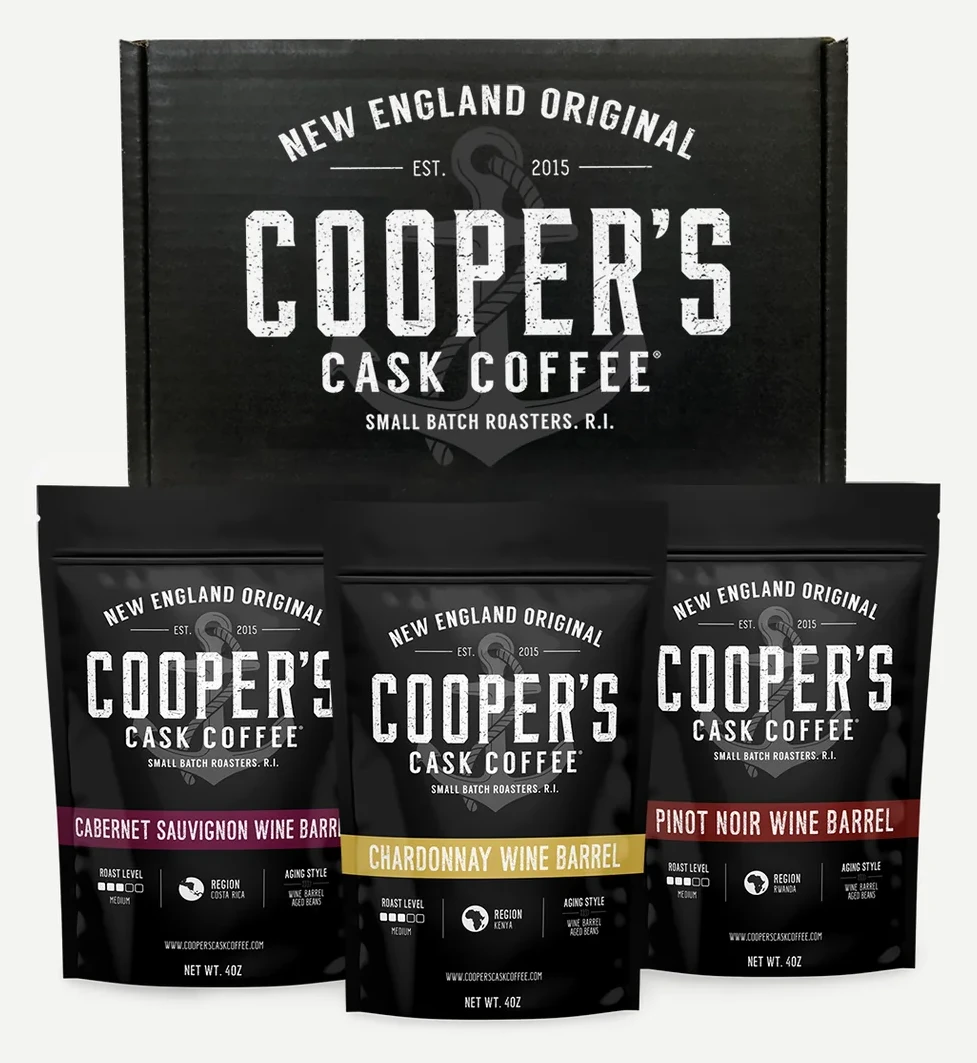
What is Cooper's Cask Pinot Noir Barrel Aged?
The Cooper's Cask Pinot Noir Barrel Aged is a medium-roast, single-origin Rwandan coffee finished in Pinot Noir wine barrels before packaging.
Cooper's Cask built its range around the idea of resting coffee in casks previously used for spirits and wine. This expression uses beans from Rwanda and ages them in Pinot Noir barrels, which the roaster credits for the fruit-forward character in the finished cup.
It is sold year-round rather than as a limited harvest release, and it comes in whole bean or pre-ground form across three bag sizes. The 12 oz bag enters at $29.95, and a subscription option is available for repeat buyers who want a lower effective cost.
Cooper's Cask Pinot Noir Barrel Aged Taste: What It Actually Tastes Like
The Pinot Noir Barrel Aged carries the roaster's own tasting notes of dried figs, caramelized sugar, and creme brulee crust across a medium roast base.
Those three notes, dried figs, caramelized sugar, and creme brulee crust, are Cooper's Cask's own words for this coffee. They point toward a cup that is sweet-leaning and fruit-tinged rather than bitter or heavily roasted, which is consistent with a medium roast profile and a wine barrel finish.
Rwandan coffees from this roast level often carry a clean, bright sweetness, and the Pinot Noir barrel layering is what adds the jammy fig quality the roaster describes. Whether the barrel character reads as subtle or prominent will depend on brew method, with immersion methods like French press tending to amplify it.
- The roaster names dried figs as the primary note, suggesting a soft, jammy fruit quality rather than sharp or citric acidity.
- Caramelized sugar points to a rounded sweetness in the body, consistent with a medium roast that stops short of bitterness.
- Creme brulee crust implies a slightly toasted, creamy finish that sits between dessert-sweet and roasty.
- These are the roaster's own descriptors for their own product, drawn from the barrel-aging process and Rwandan base origin together.
How fresh is it when it arrives?
Cooper's Cask prints no roast date on the bag, so buyers receive the coffee without knowing when it was roasted.
For a specialty coffee at this price point, the absence of a roast date means buyers must rely on inventory turnover rather than printed information to judge freshness. Ordering through the subscription route may improve consistency, since turnover on subscribed SKUs tends to be higher than on one-off purchases.
The bags come in three sizes, which at least lets buyers choose a quantity they will use within a reasonable window. The 12 oz option suits buyers who want to refresh stock frequently, while the 5 lb size makes more sense for households or small offices with regular consumption.
- Cooper's Cask prints no roast date on the bag, so age at delivery is unknown to the buyer.
- A subscription is available, which can reduce time between roast and delivery compared to ad-hoc ordering.
- The 12 oz bag allows frequent small purchases for buyers who prioritise freshness over cost per kilo.
- The 5 lb size at $139.95 lowers the per-kilo cost but requires confident, regular consumption to avoid staling.
Where the coffee comes from
This coffee comes from Rwanda, sold as a single-origin bean rested in Pinot Noir barrels before it reaches the bag.
Single-origin Rwanda tells buyers the beans come from one country rather than a blend of sources, which gives the cup a traceable regional character. Rwandan coffees are known for clean sweetness and fruit clarity, traits that suit a wine barrel finishing process.
The farm or cooperative is not named in what Cooper's Cask publishes for this coffee. Traceability reaches the country level, which is a step above a generic blend but a step short of the lot-level detail some specialty buyers expect at this price.
- Single-origin Rwanda means all beans in the bag share the same country of origin, not a multi-country blend.
- The Pinot Noir barrel process is the stated processing method, applied after the base Rwandan beans are sourced.
- Country-level sourcing gives buyers a real sense of regional cup character without farm or cooperative specifics.
- The coffee is sold year-round, meaning the Rwandan base is not tied to a single seasonal harvest lot.
Cooper's Cask Pinot Noir Barrel Aged vs Cooper's Cask Bourbon Barrel Aged
The Pinot Noir and the Bourbon Barrel Aged share the same price per kilo at the 5 lb size but differ in origin, roast level, and cup profile.
The Bourbon Barrel Aged uses Colombian beans at a medium-dark roast and carries notes of rustic sweetness, cocoa, dark fruit, and a bourbon finish. The Pinot Noir version uses Rwandan beans at a medium roast, with dried figs, caramelized sugar, and creme brulee crust. The Bourbon expression is heavier and roastier, the Pinot Noir lighter and fruit-forward.
Both share the same three bag sizes, the same lack of a printed roast date, and the same subscription option. Neither names its farm or cooperative. The practical choice comes down to roast preference: buyers who want a darker, more chocolatey cup should lean toward the Bourbon, while those who prefer lighter, sweeter, wine-influenced profiles will find the Pinot Noir a better fit.
- The Pinot Noir is a medium roast; the Bourbon Barrel Aged is medium-dark, which means more body and less brightness in the Bourbon cup.
- Rwanda vs Colombia: the Pinot Noir's origin brings cleaner fruit character, while the Bourbon's Colombian base tends toward chocolate and nuts.
- Both sit at $61.71 per kilo at the 5 lb size, so price does not separate them for high-volume buyers.
- Neither prints a roast date, so freshness transparency is equally limited across both expressions.
Cooper's Cask Pinot Noir Barrel Aged price per kilo: how it compares
At $88.04 per kilo for the 12 oz bag and $61.71 per kilo at 5 lb, this sits at the upper end of the specialty coffee market.
The price spread across bag sizes is significant. Buying the 12 oz entry bag costs over 40 percent more per kilo than the 5 lb option. For buyers who go through coffee quickly, the 2 lb bag at $71.59 per kilo is the most practical middle point between cost and freshness management.
Whether the per-kilo figure is fair depends largely on how much the barrel-aging process matters to the buyer. Rwandan single-origin coffee without that step typically sells for considerably less. The Pinot Noir treatment adds a layer of complexity that does not come cheaply, and buyers who are specifically after wine-barrel character in the cup are paying for something real rather than a label.
Who should buy it (and who should not)
This coffee suits adventurous specialty buyers who want wine-barrel influence in the cup, and it is a poor fit for anyone who needs roast-date transparency.
The Pinot Noir Barrel Aged is aimed at buyers who already enjoy specialty coffee and want something with a point of difference. The fruit-forward, dessert-leaning note profile suits those who brew with immersion or filter methods and prefer sweetness over roast intensity.
It is a harder sell for buyers who prioritise freshness information or who want to know exactly where their coffee was grown. The price also rules it out for anyone treating coffee as a daily utility rather than a considered purchase.
Buy it if
- You enjoy wine-influenced, fruit-forward cup profiles and are curious about barrel-aged processing.
- You buy in larger quantities and can take advantage of the lower per-kilo cost on the 2 lb or 5 lb bags.
- You want a year-round specialty coffee with a consistent, repeatable flavour profile.
Skip it if
- Roast-date transparency is important to you and you want to know exactly how fresh your bag is.
- You prefer darker, roastier cups with chocolate or heavy body rather than lighter, sweeter fruit notes.
- You are buying at the 12 oz size regularly, where the per-kilo cost is hardest to justify against the alternatives.
Frequently Asked Questions
Is the Cooper's Cask Pinot Noir Barrel Aged good for espresso?
Cooper's Cask sells it pre-ground to an espresso setting, so it is intended for espresso use. The medium roast and fruit-forward notes, dried figs and caramelized sugar, will produce a lighter-bodied shot with sweetness rather than the heavy, bitter profile some espresso drinkers prefer. Whole bean buyers can dial in the grind to their own machine and taste.
Cooper's Cask Pinot Noir Barrel Aged vs Cooper's Cask Bourbon Barrel Aged: which should I buy?
Choose the Pinot Noir if you want a lighter, fruit-forward cup built on Rwandan beans at a medium roast. Choose the Bourbon Barrel Aged if you prefer a darker, heavier cup with cocoa and dark fruit from Colombian beans at a medium-dark roast. Both cost the same per kilo at the 5 lb size, so the decision is purely about cup profile.
What does Pinot Noir barrel aging actually do to coffee?
Resting coffee in a barrel that previously held Pinot Noir wine allows the beans to absorb residual compounds from the wood and the wine. In the cup this tends to produce fruit and sweetness, which is consistent with the dried figs and caramelized sugar notes Cooper's Cask attributes to this coffee. The effect varies by roast level and brew method.
How many cups does the 2 lb bag make?
At a standard dose of 15 grams per cup, a 907 gram bag yields approximately 60 cups. That works out to around $1.07 per cup at the $64.95 bag price. Buyers who dose lighter will get more cups; heavier dosers fewer. The 5 lb bag extends that to roughly 151 cups at the same 15 gram dose.
Can you get this coffee on subscription?
Yes, Cooper's Cask offers a subscription option for this coffee. Subscribing typically improves the gap between roast and delivery compared with one-off orders, which matters here because the bag carries no printed roast date. A subscription also lets buyers lock in a regular cadence matched to their consumption rate across any of the three bag sizes.
What grind size should I use for French press with this barrel-aged coffee?
Cooper's Cask sells this pre-ground to a French press setting, so buyers who want that brew method can order it ready to use. Whole bean buyers should aim for a coarse grind, roughly the texture of coarse sea salt, and a four-minute steep. The immersion method tends to bring out the fruit and sweetness notes the roaster describes more fully than a quick pour-over.