What is Alessi La Cupola?
A moka pot shaped like a domed building, by an architect who meant it literally.
Alessi publishes aluminium construction with the handle and knob in thermoplastic resin, a 300ml capacity published as 10.1 fl oz, sizes of 1, 3 and 6 cups, hand washing, and Aldo Rossi as designer. Alessi states Rossi designed it in 1988 from a desire to create a coffee pot easily available to everyone. It stands 11.22 inches tall on a 3.94 inch base.
Tall and narrow is a brewing decision, not only a shape
The dome sits high above a small base, and that changes how it heats.
A moka pot's water chamber is the bottom. A narrow base concentrates the flame on a small area of metal, so it comes up to pressure faster than a broad squat pot. Faster is not automatically better here: moka rewards a gentle climb, and a pot that reaches pressure quickly is easier to overheat.
The practical consequence is a lower flame than you would use under a wide Moka Express, and taking it off the heat the moment it starts to gurgle. This applies to every moka pot and it applies more here.
The height also makes it top-heavy when full. On a gas trivet that is fine; on a small hob it is worth a thought.
Hand wash, and why that is the honest limitation
Alessi specifies hand washing, and for aluminium that is not fussiness.
Dishwasher detergent is strongly alkaline and it attacks aluminium, dulling the surface to a chalky grey and, over time, pitting it. That is why almost every aluminium moka pot carries the same instruction and why so many end up looking terrible.
It is also why aluminium pots should be rinsed rather than scrubbed with soap at all: the thin layer of coffee oil that builds up is part of how a moka pot ages well. If you want a pot you can put in the dishwasher, the answer is stainless, which is what the 9090 is.
La Cupola vs the 9090
Two Alessi icons, and the material decides everything practical.
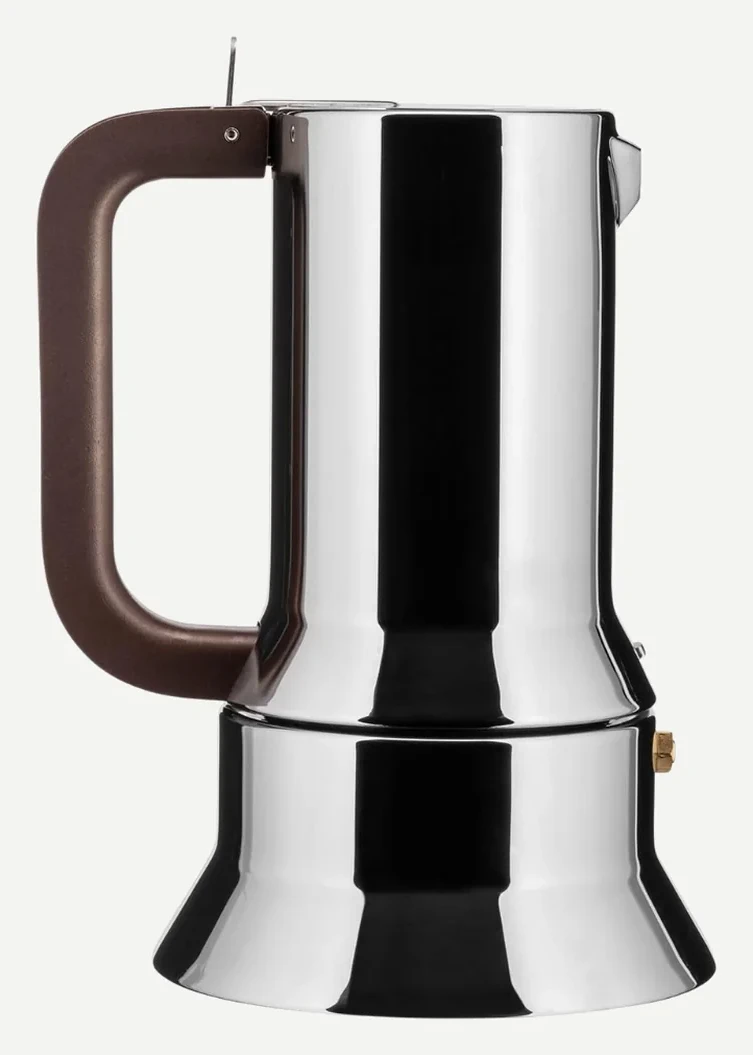
The 9090 is stainless steel, works on induction, and does not need hand washing. It costs more.
La Cupola is aluminium: lighter, cheaper, hand wash only, and almost certainly not induction, since Alessi claims none here. Rossi's brief was affordability and the pot still reflects it. Choose on your hob and your sink, not on the coffee, which is the same.
Is La Cupola worth it?
Worth it as a design piece at the lower end of Alessi money.
It is a famous object still made by the company that commissioned it, and it makes perfectly good moka coffee. Nobody should buy it believing the coffee is better than a supermarket pot's, because it is not.
Alessi publishes no induction compatibility, no gasket material, no warranty term and no weight on this listing. Hand wash is explicit. As with every moka pot the gasket is a wear part, so check that replacements are sold for it.
Who should buy it (and who should not)
Buy it if you want an Alessi and have a gas hob.
It suits somebody who likes the object, brews for one or two, and will wash it by hand as a matter of course.
Do not buy it for an induction hob without confirming. Do not buy it for a dishwasher household. And if you want the engineering rather than the shape, the Pulcina is the Alessi that changes the coffee.
Frequently Asked Questions
Can La Cupola go in the dishwasher?
No. Alessi specifies hand wash, and dishwasher detergent corrodes aluminium.
Does it work on induction?
Alessi makes no induction claim on this listing, and aluminium is not magnetic.
Who designed it?
Aldo Rossi, in 1988.
How much does the 6 cup make?
300ml, about 10 fl oz, in six small cups.
What sizes are there?
1, 3 and 6 cups.