What is the Barista Express Impress?
The Barista Express with its most common beginner mistake engineered out.
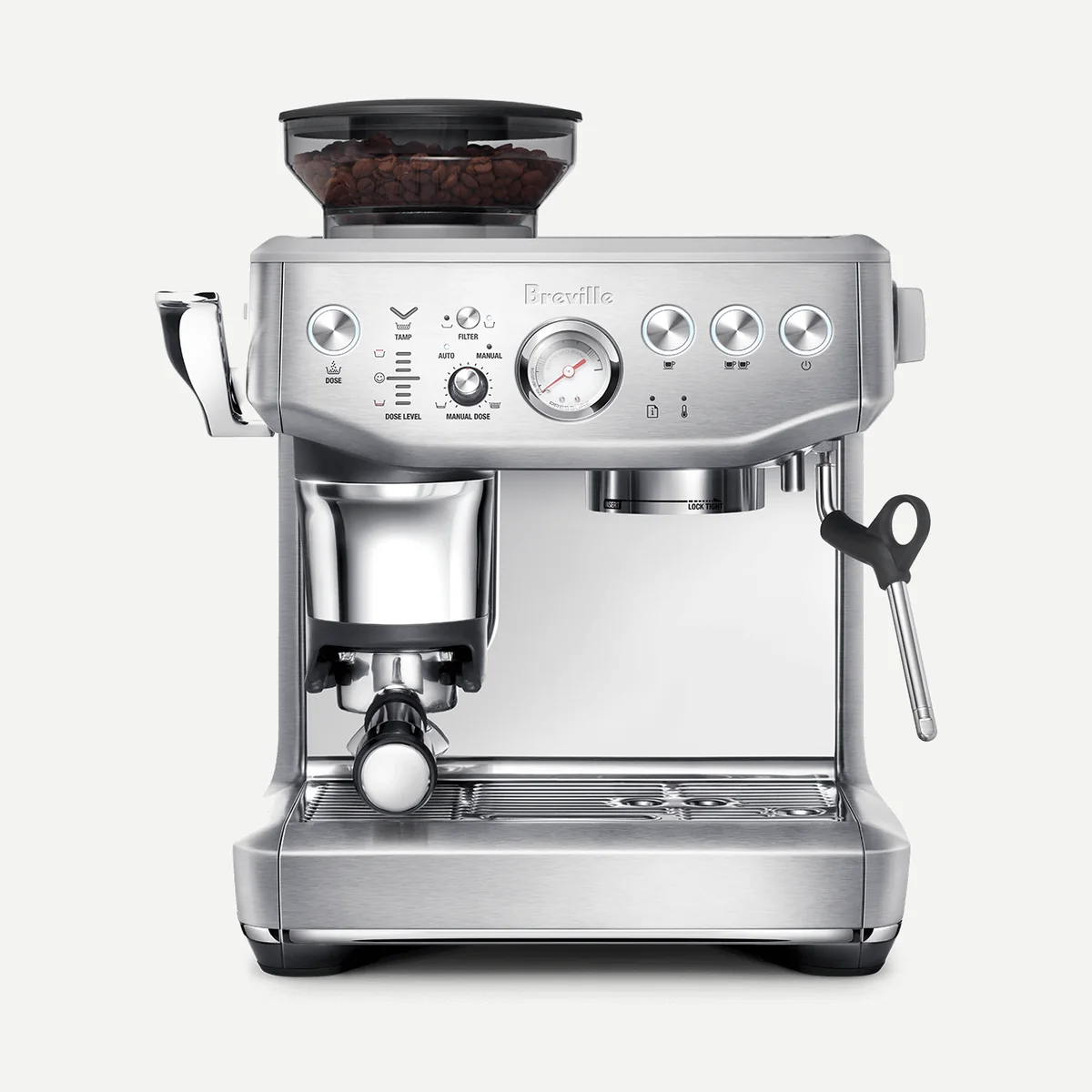
Breville publishes a 15 bar Italian pump extracting at 9 bar, a Thermocoil heater with PID temperature control, an integrated conical burr grinder with 25 settings, a 250 gram bean hopper, a 2 litre tank and a 54 mm stainless steel portafilter. There is an extraction pressure gauge on the front, low pressure pre-infusion before the 9 bar phase, and a manual steam wand that swivels 360 degrees. It measures 422 by 366 by 310 mm, draws 1750 watts and costs $799.95 on breville.com.
What makes it an Impress is the lever on the left of the group. Breville calls it the Impress Puck System, and it is the reason this machine exists.
The Impress Puck System, and why tamping matters
Most bad home espresso is a puck problem, not a machine problem.
Espresso is water pushed through a bed of coffee at high pressure. If the bed is uneven, the water finds the weak spot and rushes through it, which is called channelling, and the shot comes out sour and thin however good the beans are. Our guide to espresso channelling goes through what it looks like in the cup.
The two things that decide whether the bed is even are how much coffee goes in and how hard it is pressed. On an ordinary machine both are up to you. On the Impress, you pull a lever and Breville's manual says it applies 22 lb, about 10 kg, of tamp pressure every time. The machine then reads how far the tamp travelled and adjusts the next dose to match. Too little coffee and it adds more next time, too much and it takes some away.
That does not make the shot good by itself. Grind size still decides almost everything, and a dose that is repeatable at the wrong grind is repeatably wrong. What it does is remove two variables at once, so when you change the grind, the grind is the only thing that changed. For someone learning espresso, that is worth more than any extra feature.
The grinder
Twenty-five settings on a conical burr, built into the machine.
Breville fits a conical burr grinder with 25 settings that doses straight into the portafilter. A built-in grinder is the main reason machines in this family sell so well, because the alternative is a separate espresso grinder that can cost as much as a basic machine.
The trade is flexibility. A built-in grinder cannot be upgraded without replacing the whole machine, and it is set up for espresso rather than for filter. If you think you will want to go further with espresso later, a machine without a grinder and a good standalone grinder is the longer road. If you want good espresso at home this year without two boxes on the counter, this is the shorter one. Our grind size guide covers where espresso sits against every other method.
Heating, and the 55 seconds
Thermocoil, not ThermoJet, and that shows at switch-on.
The Impress uses Breville's older Thermocoil system, with PID control holding the brew temperature once it is there. Breville's manual says the power light flashes for up to 55 seconds while the machine heats. The ThermoJet machines further up the range, the Barista Pro and the Barista Touch Impress, publish 3 seconds.
Fifty-five seconds is not long, and at switch-on it is hardly a burden. It matters more between the shot and the milk: on a single heater the machine has to change temperature to steam, which is slower than on a ThermoJet and much slower than on a machine with two boilers.
Barista Express Impress vs the Barista Express
About $100 apart, and the difference is one lever.
The Barista Express BES870XL is the machine this one grew from, and it is listed on this site at $692.99. Both have a built-in conical burr grinder, a 54 mm portafilter, PID temperature control, pre-infusion and a manual steam wand. The Impress adds the assisted tamp and the self-correcting dose.
If you have made espresso before and tamp consistently, the Barista Express does the same job for less. If you are starting from nothing, or if a partner who has never made espresso will also use the machine, the Impress is the one that gives the same shot to both of you.
Barista Express Impress vs the Barista Pro
Faster heating against easier tamping.
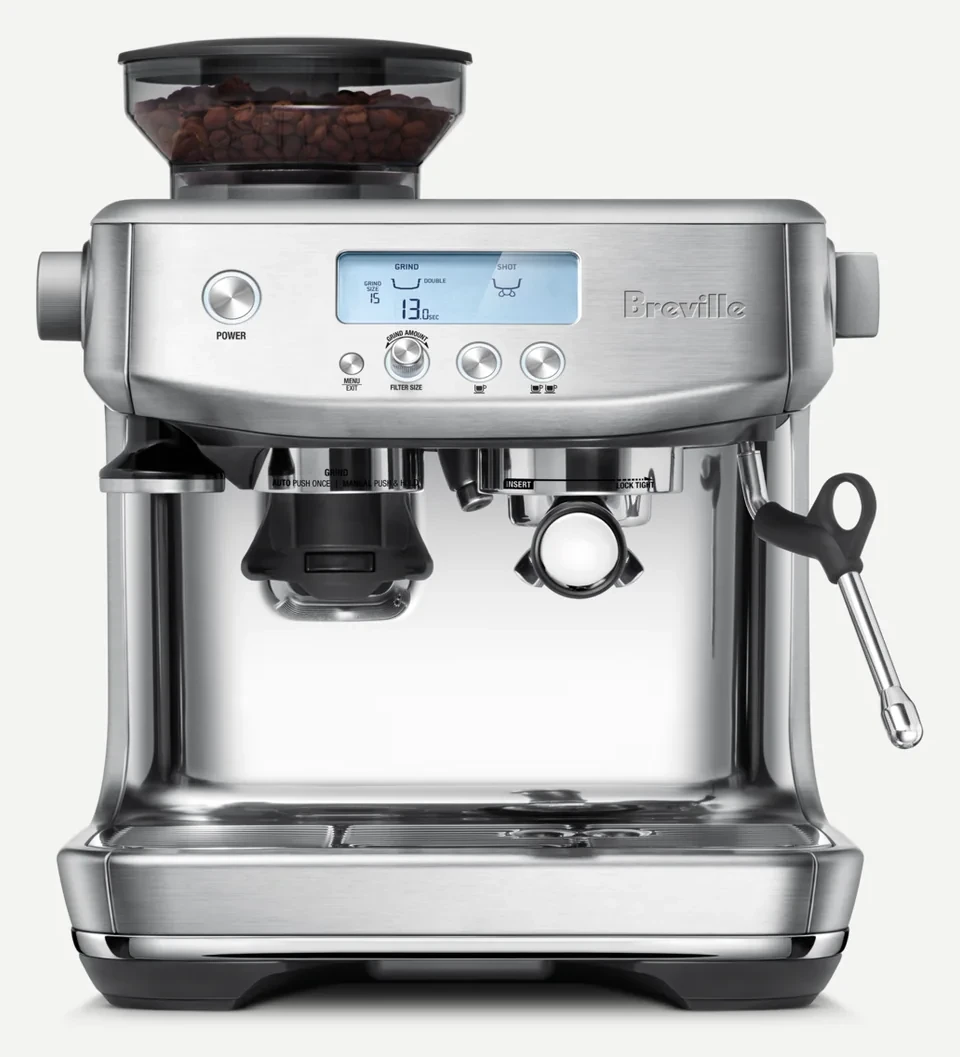
The Barista Pro is listed at $849.95 and trades the Impress lever for a ThermoJet heater, 30 grind settings and an LCD shot clock. It heats in 3 seconds and switches to steam faster. It does not tamp for you.
The choice is about which step you want the machine to take on. The Pro makes a practised user quicker. The Impress makes a beginner more consistent. For a first espresso machine, consistency is usually the better buy, because a fast machine making an uneven puck quickly is still making an uneven puck.
Milk
A manual wand, and nothing automatic about it.
The steam wand swivels through 360 degrees and textures milk by hand, as on a café machine. It will make proper microfoam once you learn how, and a 480 ml stainless jug comes in the box. If you want the machine to texture the milk for you, that is the Barista Touch Impress, at $700 more.
Is the Barista Express Impress worth it?
Worth it for a first machine, less so for a practised hand.
At $799.95 it sits in the busiest part of the espresso market, and what it offers there that the others do not is repeatability you do not have to learn. That is a real advantage in the first six months, which is when most people either get hooked on home espresso or give up on it.
What it does not offer is a published warranty or weight, a faster heater or a 58 mm basket. Breville publishes neither of the first two on the product page or in the manual, and retailers' figures are not the maker's. If those matter to you, check the warranty with the retailer before you buy.
Who should buy it (and who should not)
Buy it if
- This is your first espresso machine and you want the shot to be repeatable from day one.
- More than one person in the house will make coffee.
- You want a grinder built in rather than a second box on the counter.
Skip it if
- You already tamp well; the Barista Express does the same for less.
- You want milk textured automatically.
- You plan to buy 58 mm accessories or upgrade the grinder later.
Frequently Asked Questions
What does the Impress Puck System do?
A lever tamps the coffee at a set pressure, which Breville's manual gives as 22 lb, and the machine adjusts the next dose from how far the tamp travelled.
How many grind settings does the Barista Express Impress have?
Twenty-five, on an integrated conical burr grinder.
How long does it take to heat up?
Breville's manual says up to 55 seconds, shown by the flashing power light.
What size is the portafilter?
54 mm, in stainless steel, with single and dual wall baskets.
Does it froth milk automatically?
No. It has a manual steam wand. The Barista Touch Impress is the version that textures milk for you.