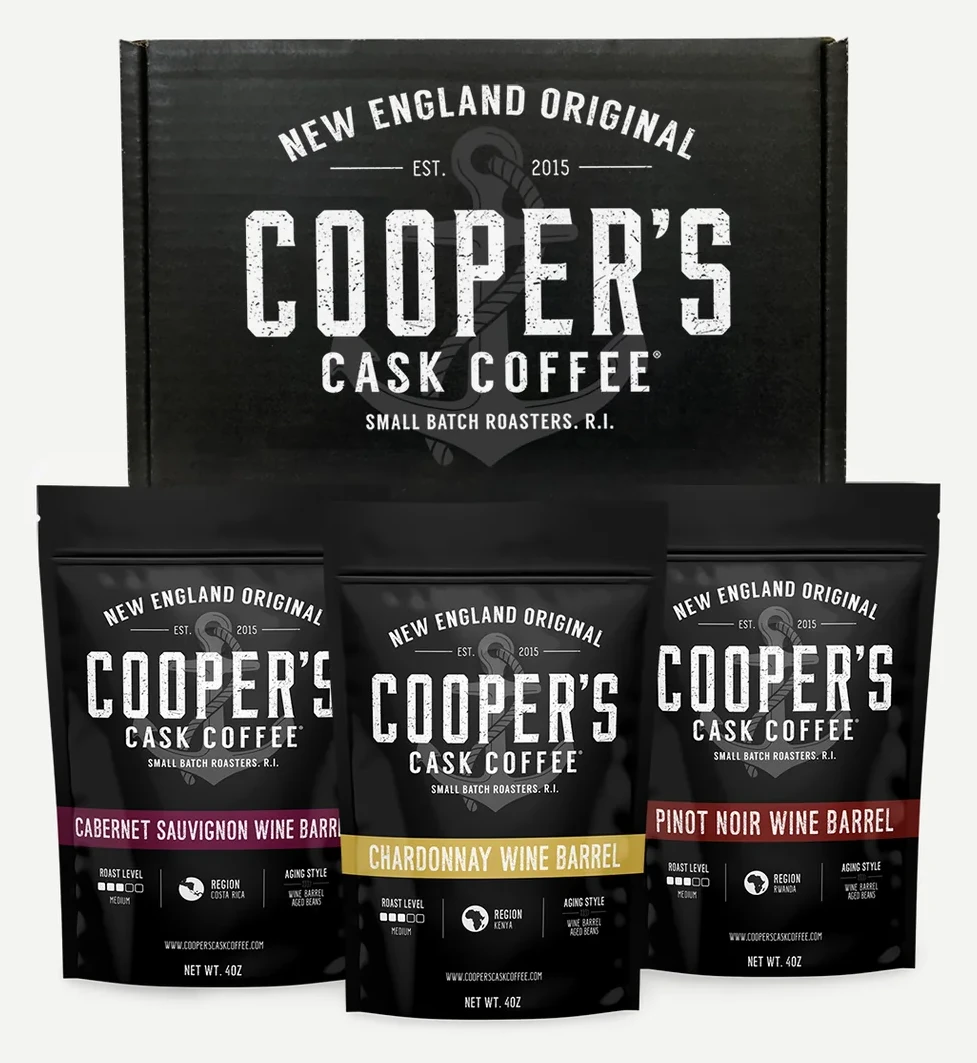
What is Cooper's Cask Cabernet Barrel Aged?
Cooper's Cask Cabernet Barrel Aged is a medium-roast Costa Rica single origin finished in Cabernet Sauvignon wine barrels, sold year-round in ground and whole bean formats.
The coffee starts as a honey-processed Costa Rica bean, meaning the fruit mucilage is left on during drying, which typically adds sweetness and body before roasting even begins. After roasting, the beans are aged in Cabernet Sauvignon barrels, layering wine-derived character on top of the base origin.
It is available in 12 oz, 2 lb and 5 lb bags, either whole bean or pre-ground to five settings: espresso, filter, French press, cold brew and whole bean. A subscription is offered. The entry price is $29.95, with per-kilo cost dropping considerably at larger sizes.
Cooper's Cask Cabernet Barrel Aged Taste: What It Actually Tastes Like
Cooper's Cask describes this as sweet with dark fruit and chocolate, a profile shaped by both the honey process and the Cabernet barrel aging.
The roaster's own notes point to sweetness, dark fruit and chocolate. At a medium roast, those descriptors suggest the origin character of the Costa Rica bean is preserved rather than roasted through, with the wine barrel providing fruit depth rather than sharp wine acidity.
Honey processing contributes natural sweetness and a fuller body compared to washed coffees from the same region. The Cabernet barrel aging is the distinguishing step, and the roaster positions the two together as the source of the dark fruit note in the cup.
- The roaster names sweet, dark fruit and chocolate as the three cup descriptors for this coffee, in their own words.
- A medium roast level keeps origin character present, which is a reasonable pairing with a honey-processed bean.
- The honey process adds sweetness and body at the green stage, before barrel aging or roasting contributes further character.
- Cabernet Sauvignon barrel aging is the step that distinguishes this from Cooper's Cask's other single-origin offerings.
How fresh is it when it arrives?
The bag carries no roast date, so buyers receive a barrel-aged specialty coffee with no way to confirm how recently it was roasted.
Cooper's Cask offers a subscription, which supports more frequent, smaller deliveries and reduces the time a bag sits before opening. The 12 oz bag size is well suited to this approach, as a smaller bag is typically consumed before staleness becomes a problem.
Three bag sizes are offered, and the choice matters for freshness as much as for price. A 5 lb bag bought without a subscription carries a real risk of the final portion being weeks old before it is brewed, with no printed date to track that.
- A subscription route is available, which helps buyers manage bag frequency and keep coffee fresher between orders.
- The 12 oz size is the most practical choice for freshness, as it is consumed more quickly than the 2 lb or 5 lb options.
- Buying the 5 lb bag without a subscription increases the risk that later portions will be stale by the time they are brewed.
Where the coffee comes from
The coffee comes from Costa Rica and is processed using the honey method before barrel aging, with traceability stopping at the country level.
Costa Rica has a well-established reputation for clean, sweet coffees, and the honey process is a deliberate choice that retains fruit character through drying. Naming the origin country and the processing method gives buyers a meaningful picture of what shaped the bean before it reached the roaster.
The farm or cooperative is not named in what Cooper's Cask publishes for this coffee. Country-level sourcing is a reasonable starting point for a barrel-aged product where the roasting and aging process is itself the core proposition, but buyers seeking farm-level traceability will not find it here.
- Costa Rica is named as the single origin, which is a specific and verifiable sourcing commitment at the country level.
- The honey processing method is confirmed, explaining the sweetness and body in the roaster's own tasting notes.
- Cabernet Sauvignon barrel aging is listed as part of the processing chain, making it a stated rather than implied step.
Cooper's Cask Cabernet Barrel Aged vs Cooper's Cask Bourbon Barrel Aged
The Cabernet version uses Costa Rica beans at a medium roast; the Bourbon version uses Colombia at a medium-dark roast, and both cost the same per kilo at the 5 lb size.
The Bourbon Barrel Aged is roasted darker and built on a Colombian base, which the roaster describes as rustic sweetness, cocoa, dark fruit and a bourbon finish. That profile skews heavier and more bitter-adjacent than the Cabernet version, whose Costa Rica origin and medium roast keep the cup lighter and fruit-forward.
Both are priced identically at the 5 lb level, at $61.71 per kilo, and neither prints a roast date. The choice between them comes down to origin preference and roast weight rather than price or freshness transparency, since those factors are equal.
- The Cabernet version: medium roast and Costa Rica origin suit buyers who prefer brightness and lighter-bodied fruit character.
- The Bourbon version: medium-dark roast and Colombian base suit buyers who want more body and a cocoa-forward, heavier cup.
- Both options: identical per-kilo pricing at the 5 lb size, identical bag sizes and identical freshness transparency, so neither wins on those grounds.
- The Bourbon version: the bourbon finish is a named descriptor, making the barrel influence more explicit in the roaster's own notes.
Cooper's Cask Cabernet Barrel Aged price per kilo: how it compares
At $61.71 per kilo on the 5 lb bag, the Cabernet Barrel Aged sits at the upper end of specialty coffee pricing, and the barrel-aging process is what justifies it.
The 12 oz bag works out to roughly $88 per kilo, which is a significant premium over most single-origin specialty coffees at that size. The 5 lb bag at $61.71 per kilo is more defensible, and at 15 grams per cup that works out to around $0.93 a cup, which is competitive with other premium barrel-aged coffees.
Buyers who drink this regularly and buy the 5 lb size will get a meaningfully lower per-cup cost than those who buy the smallest bag. The value case depends entirely on committing to the larger size or a subscription, and on accepting that barrel-aged processing justifies the premium over an unaged Costa Rica of comparable quality.
Who should buy it (and who should not)
This coffee suits adventurous specialty buyers who want wine-influenced character in the cup; it is not the right choice for buyers who prioritise freshness transparency or low per-kilo cost.
The honey process and Cabernet barrel aging produce a coffee that tastes different from a conventionally roasted single origin, and that difference is the entire point. Buyers who enjoy wine-adjacent complexity in coffee, or who want something unusual to serve to guests, are the natural audience.
Buyers who require a roast date on the bag, or who are comparing cost per kilo against unaged specialty coffees, will find this harder to justify. The per-kilo cost at the smallest bag size is high, and freshness is entirely a matter of trust.
Buy it if
- You enjoy wine-influenced or fruit-forward complexity and want a barrel-aged coffee that is genuinely different from your everyday cup.
- You can commit to the 2 lb or 5 lb size, where the per-kilo cost drops to a more reasonable level for a specialty product.
- You prefer a medium roast that preserves origin character rather than roasting through it.
Skip it if
- A printed roast date matters to you, since Cooper's Cask does not include one on this bag.
- You are comparing cost per kilo against unaged Costa Rica specialty coffees, where this will rarely come out ahead at the 12 oz size.
- You want farm-level traceability, as sourcing here is confirmed only at the country level.
Frequently Asked Questions
Is the Cooper's Cask Cabernet Barrel Aged good for espresso?
Cooper's Cask sells this in an espresso grind, so it is intended to work as espresso. The medium roast and the honey-processed Costa Rica base should pull reasonably well as an espresso, with the dark fruit and chocolate notes translating into the shot. At 15 grams a dose from the 5 lb bag, each shot costs around $0.93.
Cooper's Cask Cabernet Barrel Aged vs Cooper's Cask Bourbon Barrel Aged: which should I buy?
The Cabernet version uses Costa Rica beans at a medium roast and describes the cup as sweet, dark fruit and chocolate. The Bourbon version uses Colombia at a medium-dark roast and adds rustic sweetness and a bourbon finish. Both cost the same per kilo at the 5 lb size. Choose the Cabernet for a lighter, fruit-forward cup and the Bourbon for more body and a heavier finish.
What does barrel aged coffee actually taste like compared to regular coffee?
A barrel-aged coffee picks up character from whatever liquid previously sat in the wood, in this case Cabernet Sauvignon wine. Combined with the honey process, which adds sweetness and body at the drying stage, the result is a cup with more fruit complexity and a wine-adjacent quality than a conventionally processed Costa Rica. The roaster describes the result as sweet, dark fruit and chocolate.
How much coffee do you get from the 5 lb bag?
A 5 lb bag is approximately 2.27 kilograms or 2,270 grams of coffee. At a standard dose of 15 grams per cup, that works out to roughly 151 cups. At the 5 lb price of $139.95, each cup costs around $0.93, which is the best per-cup value of the three sizes available.
Can you get this coffee on subscription?
Yes, Cooper's Cask offers a subscription for this coffee. A subscription is the most practical route for buyers who want to manage freshness, since the bag carries no roast date. Receiving smaller bags more frequently reduces the risk that coffee sits too long before it is brewed, particularly relevant for the 2 lb and 5 lb sizes.
What grind should I use for French press with a barrel aged coffee?
Cooper's Cask lists a French press grind option for this coffee, so buyers can order it pre-ground for that method. A coarse, even grind is standard for French press, and a medium-roast honey-processed bean like this should work well at that setting. The four-minute steep time common to French press suits the fruit and chocolate notes the roaster describes.