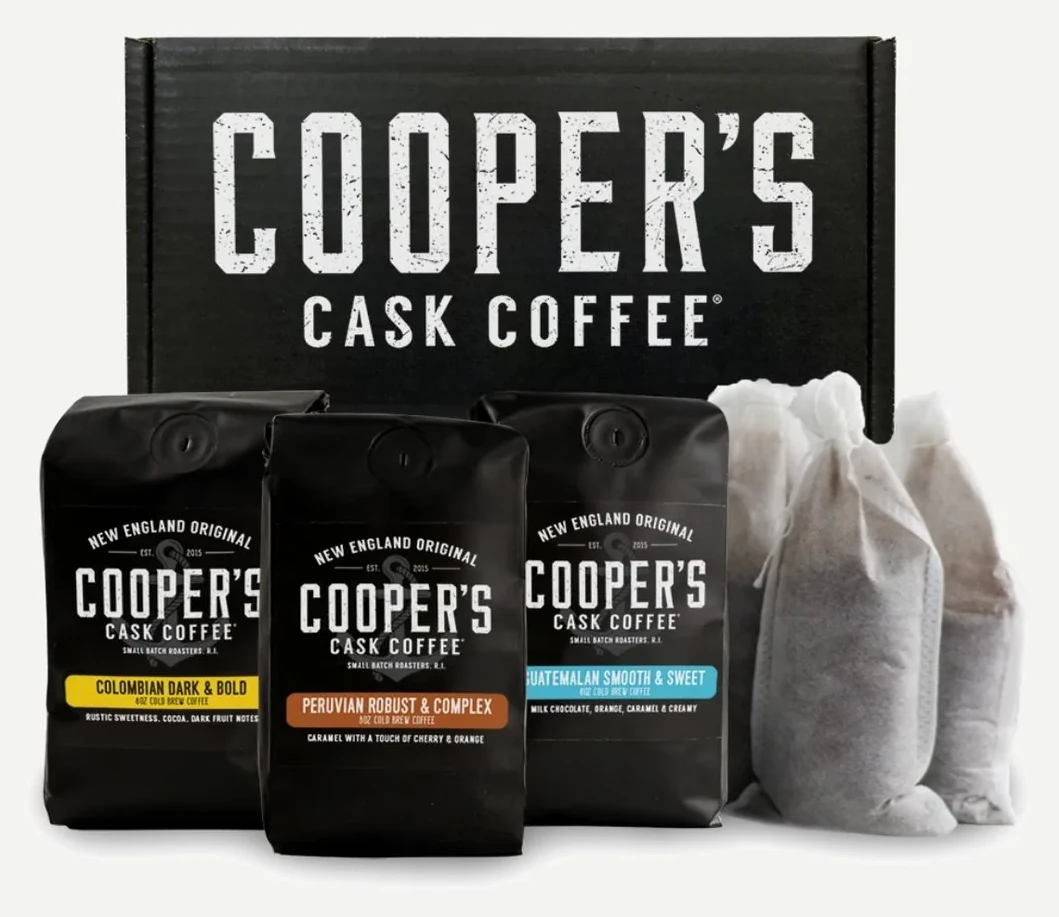
What is Cooper's Cask Peruvian Cold Brew?
The Cooper's Cask Peruvian Cold Brew is a medium roast, single origin Peruvian coffee roasted and sold year round by Cooper's Cask Coffee Company.
Cooper's Cask positions this as a dedicated cold brew coffee, ground or whole bean, available in three bag sizes. The 1 lb bag starts at $18.95, the 2 lb at $37.95 and the 5 lb at $79.95. A subscription option is available for repeat buyers.
This is a single product rather than a range, built around one origin and one roast level. It is not a decaf and is not flavoured. Grind options cover cold brew, espresso, filter, French press and whole bean, so it is versatile despite its cold brew branding.
Cooper's Cask Peruvian Cold Brew Taste: What It Actually Tastes Like
The Peruvian cold brew is a medium roast with caramel, cherry and citrus as its published flavour profile, described by the roaster on its own listing.
Cooper's Cask describes the cup as smooth caramel with cherry and citrus. These are the roaster's own words for its own coffee, and there is no third-party cupping score behind them. For cold brew specifically, a medium roast tends to produce a rounded, approachable cup with less bitterness than a dark roast.
The caramel and cherry notes point toward sweetness in the cold extraction, while the citrus element suggests some brightness survives the long steep. Whether those notes land depends heavily on grind size, ratio and steep time, none of which Cooper's Cask specifies on the listing.
- Caramel is the lead note, signalling a sweet, low-bitterness cold brew that suits drinkers who prefer milk or drink it straight.
- Cherry adds a mild fruit character consistent with Peruvian high-altitude growing regions, though this is the roaster's own claim.
- Citrus suggests some acidity survives cold extraction, which can cut through sweetness and keep the cup from tasting flat.
- Medium roast is the published level, meaning the bean's origin character is preserved more than a dark roast would allow.
How fresh is it when it arrives?
Buyers receive no roast date information with this coffee, making it impossible to verify how recently the beans were roasted before shipping.
Cooper's Cask offers a subscription, which means repeat orders can be set to arrive at a regular interval. That structure gives buyers some indirect control over freshness by letting them pace deliveries to match consumption rather than stockpiling.
Three bag sizes let buyers choose a volume that matches how quickly they brew. The 5 lb bag suits households running large cold brew batches regularly, while the 1 lb bag reduces the risk of coffee sitting open for weeks. Cold brew's long steep time is more forgiving of slight staleness than espresso, but fresher beans still produce a cleaner cup.
- Cooper's Cask prints no roast date, so buyers cannot judge freshness at the point of ordering or on arrival.
- A subscription option lets buyers set a regular delivery cadence, which partially compensates for the absence of roast dating.
- Three bag sizes from 454 g to 2.27 kg let buyers match order volume to consumption speed, reducing the chance of beans going stale in storage.
- Cold brew extraction is more forgiving of older beans than espresso, but buying the smallest available size is the safer option for buyers without a clear throughput.
Where the coffee comes from
This coffee comes from Peru and is sold as a single origin, meaning all the beans in the bag share the same country of origin.
Peru is a recognised specialty coffee origin, with growing regions in the northern highlands producing beans associated with mild acidity and sweetness. Traceability here reaches the country level, which is a baseline for single origin claims and more informative than a blend label.
Cooper's Cask does not name a farm or cooperative on its listing. Buyers who want sub-country traceability, such as region, altitude or producer name, will not find it here. The sourcing score reflects that the country is named and the single origin claim is clear, but the chain stops there.
- Single origin status is confirmed: every bean in the bag comes from Peru, not a multi-country blend.
- Peru is a credible specialty origin with a track record in cold brew and filter roasts, lending weight to the caramel and cherry notes.
- Traceability extends to the country level, which is a meaningful commitment beyond a generic blend but short of full farm transparency.
- No organic or fair trade certification is listed for this coffee, unlike Cooper's Cask's Ethiopia Decaf, which carries an organic certification.
Cooper's Cask Peruvian Cold Brew vs Cooper's Cask Ethiopia Decaf
The Peruvian cold brew and the Ethiopia Decaf share a roaster and a price point, but serve different drinkers with different priorities.
Both coffees are medium roast single origins at the same price per kilo on the 5 lb size, and neither prints a roast date. The clearest practical difference is that the Ethiopia Decaf is Swiss Water processed and certified organic, while the Peruvian is caffeinated with no certification listed.
On flavour, the Ethiopia Decaf publishes chocolate orange, sweet lemon and black tea notes, where the Peruvian runs caramel, cherry and citrus. The Decaf also comes in a 340 g starter size, while the Peruvian's smallest bag is 454 g. Buyers choosing on taste alone are picking between fruity-sweet and chocolatey-citrus profiles.
- Peruvian cold brew wins for caffeinated drinkers: the Ethiopia Decaf is the only option if caffeine is a concern.
- Ethiopia Decaf wins on certification: it carries an organic label and uses Swiss Water decaffeination, which matters to some buyers.
- The Peruvian wins on smallest available bag size for first-time buyers wanting lower commitment before a larger order.
- Ethiopia Decaf wins for buyers wanting a 340 g entry bag, the smallest size either roaster offers across the two.
Cooper's Cask Peruvian Cold Brew price per kilo: how it compares
At $41.78 per kilo on the 1 lb bag, the price drops meaningfully to $35.25 per kilo once a buyer moves to the 5 lb size.
The per-kilo gap between the 1 lb and 5 lb sizes is about $6.50, which is a real saving for a household that brews cold brew consistently. At 15 g a cup, the 5 lb bag works out to roughly $0.53 per cup, and the 1 lb bag to $0.63 per cup. For a specialty single origin, that is competitive.
With few direct rivals yet benchmarked on this site at per-kilo level, a definitive competitive verdict is premature. What the pricing structure does reward clearly is volume commitment. Buyers who go through cold brew quickly enough to justify the 5 lb bag get the best value this roaster offers, and the subscription option makes that easier to manage.
Who should buy it (and who should not)
This coffee suits regular cold brew drinkers who want a named single origin and are comfortable buying without a roast date.
The medium roast and published caramel, cherry and citrus notes make this a good fit for drinkers who want a sweet, approachable cold brew without going dark roast. The range of grind options means it also works for filter and French press, so it is not locked to one brew method.
Buyers who track roast dates, want farm-level sourcing detail, or need an organic certification will find this listing thin on those fronts. The Ethiopia Decaf from the same roaster covers the organic and decaf needs, so the Peruvian is the right pick only if caffeine and a Peruvian profile are both wanted.
Buy it if
- You brew cold brew regularly and want a single origin cup at a manageable per-kilo cost.
- You prefer caramel and cherry sweetness over chocolate or earthier profiles in your cold brew.
- You are willing to buy in a larger bag size to get the best per-kilo price from this roaster.
Skip it if
- You want a roast date on the bag so you can judge freshness before you brew.
- Farm-level sourcing transparency or an organic certification matters to your buying decision.
- You need a decaf option, as this coffee is caffeinated with no decaf version available.
Frequently Asked Questions
Is the Cooper's Cask Peruvian Cold Brew good for hot coffee too?
Yes. Despite the cold brew name, it is sold with grind options for espresso, filter and French press as well as cold brew. The medium roast and caramel, cherry and citrus profile translate to a balanced hot cup, so buyers are not locked to cold extraction. It works across most common brew methods.
Cooper's Cask Peruvian Cold Brew vs Cooper's Cask Ethiopia Decaf: which should I buy?
Buy the Peruvian if you want a caffeinated cup with a sweet, fruit-forward profile and do not need an organic certification. Buy the Ethiopia Decaf if you want to cut caffeine, want Swiss Water processing, or prefer a chocolate orange and black tea profile. Both sit at the same price per kilo on the 5 lb size.
What grind size works best for cold brew with this coffee?
A coarse grind is the standard starting point for cold brew, as it slows extraction during the long steep and reduces bitterness. Cooper's Cask offers a dedicated cold brew grind option at checkout, which is the most straightforward choice for buyers who do not have a grinder. If you grind at home, aim for a texture similar to coarse sea salt.
How much does the 5 lb bag cost per cup?
The 5 lb bag is priced at $79.95, which works out to $35.25 per kilo. At a standard dose of 15 g per cup, that is roughly $0.53 per cup. That figure assumes 15 g per serving; heavier doses for cold brew concentrate will reduce the cup count and raise the cost per serving accordingly.
Does Cooper's Cask offer a subscription for this coffee?
Yes, a subscription is available. This is useful for buyers who brew cold brew regularly, since it lets you set a delivery cadence that matches your consumption rate. Given that no roast date is printed on the bag, a regular subscription interval is also the most practical way to keep your stock reasonably fresh.
Is Peruvian coffee good for cold brew?
Peru is a mild, low-acidity origin, which makes it well suited to cold extraction. Cold brew tends to suppress acidity and amplify sweetness, and a Peruvian bean with caramel and fruit notes plays to those tendencies. Medium roast preserves the origin character better than a dark roast would, which is the right call for this brew method.