What is the JURA E4?
A machine that costs $1,399 and will not make you a cappuccino.
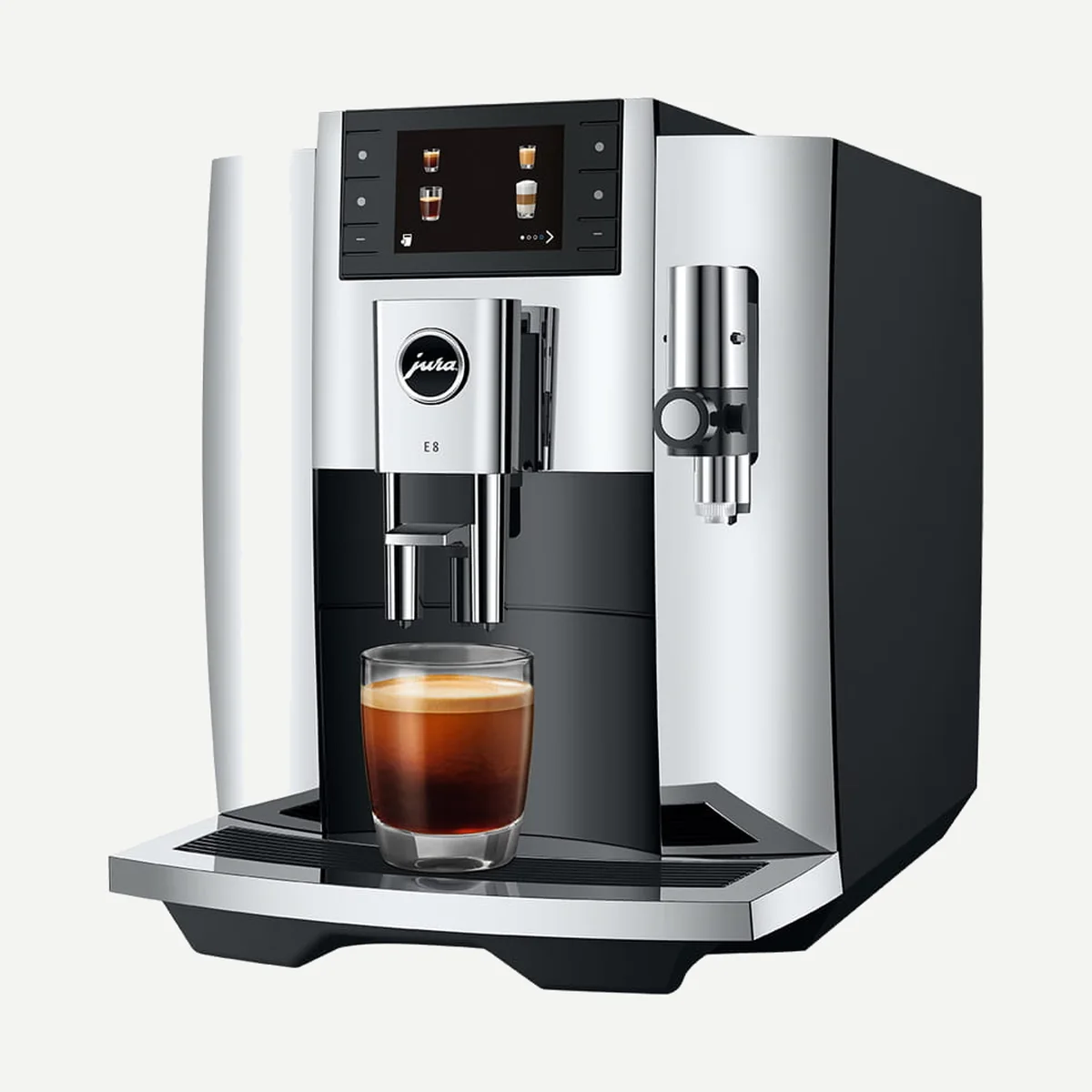
JURA publishes five specialities on the E4 and every one of them is black: espresso, two espressos, coffee, two coffees and hot water. There is no milk system, no carafe, no wand and no frother, and that is not an omission at the bottom of a range. It is what this machine is.
What JURA publishes instead is brewing: a variable brewing unit taking 5 to 16 grams, the Pulse Extraction Process, a 15 bar pump, a thermoblock heater, a Professional Aroma Grinder, a 280 gram bean container and a 1.9 litre tank. It is made in Portugal, weighs 22 lb, draws 1450 watts and has a symbol display, Wi-Fi and three coffee strength levels. As bean-to-cup machines go it is unusually narrow in what it sets out to do.
The missing milk system is the whole product
Most of what goes wrong with a bean-to-cup goes wrong in the milk circuit.
An automatic milk system is tubes, a carafe and a pump moving a perishable liquid through narrow channels several times a day, and it has to be rinsed after every use and stripped down regularly. It is the single most common complaint about bean-to-cup machines, and it is the part that fails.
The E4 does not have one. For a household that drinks black coffee, that is a machine with less to clean, less to break and nothing sitting in the fridge in a plastic jug. For a household that drinks lattes it is the wrong machine at any price, and no accessory changes that, because there is no steam wand to add to.
The honest way to read the price is that you are paying Swiss money for the coffee half of a machine and nothing for the milk half. Whether that is good value depends entirely on what you drink, which is unusual enough to be the first question rather than the last.
Pulse Extraction, and what it is actually for
It is aimed at exactly the drinks this machine makes.
JURA's Pulse Extraction Process pushes water through the coffee in short, measured intervals rather than one continuous flow. JURA's own description is that it forces water through at precisely measured intervals and, as a result, extracts a maximum of aroma, and it says the process is for short drinks like ristretto and espresso. That is the maker's claim and it is quoted as one.
The reasoning behind pulsing is sound and not unique to JURA: a short drink gives the water very little contact time, and interrupting the flow lets it soak rather than race through. Whether it delivers what JURA says of it is not something this site has tested, and nobody here has drunk from this machine.
Five to sixteen grams, which is the number to notice
Dose is the specification most bean-to-cup makers never print.
Most bean-to-cups keep their dose quiet, and the reason is usually that it is small. JURA publishes a range of 5 to 16 grams and says the E4 makes double drinks in two cycles so that both cups get the full range rather than splitting one small puck between them.
Sixteen grams is close to the 18g a commercial basket uses, which puts this in a different class from a machine pressing seven grams into a fixed chamber. It also means the strength settings do something physical rather than just running more water.
The filter, the descaling and the app
Upkeep is most of what owning one of these is actually like.
JURA publishes a CLEARYL Smart+ filter cartridge with automatic filter detection, so the machine knows when a cartridge has been fitted rather than waiting to be told. There is an integrated rinsing, cleaning and descaling programme, a monitored drip tray and a TUV certification for the hygiene system. What JURA does not state anywhere on this machine's page is whether using the filter reduces or removes the need to descale, which is the question every buyer of a filtered machine actually asks. Why that matters at all comes down to your water, which is covered in water and temperature.
The machine also connects to a home network over Wi-Fi and takes instructions from JURA's J.O.E. app, and it has three coffee strength levels and a programmable switch-off. Standby draws zero watts, which is a rarer claim than it sounds on a machine that holds itself ready.
JURA E4 vs the Gaggia Anima
Twice the money, half the drinks, and the argument is still not silly.
The Gaggia Anima is $699.00 and has a Pannarello wand, so it makes cappuccino. The E4 is around $1,399 and does not. On a feature count the Gaggia wins easily, and for most households it is the more sensible purchase.
What the extra money buys is the brewing and the upkeep: a published 5 to 16 gram dose against a hopper figure and nothing about the dose, a filter system with automatic detection, an integrated descaling programme, Wi-Fi, zero watt standby, and a warranty JURA actually prints. It is a machine for somebody who has decided they drink black coffee and wants the best version of that one job.
Is the JURA E4 worth it?
Only if you genuinely do not drink milk drinks, in which case it is the most focused machine here.
Nothing else at this price is this deliberate about doing less. There is no milk circuit to rinse, the filter is detected automatically, standby draws no power and the machine takes instructions from a phone. For a black coffee household that wants to press one button, that is a coherent and rather elegant product.
It is poor value for anyone else, and the warranty deserves reading before buying. Two years or 6,000 brews, whichever comes first, means a house pulling ten drinks a day is out of cover in under two years, and 6,000 is not a large number for a machine bought to be used.
Who should buy it (and who should not)
Buy it if
- You drink espresso and black coffee and nobody in the house wants milk drinks.
- You want the least possible cleaning from a bean-to-cup machine.
- You want a published dose range rather than a hidden one.
Skip it if
- Anyone in the house drinks cappuccino, latte or flat white; there is no wand to add, and the JURA E6 is the one in this range that makes them.
- You brew more than a few drinks a day, because of the 6,000 brew cap on the warranty.
- You want to see a price before you decide, since JURA does not publish one.
Frequently Asked Questions
Does the JURA E4 make cappuccino or latte?
No. JURA lists five specialities and all are black: espresso, two espressos, coffee, two coffees and hot water. There is no milk system and no steam wand.
What is JURA's Pulse Extraction Process?
Water is pushed through the coffee in short measured intervals rather than continuously. JURA says this extracts a maximum of aroma and that it is intended for short drinks like ristretto and espresso.
How much coffee does the E4 use per cup?
JURA publishes a variable brewing unit taking 5 to 16 grams, and says double drinks are made in two cycles so each cup gets the full range.
What warranty does the JURA E4 have?
Two years or up to 6,000 coffee brewings, whichever comes first, as published by JURA's own shop. The machine's own product page gives no term.
Where is the JURA E4 made?
Portugal, which JURA prints in the specifications on the product page.