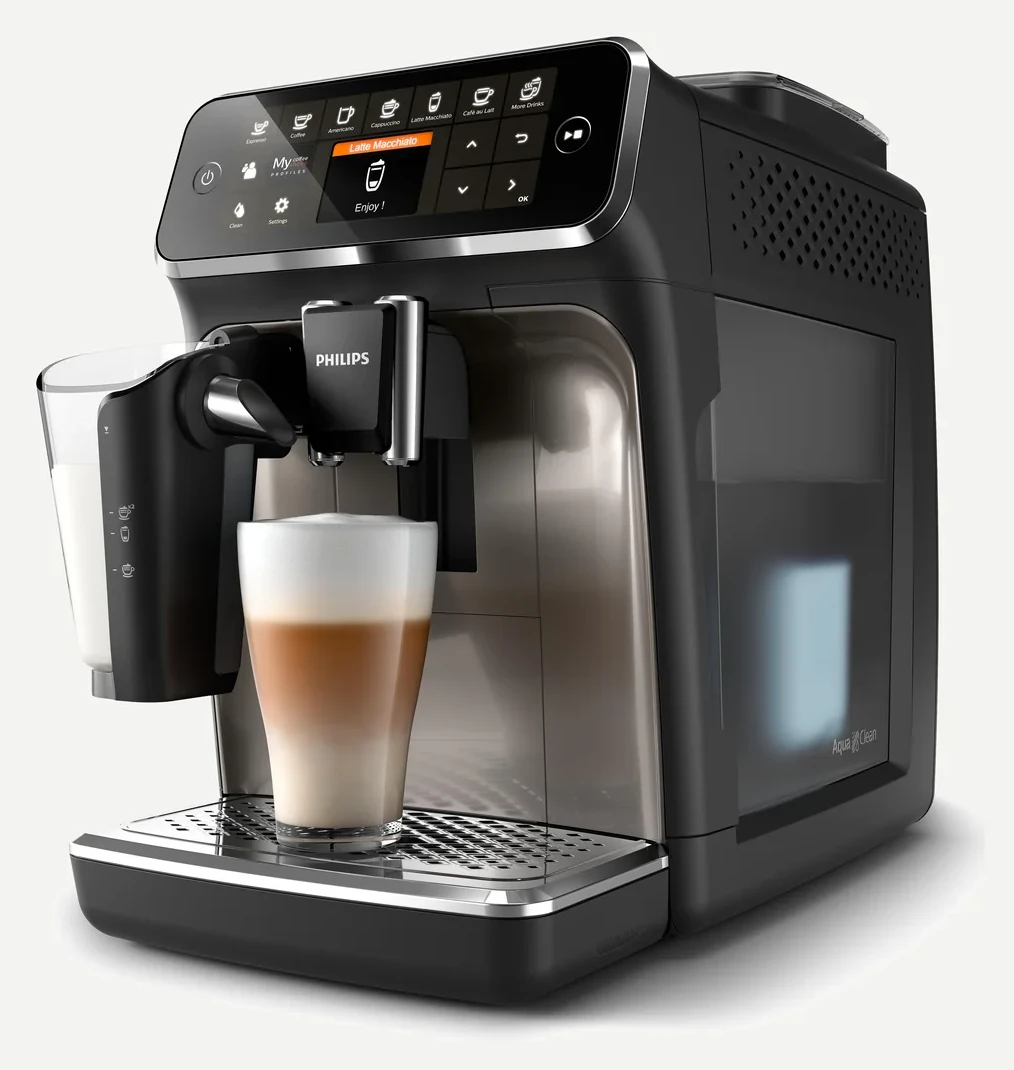
What is the Philips Series 5500 LatteGo?
The bean-to-cup that names all twenty of its drinks, and the one whose price nobody will state.
Philips publishes a 15 bar pump, a ceramic burr grinder with 12 settings, a 275 gram bean hopper, a 1.8 litre tank, four user profiles plus a guest, a removable brew group, a TFT display and twenty pre-programmed drinks. The machine is 246 by 371 by 433 mm, weighs 17.64 lbs, draws 1500 watts and carries a two year warranty.
A note on which machine this is. Most shops sell the 5500 as the EP5544/94, and Philips has no page for that number: its own site documents the EP5544/90 in Grey Chromed and the EP5547/90 in Black Chrome. Everything here is the EP5544/90, because a specification has to come from the machine it describes.
Twenty drinks, and Philips names every one
A drink count is only worth anything when the maker says what the drinks are.
Philips lists them: espresso, coffee, cappuccino, latte macchiato, iced coffee, hot water, americano, caffe crema, caffe latte, travel mug, espresso lungo, ristretto, flat white, cafe au lait, iced latte, iced cappuccino, iced americano, iced caffe crema, iced cafe au lait and iced caffe latte.
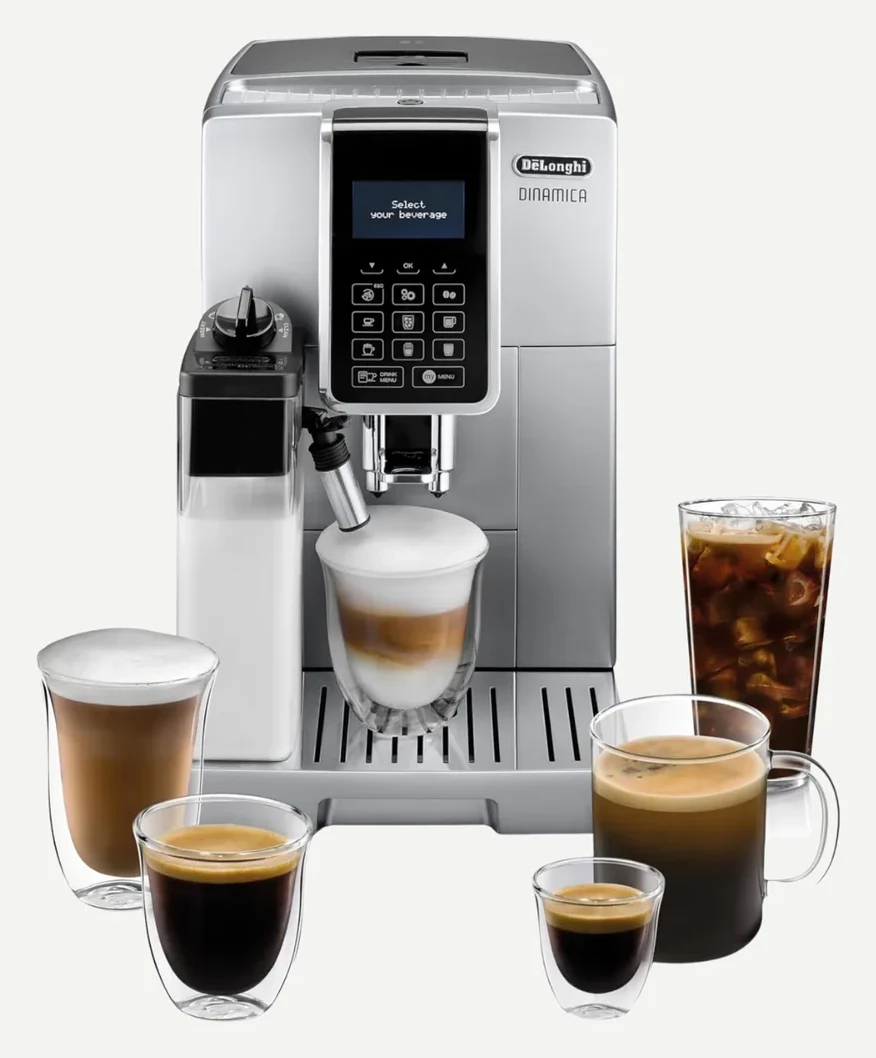
That is worth comparing with the Dinamica LatteCrema, which advertises eighteen recipes and names seven of them. Eighteen unnamed drinks and twenty named ones are not the same claim, and the second is the one you can check before buying. Six of the Philips list are iced, which is a real category rather than a garnish, and there is a travel mug setting that brews to a tall vessel rather than overflowing a cup.
Two parts, no tubes, and why that is the whole machine
The milk circuit is what breaks on these, and Philips removed it.
An automatic milk system is normally a carafe, a pump and a set of narrow tubes moving a perishable liquid several times a day. It has to be rinsed after every use and stripped periodically, and it is the single most common complaint about bean-to-cup machines of any brand.
Philips calls LatteGo a two part system with no tubes, and states that both parts are dishwasher safe. The carafe holds 8.79 oz. Philips also claims the parts can be rinsed under a tap in about fifteen seconds, which is its own figure and is quoted as that. Whether it is fifteen seconds or thirty, the argument holds: fewer components carrying milk is fewer components growing something.
The frothing itself Philips describes as cyclonic, releasing microbubbles at 394 metres per second. That is Philips' number, it is faster than the speed of sound, and this site is not going to repeat it as a measurement. What can be said is that the system froths plant milks as well as dairy, which Philips states, and that milk alternatives behave differently in any frother.
The descaling claim, and the arithmetic under it
No descaling up to 5000 cups is a strong claim with a footnote worth reading.
Philips prints it plainly on the product page, and the footnote says it assumes eight filter replacements as indicated by the machine, with actual cups depending on coffee choice, rinsing and cleaning. Philips' filter page gives the other half: about 625 cups per cartridge.
So the promise is real and it is a subscription. Eight AquaClean cartridges get you to 5000 cups without descaling, and a household drinking four cups a day reaches 5000 in about three and a half years. Descaling is the chore that eventually kills these machines, so paying for cartridges to avoid it is a reasonable trade, but it belongs in the running cost rather than in the purchase price.
The price Philips will not print
One machine, four retailers, and nearly double between the cheapest and the dearest.
Philips does not publish a price for this machine. Its own Where to Buy widget returns no Philips figure at all, and the four retailers it lists carry it at $699.00, $850.47, $929.00 and $1,299.95.
That spread is not a sale against a list price, it is the same machine at nearly twice the money depending on where you look, and it makes this the one product on this site where the advice is about shopping rather than specification. Check three sellers before buying, and treat any single number, including the one on this page, as a snapshot.
Philips 5500 vs the Philips 4300
The cheaper Philips is one of the best-scoring machines here, which makes this a fair fight.
The Philips 4300 LatteGo is $999.00 and scores well on this site precisely because Philips publishes so much about it. Both share the LatteGo system, the ceramic burrs and the removable brew group.
What the 5500 adds is the drink list and the profiles: twenty named drinks against the 4300's shorter list, four user profiles, and a TFT display instead of a simpler one. If the household is one or two people drinking two or three familiar drinks, the 4300 does that job and the money is better spent on beans. If there are four of you and half of you drink iced coffee, this is the machine that stops the arguments.
Is the Philips 5500 worth it?
At $699 it is the best value in this category. At $1,299.95 it is not.
That is an unusual verdict to have to write, and it follows from Philips leaving the price blank. On specification this is a strong machine: the widest named drink list here, the milk system with the least to clean, a removable brew group and a credible route to never descaling.
What holds it back from an unqualified recommendation is the paperwork around it. Philips cannot keep its own two pages for this series consistent, printing 120 V and Romania on one and 230 V and China on the other, and the SKU most people will actually be sold is one Philips does not document at all.
Who should buy it (and who should not)
Buy it if
- Several people drink different things, and iced coffee is among them.
- You want the least milk-system cleaning available in a bean-to-cup.
- You are willing to shop around, because the price genuinely moves.
Skip it if
- You drink two familiar drinks; the 4300 does that for less.
- You want the maker to stand behind one price and one spec sheet.
- You would rather not buy filter cartridges to avoid descaling.
Frequently Asked Questions
How many drinks does the Philips 5500 make?
Twenty, and Philips names all of them. Six are iced, and one is a travel mug setting.
Is LatteGo dishwasher safe?
Yes. Philips states both parts of LatteGo go in the dishwasher, and that the system has no tubes.
Does the Philips 5500 need descaling?
Philips claims no descaling for up to 5000 cups when using AquaClean filters, footnoting that this assumes eight filter replacements. Each cartridge covers about 625 cups.
What does the Philips 5500 cost?
Philips publishes no price. The four retailers on its own Where to Buy list carry it between $699.00 and $1,299.95, so it is worth checking several.
What is the difference between EP5544/90 and EP5544/94?
The /90 is the SKU Philips documents on its own site. The /94 is what most shops sell, and Philips has no page for it.