What is the Matiks Stainless Induction Cezve?
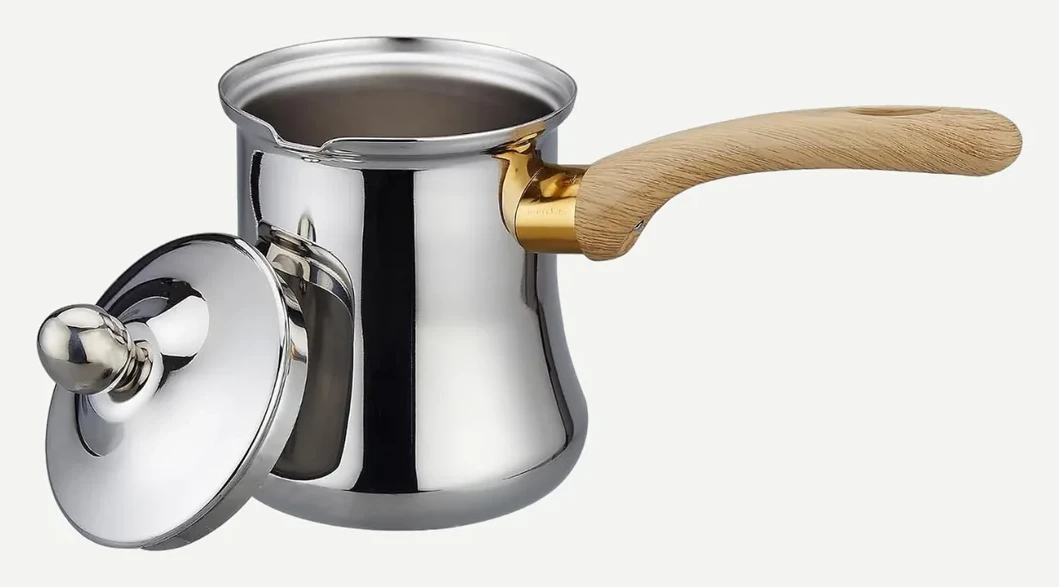
A 1mm stainless steel cezve, 15 fluid ounces, that runs on induction. That last part is the entire reason it is interesting.
Nearly every cezve is copper, and copper does not work on induction. Most stainless ones do not either, because a cezve's base is small and an induction hob has to detect it. Matiks build a double-layer base specifically to be found by the coil, and they are direct about the limit: at 3.3 inches the base is compact, so their own tip is to use a smaller induction zone.
The pot measures 2.75 inches at the mouth and 4 inches tall, with a 5.2 inch handle. It comes with a measuring scoop in a gift box.
Brew quality and what it is made of
Stainless is not the traditional material and the trade is honest: it conducts more slowly than copper and keeps climbing for a moment after it leaves the heat. On a method where the decisive moment is the second or two when the foam rises, that costs you some margin.
What it buys is a pot that cannot corrode, needs no lining, and does not care what you do to it. Matiks specify 1mm food-grade stainless and a double-layer base, and the base is the part doing real work: a single thin layer over an induction coil is how you get a scorched ring and a bitter cup.
Use a lower setting than you would under copper and take it off earlier than feels right. Both are habits, learned in a few brews.
What you can brew with it
Turkish coffee first, and the Greek, Arabic and Armenian versions of the same method, all of which are described in the method itself. 450ml is enough for three to four of the small servings this is drunk in.
It also does the ordinary small-pot jobs: warming milk, chai, hot chocolate, melting butter, small sauces. Stainless is better suited to that than tin-lined copper, which you would rather not use for melting butter every week.
Living with it, day to day
Two design decisions stand out and both are unusual in this category.
Dual pour spouts. A traditional cezve has one, which means left-handers pour across themselves. Two spouts is a small change that a lot of people will notice every single time.
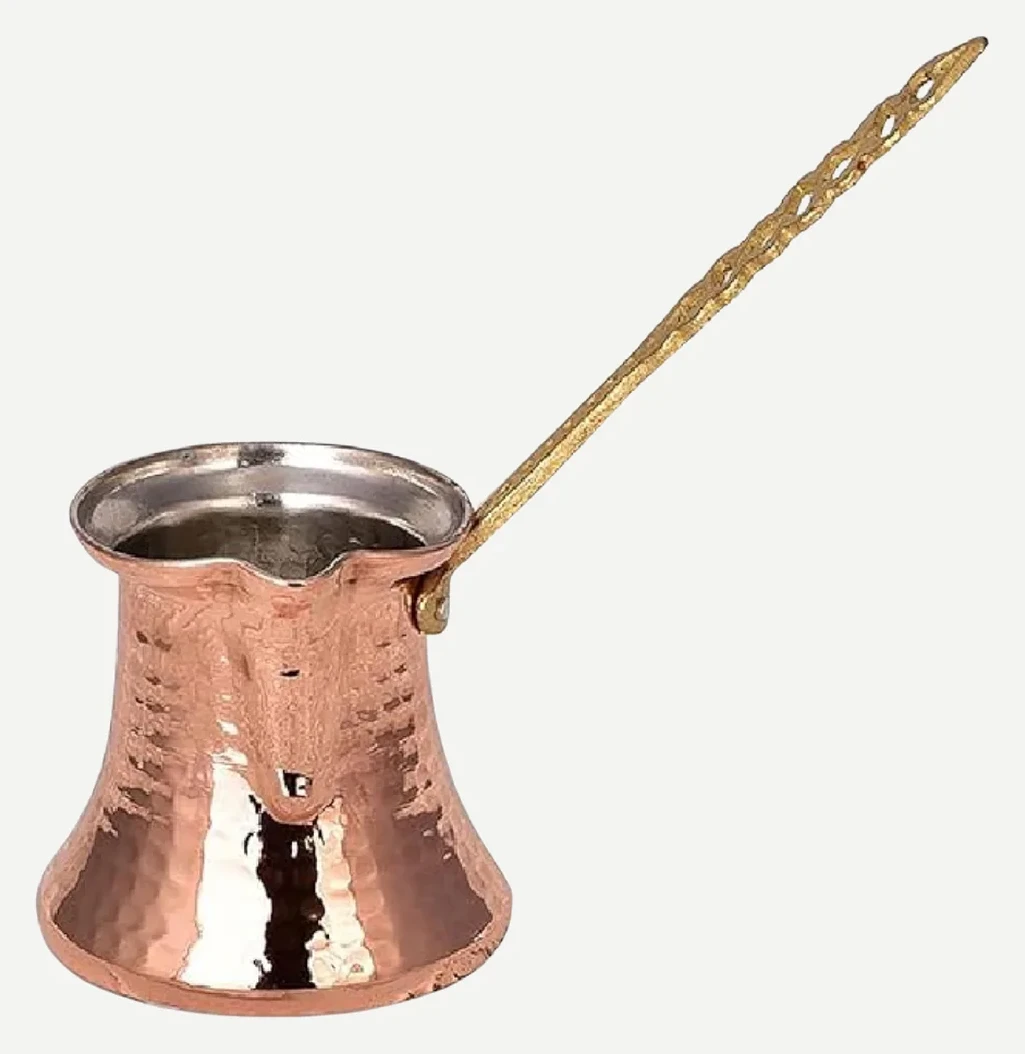
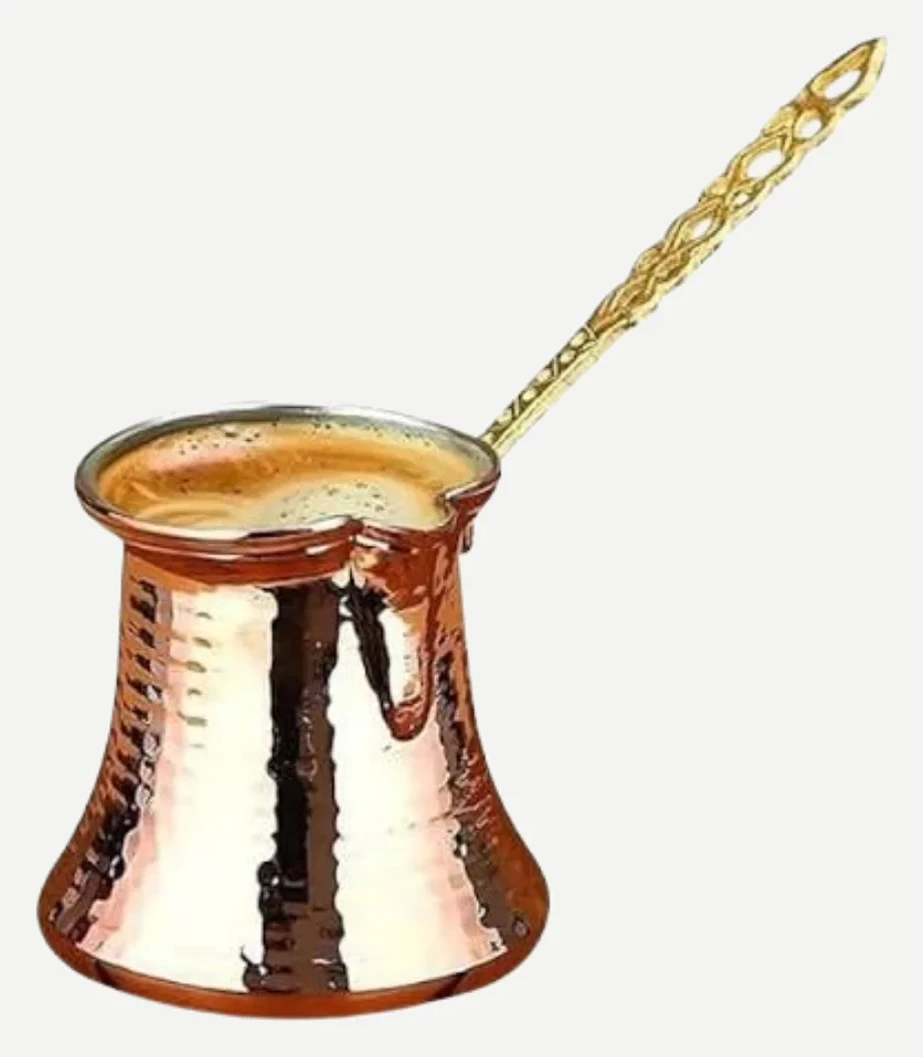
A silicone handle rated to stay cool, and dishwasher safe along with the body. Compare that with the Hakan Hammered Copper Cezve, whose brass handle needs a mitten, or any copper pot, which must be hand washed and dried.
The induction caveat is worth repeating because it is the reason to buy this pot and it has a condition attached: a small base on a large hob zone may heat slowly or not register at all. On a small zone it is fine.
Matiks Stainless Induction Cezve vs the Caizen Stainless Steel Cezve
Two stainless cezves at almost the same capacity, and one of them works on induction.
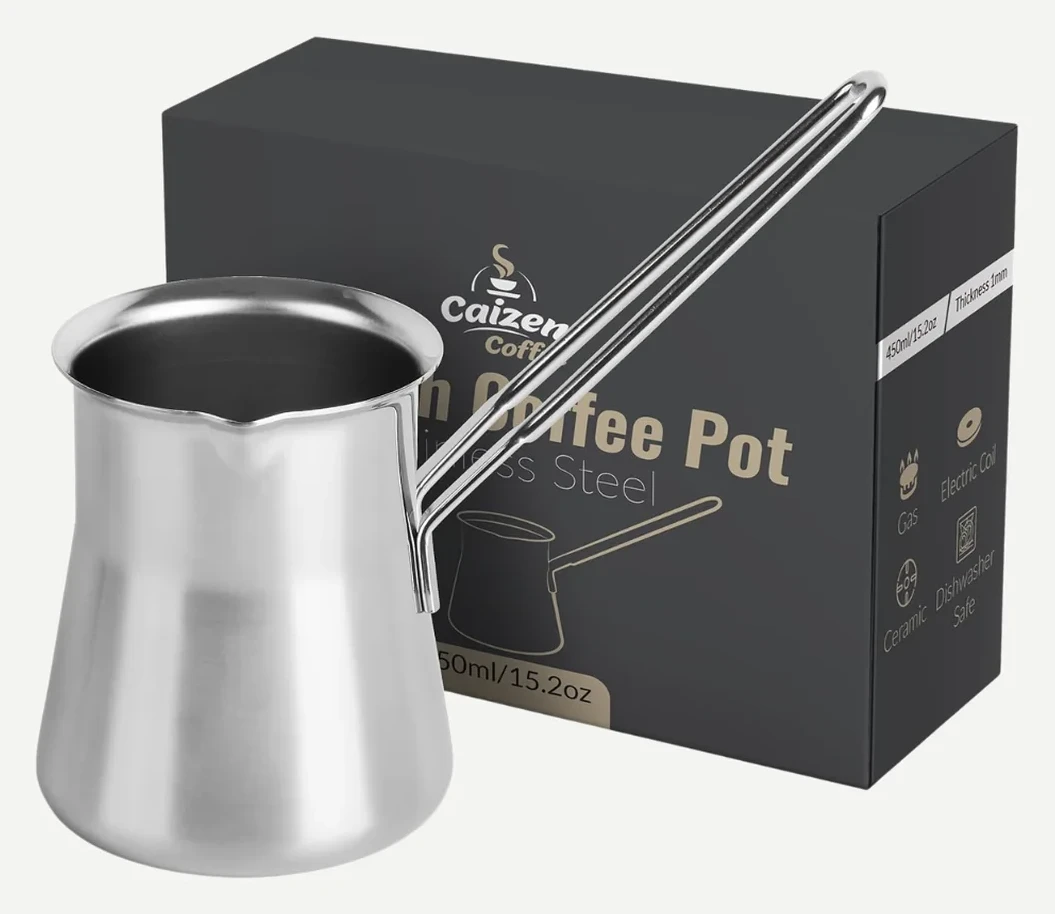
The Caizen stainless cezve is 15 ounces at $24.99 and is explicitly ruled out for induction, almost certainly because its base is too small or thin to be detected. Its handle is stated to stay cool; the listing does not say what it is made of.
The Matiks is 15 ounces, 1mm with a double-layer base, induction-ready, dual spouted, dishwasher safe, with a silicone handle. It is the better-specified pot by a clear margin.
The catch is that no price appears anywhere in what we have, so the comparison stops at the specification. If it is near the Caizen, it is the obvious choice. If it is much above, that is a judgement only a price can settle.
Is the Matiks Stainless Induction Cezve worth it?
For an induction kitchen this is close to the only answer, and that is worth something on its own: the alternative is a hob adapter plate, which works and adds a lump of steel between the flame and the pot.
On a gas hob the calculation changes completely. There, copper is the better material and the Hakan Hammered Copper Cezve starts at $23.90.
We cannot tell you whether the price is right, because it is not in the record. What we can say is that the specification is the strongest of the stainless pots here and that every one of its unusual features solves a real irritation rather than an invented one.
Who should buy it (and who should not)
Buy it if
- You cook on induction and thought Turkish coffee was off the menu, or if you want a cezve you can put in the dishwasher and never think about
- Left-handers should note the second spout
Skip it if
- You have gas, where copper responds better and costs less
- If your induction hob has only large zones, check the smallest one: a 3.3 inch base is at the edge of what many hobs will detect
Frequently Asked Questions
Does a cezve work on an induction hob?
Almost none do. Copper is not magnetic and most stainless cezves have a base too small or too thin for the hob to detect. The Matiks is built with a double-layer base specifically to be found by the coil.
Why does the maker say to use a smaller induction zone?
Because the base is 3.3 inches across. Induction hobs detect a pan by its base, and a small base on a large zone may heat slowly or not register at all. On a small zone it is fine.
Is the Matiks cezve dishwasher safe?
Yes. Both the stainless body and the silicone handle are stated as dishwasher safe, which no copper pot can claim.
What are the dual spouts for?
Pouring cleanly with either hand. A traditional cezve has a single spout, which forces left-handed brewers to pour across themselves.